



Timor-Leste is a new country that was born in the beginning of this century, having gone through a period of colonial rule by Portugal and later, under Indonesian control until its independence in May 2002.
With a population of about 1.3 million people, the country has inhabitants not only in urban areas but also in the rural mountainous regions.
The country's land area is roughly the same size as Tokyo Metropolitan Area (Tokyo, Chiba, Saitama, Kanagawa), and consists mostly of mountainous terrain, surrounded by the sea with a warm climate all year round, making it a naturally rich environment. However, due to its steep terrain and geology that is vulnerable to erosion, the country faces many difficulties such as landslides and other natural disasters.
After 20 years of independence, security has improved, and Timor-Leste is entering a development phase where economic growth and stable livelihoods are being spread among its citizens, moving away from the period of post-conflict recovery and building basic structures of the country. Efforts are being made to diversify domestic industries and create employment opportunities, as well as developing basic social and economic infrastructure in order to break free from dependence on oil and natural gas that are mined from nearby waters. In light of the recent COVID-19 pandemic, it is necessary to address issues such as improving livelihoods and making better use of the country's domestic resources, such as the agriculture, forestry, and fisheries industry. In addition, in April 2021, a major flood occurred due to a cyclone, and with the expected impact of climate change, responding to these issues is also a challenge.
JICA has been providing continuous support to Timor-Leste since just after the 1999 national referendum, which decided for substantial independence. JICA has been involved in activities such as the restoration of infrastructure that had been damaged by the turmoil that preceded independence, developing human resources through sharing of knowledge, and improving the lives and health and hygiene of residents through cooperation with Japanese/local/international NGOs. Socio-economic infrastructure supported by JICA covers a wide range including development of ferry terminals in the capital city of Dili, the construction of roads and bridges, and the construction of the engineering department of the National University of Timor Lorosa'e, the only national university in the country. Our support also extends on capacity development in the field of agriculture, where we focus into increasing production and improving distribution of domestic rice, forestry and natural resource conservation, where we support sustainable lives of residents in mountain areas, and higher education, in which we partner with Japanese universities to provide human resource development in engineering field.
While the world remains uncertain with events such as the COVID-19 pandemic and the situation in Ukraine, Timor-Leste has been holding stable elections in recent years and is moving forward as a democratic nation. As the country looks towards joining ASEAN, JICA will continue to work towards contributing to the development of Timor-Leste through these activities, while also making efforts to be a bridge for exchange between the people of Timor-Leste and Japan.
This website introduces JICA's activities in Timor-Leste, and we hope that it will serve as an opportunity for you to think together about the development of Timor-Leste.
Please also visit our office's Facebook page.
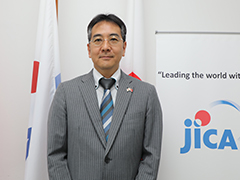
ITO Mimpei
Chief Representative
JICA Timor-Leste office
scroll