

Short-term researchers activitis report(G2:Duckweed Holobiont Collection)
Short-term researcher Activities Repot
Asst. Prof. Dr. Shogo Ito, Kyoto University (Duration: 30 Nov – 3 Dec 2025)
Assoc. Prof. Dr. Tokitaka Oyama, Kyoto University (Duration: 30 Nov – 3 Dec 2025)
Asst. Prof. Dr. Tomokaki Muranaka, Nagoya University (Duration: 1 – 4 December 2025)
1 – 2 December:
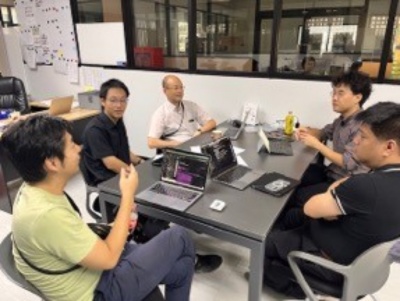
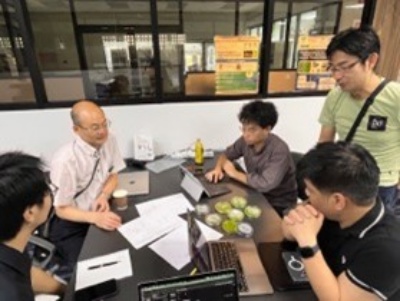
Dr. Oyama, Dr. Ito and Dr. Muranaka held a meeting in Kasetsart University with Dr. Ekpahan and Dr. Yosapol to strategize on the maintenance and optimization of data and biological resources (DNA and duckweed) at the DHbRC (Duckweed Holobiont Resource & Research Center).
We agreed to update the database to include information on DNA samples including previously lost duckweed strains. Additionally, we committed to fostering a more active environment for Thai researchers to utilize plant samples at DHbRC and share their findings through academic publications. To further stimulate duckweed research and development within Thailand, a collaborative project for gene expression analysis of indigenous duckweed species was discussed. The Japanese team reaffirmed its commitment to providing support for the success of this future project.
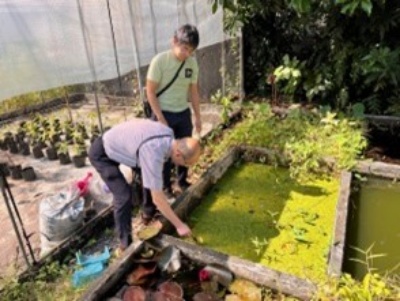
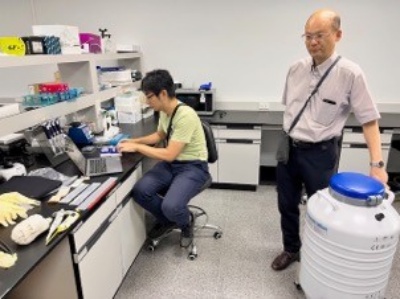
Following a comprehensive analysis of diurnal gene expression patterns in duckweed plants (Lemna aequinoctialis) growing in the botanical garden at Kasetsart University around the summer solstice in June and the autumn equinox, Dr. Ito conducted a similar experiment around the winter solstice. From 12:00 on December 1st to 9:00 on the 2nd, he harvested duckweed samples every three hours and extracted RNA from each time-point sample to analyze gene expression patterns. He plans to carry out similar 24-hour sampling at around the spring equinox.
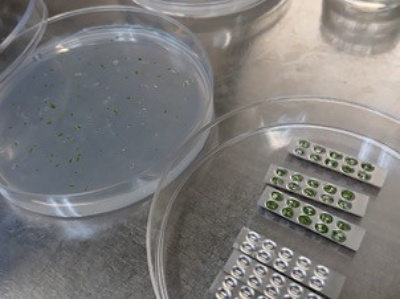
In collaboration with Dr. Peerapat (a member of the G3 team) and his graduate student Ms. Chomphoonut Ruamsin, Dr. Ito carried out vitrification-based cryopreservation of duckweed strains collected in Thailand by the G3 team, using liquid nitrogen. In this experiment, healthy duckweed plants were obtained by thoroughly sterilizing their surfaces and using a sucrose-supplemented medium for the pre-culture. During this short-term visit, in addition to three species of duckweeds (Spirodela polyrhiza, Landoltia punctata, and Lemna aequinoctialis) that had already been successfully cryopreserved in liquid nitrogen, the fourth species, Wolffia globosa, native to Thailand and known as a high-protein superfood for humans, was newly cryopreserved. Some of the preserved samples were rapidly thawed after short-term storage, and their viability is currently being assessed.
A total of 19 clones from 4 duckweed species, including previously preserved samples, are currently cryopreserved in 58 tubes at DHbRC, with some clones stored in multiple tubes.
2 – 3 December:
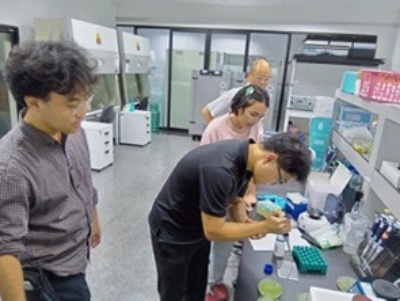
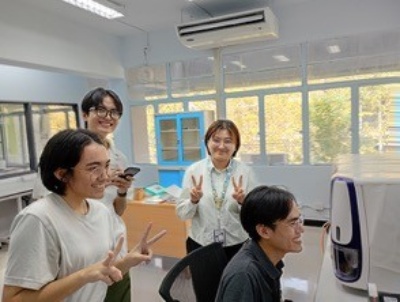
Dr. Muranaka established the method to analyze the ploidy level of duckweeds using a cell sorter (BD FACSMelody) with Dr. Yosapol's lab members and the cell sorter operator. We had attempted this during a previous visit in June 2025, but the cell sorter was not compatible with the DAPI staining reagent we had brought. Therefore, this time we used PI staining reagents. After optimizing the experimental conditions, three peaks were detected at positions consistent with the genome size for Spirodela polyrhiza, Lemna aequinoctialis, and Wolfia globosa. All five strains of Lemna aequinoctialis provided by Dr. Yosapl and Dr. Peerapat were estimated to be diploid. Because the experimental conditions have been established, it will be easier to determine the ploidy of duckweeds in Kasetsart University's collection.
Note:
The project consists of six research groups namely: G1: Duckweed Holobiont Resource & Research Center (DHbRC). G2: Duckweed holobiont collection. G3: Duckweed holobiont analysis and biotechnology. G4: Duckweed biomass utilization. G5: Duckweed wastewater treatment technology. G6: Social implementation activities toward BCG economy.