

Workshop on “Japanese Nursing Excellence: Strategic Pathways for Nursing Education, Advancement, and Administration in Bangladesh”
10th February 2026.
On January 26, 2026, a workshop was held to share Japan’s experience in nursing administration. The purpose of the workshop was not only to learn about the development of Japan’s nursing sector after the Second World War, but also to use that experience as a basis for dialogue, enabling participants to jointly explore approaches to nursing development that are appropriate to the Bangladeshi context.
Participants were mainly individuals who currently lead, or are expected to lead, the nursing sector in Bangladesh. A total of 36 participants attended, representing the administrative, educational, and clinical sectors, including the Directorate General of Nursing and Midwifery (DGNM), the Bangladesh Nursing and Midwifery Council (BNMC), the National Institute of Advanced Nursing Education and Research (NIANER), the Bangladesh Nurses Association (BNA), principals and faculty members of target nursing colleges, Master Trainers (MTs), and nursing superintendents and senior staff nurses from partner hospitals.
The workshop invited Dr. Yayoi Tamura, a Project Assistance Committee member with extensive experience in Japan’s nursing administration who visited Bangladesh in May 2025 as a member of the JICA advisory mission. In her lecture, Dr. Tamura explained the evolution of nursing policies and systems, as well as the positioning of nurses as a professional workforce in Japan. Beyond introducing Japan’s institutional history, she emphasized that “developing policies and systems takes time, and continuity as an organizational commitment is essential.”
Following the lecture, participants were divided into three thematic groups: (1) nursing administration, (2) nursing education, and (3) professional development and career path development. Drawing on Japan’s experience while taking into account the realities and constraints in Bangladesh, each group developed an action plan through discussion.
On February 8, a follow-up session was held to present the action plans and engage in further discussion, with Dr. Tamura joining online. The discussions focused on refining the action plans to enhance their feasibility and practicality. The session concluded with remarks from the Director General of DGNM, who shared messages on the future development of nursing in Bangladesh.
According to the post-workshop survey, participants rated both their level of understanding and overall satisfaction at an average of 4.7 out of 5. The participants commented that “the workshop was very fruitful,” “we realized that change in nursing is in our own hands,” and “this was not merely an exercise, but something that has already moved into practice.”
In addition, Dr. Tamura’s closing message, “The future of nursing in Bangladesh rests on your shoulders,” left a strong impression on participants and encouraged them. Following the workshop, participants have already begun considering and preparing for the implementation of their action plans. Throughout the remaining project period, continued efforts will be made to support and encourage these initiatives.
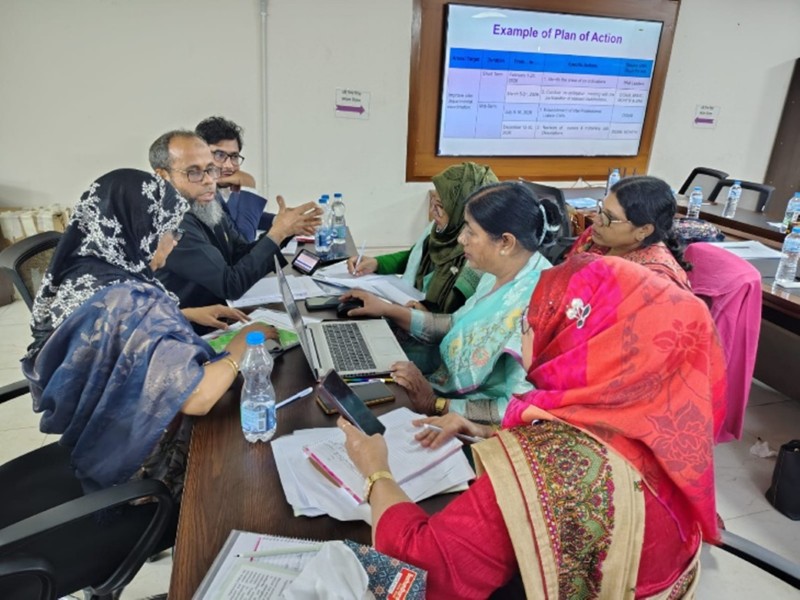
Developing action plans based on Japan’s experience.
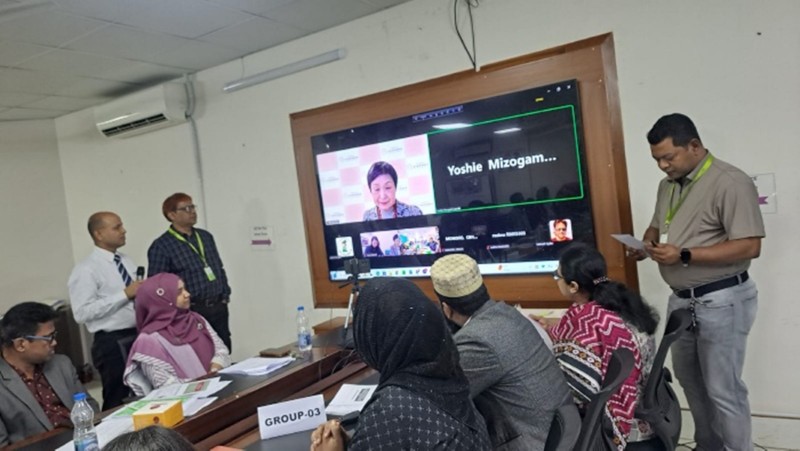
Dr. Tamura joined the discussion session on 8th February.