

Dissemination Seminar Held to Share the CBNS Model and Showcase the Growth of Master Trainers
As the project entered its final stage, a Dissemination Seminar was held on May 14, 2026, at the Bangladesh-China Friendship Conference Center (BCFCC). The seminar was organized as one of the activities under Output 4, “Networking of nursing colleges and related organizations is strengthened.” It aimed to share the experiences and achievements of the Project for Capacity Building of Nursing Services Phase II (CBNS-II), including the “CBNS Model,” with institutions beyond the project sites, thereby promoting wider dissemination of the model and strengthening networks among nursing colleges and related stakeholders.
Participants included representatives from the Directorate General of Nursing and Midwifery (DGNM), the Bangladesh Nursing and Midwifery Council (BNMC), the National Institute of Advanced Nursing Education and Research (NIANER), the Bangladesh Nurses Association, donor partners, target nursing colleges and collaborative hospitals, as well as representatives from public and private nursing colleges and hospitals outside the project sites and members of the media. Although government restrictions on domestic travel required some participants to join remotely, 161 participants attended the seminar in total, including 30 online participants. Representatives from 33 non-target public nursing colleges and institutes were also present.
The true protagonists of the seminar were the Master Trainers (MTs) who had been developed through the project. Throughout CBNS-II, MTs from both target nursing colleges and hospitals had strengthened their knowledge, facilitation skills, and leadership capacities. In particular, many hospital-based MTs had limited opportunities to facilitate discussions and deliver presentations in large forums during the early stages of the MT training, and were sometimes hesitant to take the lead. However, over time, both college-based and hospital-based MTs assumed increasingly important leadership roles within their institutions and accumulated valuable experience through a range of project activities, including facilitating Faculty Development (FD) training and Clinical Nursing Teacher (CNT) training. Through these experiences, they steadily strengthened their communication, facilitation, and leadership skills. At this seminar, they stood before more than 100 participants, delivered well-structured presentations within the allocated time, and responded thoughtfully to questions and panel discussions. Their performance vividly demonstrated the project's vision of nurturing professionals who learn in the workplace, teach in the workplace, and support others in the workplace.
The seminar also introduced the “CBNS Model,” which had been developed through the implementation experiences of both CBNS-I*1 and CBNS-II. The model represents a practical approach to nursing workforce development built upon four interrelated components: capacity development through cascade training and localization; active learning methodologies that enhance participants' engagement and learning outcomes; strengthened collaboration between nursing colleges and hospitals; and standardization and quality improvement through mutual learning among institutions.
Representative MTs from the eight target regions shared practical examples illustrating how the CBNS Model had been translated into action. These included FD training, CNT training, ward-based in-service training, debriefing practices, coordination committees between nursing colleges and hospitals, strengthened clinical practice, mutual learning visits, and accreditation-related initiatives. Through these presentations, MTs themselves became the voices of the project's achievements, sharing their experiences and lessons learned in their own words.
The seminar also revealed that the project's influence had already begun extending beyond the target institutions. Representatives from non-target nursing colleges and institutes remained actively engaged throughout the sessions, including those participating online, and contributed numerous questions and comments during the discussions. Following the seminar, principals from non-target nursing colleges visited the project office to learn more about the activities, while the project team received multiple requests for materials and further information from other institutions. Moreover, at Shaheed Suhrawardy Medical College Hospital (ShSMCH), one of the target hospital, the attentive clinical supervision provided by MTs and CNTs has gained recognition among both public and private nursing institutions in and outside Dhaka, resulting in an increasing number of nursing students seeking clinical placements there.
The Dissemination Seminar served not only as a platform to introduce the CBNS Model, but also as an opportunity for MTs to present their own experiences and achievements with confidence. Their voices generated new interest, inspired further connections, and encouraged the spread of good practices beyond the project's target sites. Although CBNS-II is approaching its completion, the human resources and practical knowledge cultivated through the project are expected to continue contributing to the advancement of nursing education and practice in Bangladesh for years to come.
*1 CBNS-I was conducted from 2016 to 2021 at Dhaka Nursing College and Dhaka medical College Hospital.
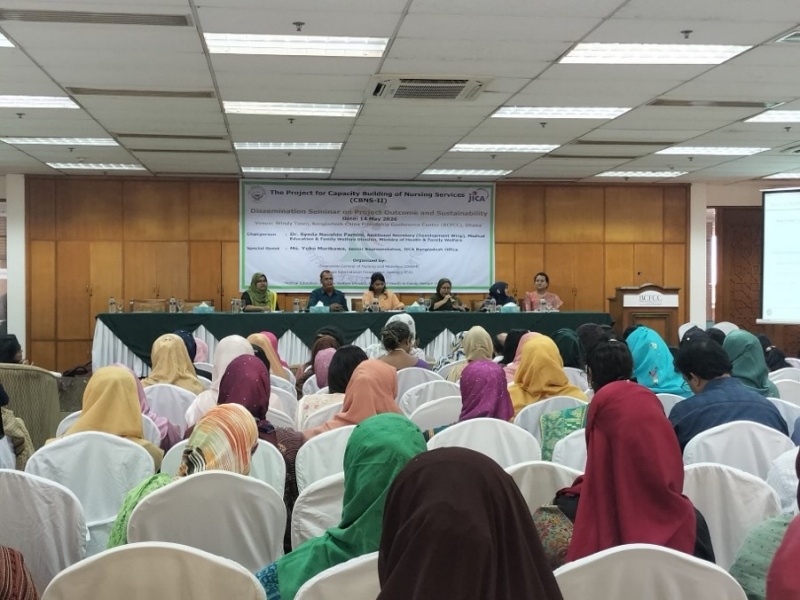
Panel discussion session.
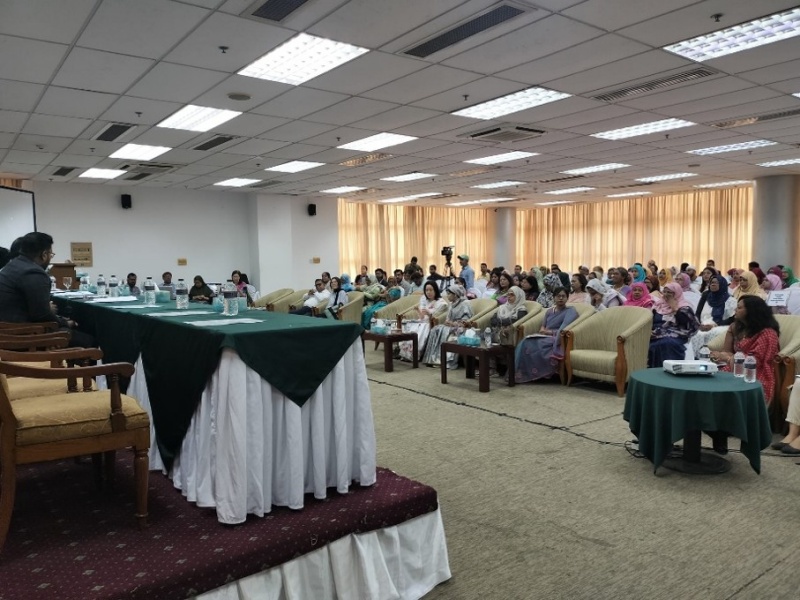
More than 100 participants gathered.
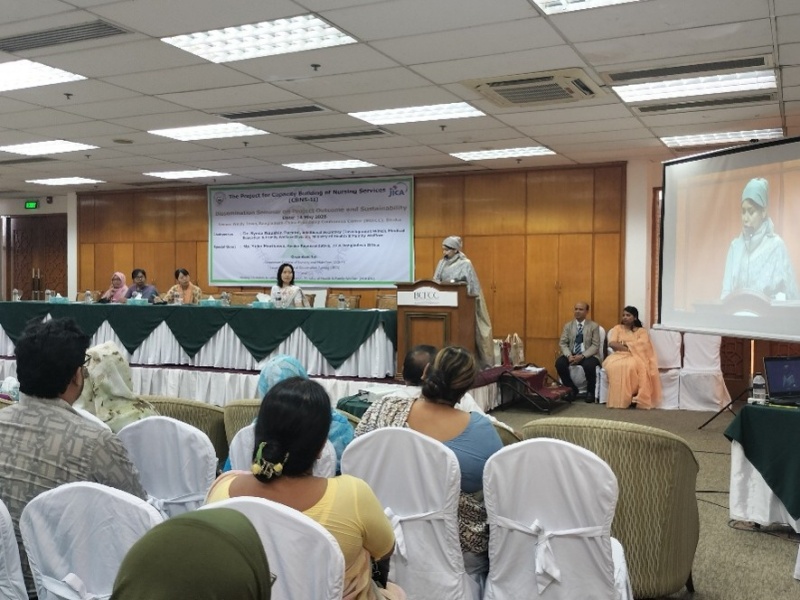
Closing remarks from Additional Secretary of MEFWD.
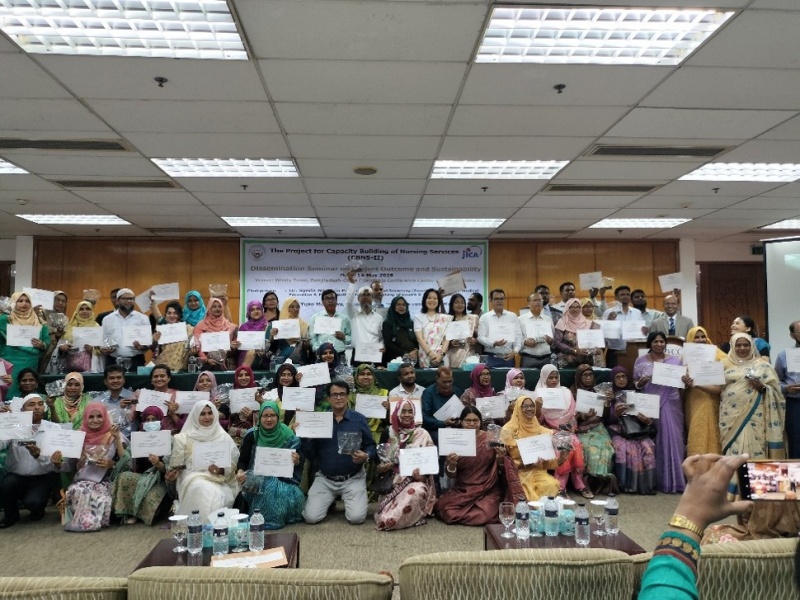
Photo with MTs.