

The Second Joint Coordinating Committee (JCC) meeting for the project for Elimination of Lymphatic Filariasis Phase 2
On 28 August 2025, the Second Joint Coordinating Committee (JCC) meeting was held in Port Moresby in a hybrid format, following the inaugural session in 2024. The meeting provided an opportunity to assess progress achieved over the past year and to confirm program priorities moving forward. Participants included representatives from the Papua New Guinea (PNG) National Department of Health (NDoH), the World Health Organization (WHO), JICA Headquarters (online), the JICA PNG Office, and the Lymphatic Filariasis (LF) Project Team.
The agenda focused on progress made between August 2024 and August 2025. Presenters reported steady advances toward the project’s targets; however, they also underscored the growing strain on the Neglected Tropical Diseases (NTDs) programme resulting from recent reductions in international assistance; most notably the withdrawal of support from the United States Agency for International Development (USAID). This funding had long served as a core resource for recent Mass Drug Administration (MDA) activities in PNG implemented through WHO budget coordination, and its loss is placing increasing pressure on ongoing operations. These cuts have had a direct impact on provincial operations, including the postponement of planned MDA activities. The LF project emphasised the importance of strengthened domestic financing and reaffirmed that visible government commitment is essential for maintaining partner confidence and attracting future investment. Discussions also underscored the continued value of strong collaboration with Provincial Health Authorities (PHAs), whose leadership and local ownership remain central to the successful delivery of field operations.
Looking ahead, stakeholders agreed to further integrate LF activities with broader NTDs and public health initiatives, including routine immunisation, to maximise available resources. The Project also tabled its annual financial report for April 2024 to March 2025.
A summary of key progress and planned activities is provided below:
| Output1 :NDoH's capacity for National LF program implementation is strengthened |
|---|
| ・The National NTD Strategic Plan (NSP), including LF, was formally endorsed in April 2025 and publicly launched in June 2025. ・Coordination is underway toward establishing a Technical Working Group (TWG) for NTDs. |
| Output2 :Operational capacity for Mass Drug Administration (MDA) is developed and strengthened in the target provinces. |
| ・Completed its second MDA in May 2025 (administered pop.: approx. 250,000; coverage: approx. 79%) in West New Britain (WNB). ・MDAs planned for: West Sepik (Round 1_2026, Round 2_2027) and East Sepik (Round 1_2027, Round 2_2028), partly beyond the project period. ・Standardized the full MDA process: micro-planning, procurement/logistics, training for health workers, implementation, and data management and evaluation etc. ・Baseline infection surveys planned for Manus and the Autonomous Region of Bougainville (ARoB) around 2025–2026. |
| Output3: Operational capacity for Transmission Assessment Survey (TAS) is developed and strengthened in the target provinces. |
| ・TAS Round2 in New Ireland province scheduled for November 2025. ・First IDA Impact Survey (IIS) in WNB planned for 2026. ・Standardized TAS processes, mirroring MDA: micro-planning, procurement/logistics, training for health workers, implementation, and data analysis. |
| Output4: Capacity for Morbidity Management and Disability Prevention (MMDP) is enhanced in the target provinces and autonomous region. |
| ・Compiled and shared a list of LF suspicious patient cases during MDA in WNB. ・Supported the rollout of Integrated Skin NTDs Training led by NDoH (WNB in May 2025; West Sepik in July 2025; New Ireland in November 2025 planned), including sharing LF updates and logistical coordination. |
The Project Team will continue to support NDoH to strengthen its planning, budgeting, and coordination capacity, ensuring that PNG Government can sustain LF elimination and related disease control efforts beyond the life of the Project. Continued engagement with donors and implementing partners will remain a priority.
Local media outlets attended the JCC, and interviews with the Project Team and NDoH representatives were featured in the following day’s newspapers. In PNG, ten skin diseases, including LF, leprosy, and scabies, are listed under the National Strategic Plan (NSP) for NTDs. However, a considerable number of skin conditions not classified as NTDs; such as dermatitis and allergic skin disease, continue to present diagnostic challenges at the primary care level. Strengthening public understanding through clear and accurate information delivered via the media remains a critical element in supporting timely health-seeking behaviour.
For more information:
A Big Step Forward: Partners Gather to Eliminate Lymphatic Filariasis in PNG (2025.09.22, JICA PNG Office)
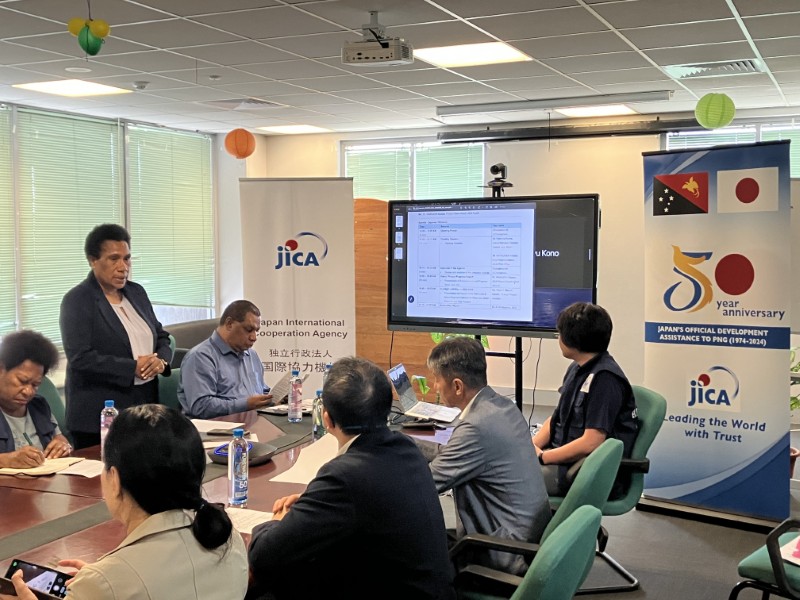
Dr. Petronia Kaima, Acting/Manager of the Disease Control Unit served as the meeting MC and facilitated the discussions.
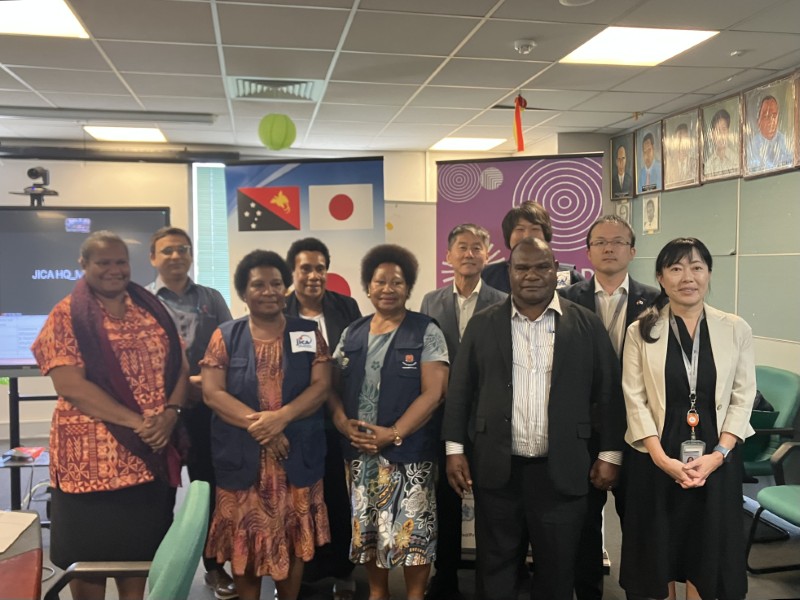
The group photo after the JCC meeting.