

[Update] PNG Publishes Digital Version of National Strategic Plan for NTDs
In April 2026, the National Department of Health (NDoH) of Papua New Guinea (PNG) published the digital version of the National Strategic Plan for Neglected Tropical Diseases (NTDs) 2025–2029 on its website. The strategy was officially launched in June 2025, and its online publication marks an important step towards improving access to policy information and strengthening coordination among stakeholders involved in NTD control. The JICA-supported Lymphatic Filariasis (LF) Elimination Project provided advice on selected sections of the strategy, supported the launch event, and assisted with coordination for the public release of the digital version.
Making the strategy publicly available ensures that government agencies, development partners and implementing organisations can work from a common framework. It also supports greater transparency, improves access to information and contributes to stronger health governance in PNG. Beyond the development of the strategy itself, public access to the document helps promote a shared understanding of priorities and supports greater accountability across the health sector.
In recent years, PNG has made progress in developing national strategies and guidelines across a range of disease control programmes and public health initiatives. However, the development and regular updating of such policy documents can be challenging due to limited institutional and technical capacity. Continued collaboration between NDoH, the World Health Organization (WHO) and other partners has therefore played an important role in advancing strategic planning and strengthening programme management. Support provided through this project has similarly contributed to enhancing NDoH’s planning and implementation capacity for NTD programmes.
NTDs remain a significant public health challenge in PNG, particularly in remote and underserved communities. Diseases such as lymphatic filariasis, yaws, scabies, trachoma and other NTDs continue to affect vulnerable populations across the country. While many NTDs are preventable and treatable, transmission remains common in areas where access to healthcare services, safe water, sanitation and health information is limited.
Recognising the constraints on health resources, the strategy promotes an integrated approach that brings together Mass Drug Administration (MDA), disease surveillance, case management and community engagement across multiple NTDs. By integrating interventions across multiple NTDs, the strategy aims to improve efficiency and maximise the use of limited human and financial resources. Such integrated approaches are also expected to contribute to stronger health systems and more efficient delivery of health services beyond individual disease programmes.
NTD programmes also contribute to broader efforts to achieve Universal Health Coverage (UHC) by extending essential health services to populations that are often the hardest to reach. In this way, NTD interventions support not only disease control but also greater health equity and stronger primary healthcare systems.
Mass Drug Administration (MDA) remains a key public health intervention for reducing transmission and preventing long-term disability associated with NTDs. Continued investment in NTD control is expected to generate benefits beyond health, supporting school attendance, workforce participation, community wellbeing and broader socioeconomic development. Despite their significant health and socioeconomic impacts, NTDs often remain overlooked by both the public and policy-makers. As a result, securing adequate resources and sustaining long-term investment can be challenging. Raising awareness and understanding of NTDs therefore remains an important part of efforts to address these diseases and ensure they receive the attention they require. From this perspective, NTD programmes play an important role not only in improving health outcomes but also in supporting broader social and economic development.
The strategy provides a roadmap for NTD control and elimination efforts in PNG over the coming years. More importantly, it creates a common platform for government agencies, Provincial Health Authorities, development partners and communities to work towards shared public health goals. Moving forward, NDoH, Provincial Health Authorities, WHO and other partners will continue working together to strengthen community health systems and accelerate progress towards the control and elimination of NTDs.
Access the National Strategic Plan
National Department of Health, Papua New Guinea
Publications > Policies & Standards > Neglected Tropical Diseases (NTDs) Program
URL: https://www.health.gov.pg/subindex.php?acts=1
If the document is unavailable through the website, a PDF version can be downloaded separately.
Key Features of the National Strategic Plan (2025–2029)
The National Strategic Plan for Neglected Tropical Diseases (NTDs) 2025–2029 was developed as Papua New Guinea’s national framework for advancing NTD control and elimination efforts. Key features include:
- A comprehensive national strategy covering approximately ten NTDs, including lymphatic filariasis (LF), yaws, soil-transmitted helminthiases (STH), scabies, trachoma, leprosy, Buruli ulcer, dengue and rabies.
- Promotion of integrated, cross-disease approaches that combine Mass Drug Administration (MDA), surveillance, case management and community awareness activities in endemic areas.
- Integrated interventions across 16 endemic provinces to maximise the efficient and sustainable use of limited health resources.
- Four strategic priorities:
1. Strengthening government ownership and multi-sectoral coordination;
2. Enhancing resource mobilisation and financial sustainability;
3. Expanding access to treatment and public health interventions; and
4. Strengthening monitoring, evaluation and operational research.
- Building a sustainable and evidence-based NTD programme through collaboration among the National Department of Health, Provincial Health Authorities, WHO, research institutions, NGOs and the private sector.
- Providing a medium- to long-term framework to guide programme planning, resource mobilisation, monitoring and coordination across stakeholders involved in NTD control.
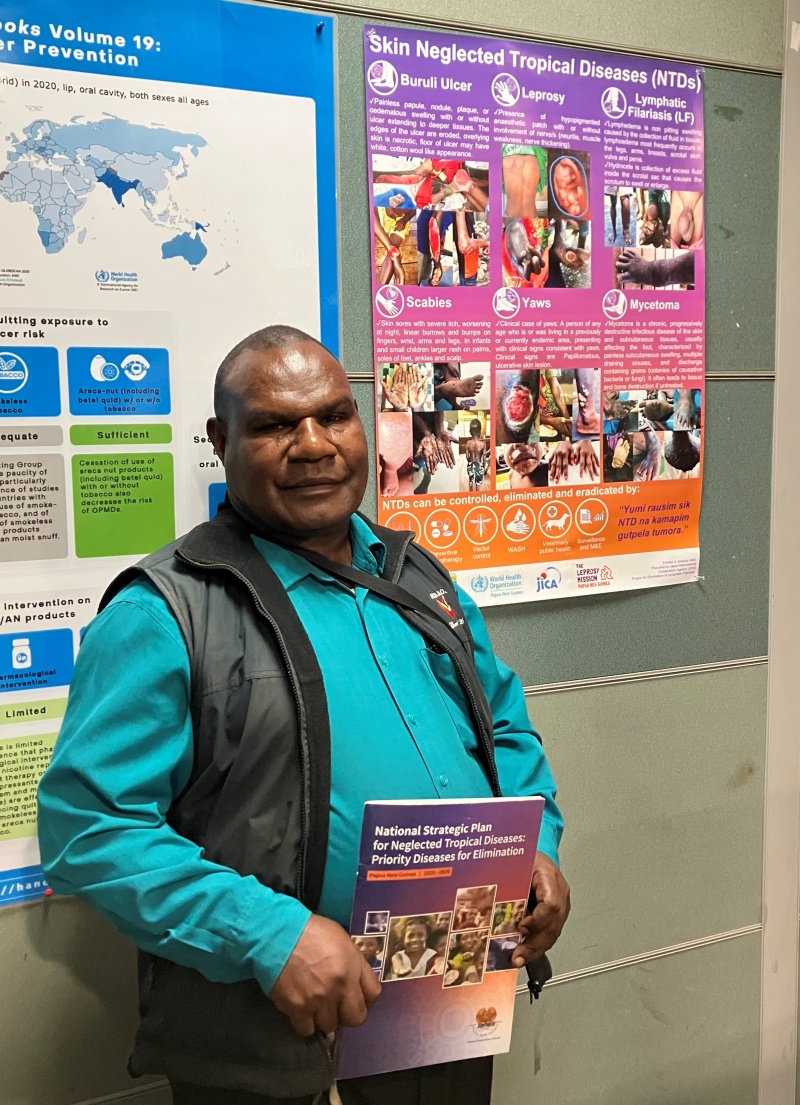
NDoH NTDs Team Lead Officer presenting the National Strategic Plan for NTDs in front of a skin NTD awareness poster.