

Short-term researchers, JST evaluation team and JICA HQ official
15 people visited Thailand for research meetings, 4th JCC meeting(Joint coordinating committee meeting) and research site visit and discussion for JST evaluation.
Around same time, Minister and First secretary of Embassy of Japan made a visit to the project.
Members visited Khon Kaen and Bangkok
Masaaki Morikawa (Chief researcher, Hokkaido Univ.) 2025/09/20 - 26
Yoshitaka Ebie (G6, NIES) 2025/09/21 - 25
Yuka Ogata(G6, NIES) 2025/09/21 – 25
Michihiko Ike (G3, Univ. of Osaka) 2025/09/21 - 25
Hidehiro Ishizawa (G3, Univ. of Hyogo) 2025/09/21 - 25
Tadashi Toyama (G5, Univ. of Yamanashi) 2025/09/21 - 25
Kazuhiro Mori (G5, Univ. of Yamanashi) 2025/09/21 - 24
Naoki Shikazono (JST evaluation mission) 2025/09/21 - 25
Chiyo Yoshikai (JST evaluation mission) 2025/09/21 - 25
Ryo Hashimoto (JICA HQ, Tokyo) 2025/09/21 - 26
Member visited Khon Kaen
Kengo Kubota (G4, Tohoku Univ.) 2025/09/20 - 23
Members visited Bangkok
Kenichiro Matsumoto(G4, Hokkaido Univ.) 2025/09/22 – 25 (click for report
)
Shogo Ito (G2, KyotoUniv.) 2025/09/20 – 25 (click for report
)
Tikitaka Oyama((G2, KyotoUniv.) 2025/09/21 – 25 (click for report
)
Yasuhiro Tanaka (G2, Univ. of Yamanashi) 2025/09/22 – 25 (click for report
)
Note
The project consists of six research groups namely: G1: Duckweed Holobiont Resource & Research Center (DHbRC). G2: Duckweed holobiont collection. G3: Duckweed holobiont analysis and biotechnology. G4: Duckweed biomass utilization. G5: Duckweed wastewater treatment technology. G6: Social implementation activities toward BCG economy.
*JST: Japan Science and Technology Agency *NIES: National Institute of Environmental Studies
Activities report
September 22, 2025
Japanese team visited the Dr. Pairaya’s Laboratory at Khon Kaen University and discussed the results and status of research into anaerobic digestion and methane fermentation using duckweed as a raw material (G4). They discussed approaches to evaluating the decarbonization effects of the developed technology. In addition, had a field survey of the pilot plant at the tapioca starch factory and a briefing on the operation of the wastewater treatment system.
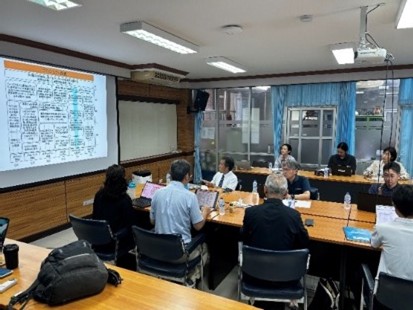
A research meeting in Khon Kaen University.
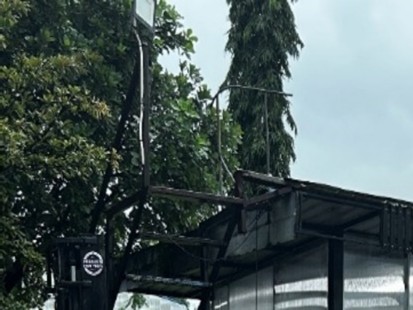
A pilot scale biogas plant.
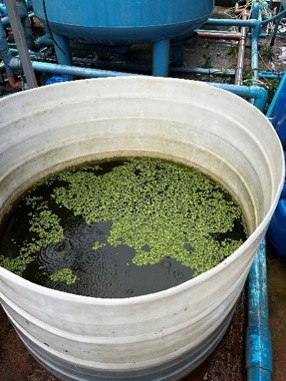
An experiment for duckweed production with tapioca starch wastewater.
September 23, 2025
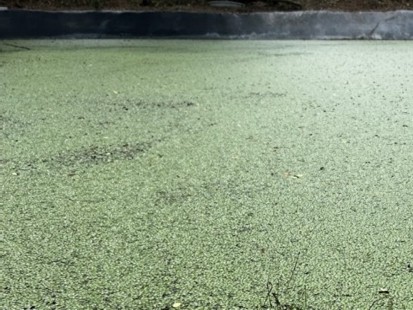
They visited a pilot site of duckweed-based wastewater treatment ponds at a pig farm in Lop Buri province to confirm the status of duckweed growth and reviewed the ongoing greenhouse gas emission measurements. On this occasion, they also had the opportunity to observe power generation using biogas produced from the covered lagoon treatment of piggery wastewater. It was considered that utilizing duckweed biomass produced in the course of wastewater treatment for methane fermentation on-site could further contribute to decarbonization.
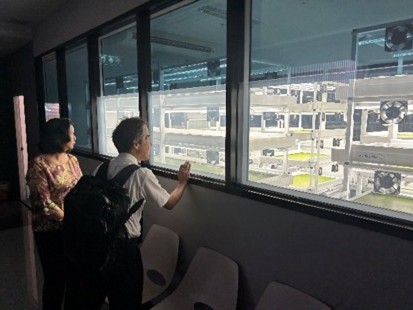
Japanese team then moved to Kasetsart University to observe a bench-scale demonstration test of duckweed wastewater treatment installed and operating on campus, confirming that wastewater treatment and duckweed biomass production were satisfactory. They also visited duckweed plant factory in DHbRC. Besides, received an explanation regarding the development of a database (catalog) of duckweed-associated microbes at Kasetsart University.
Following this, all the members reported on and discussed the research results of G3 (The University of Osaka/ University of Hyogo Group) regarding enhancing holobiont functions. they also participated in the research reports and discussions of G5 (University of Yamanashi Group) and G6 (National Institute for Environmental Studies Group). Finally, they visited a shopping mall Bangkok to observe the sale of Wolffia (edible duckweed).
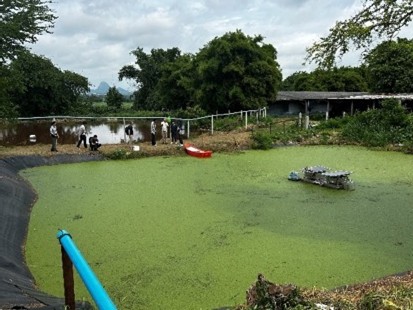
A duckweed-covered wastewater treatment pond.
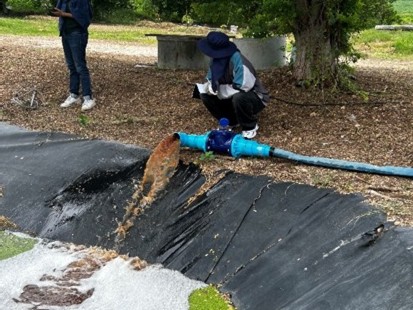
Measuring wastewater flow.
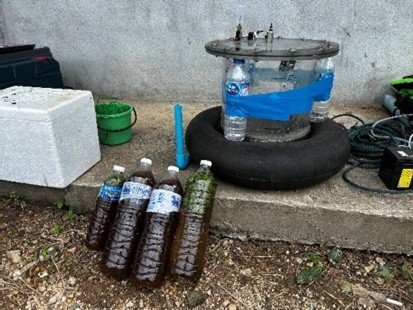
Collected water samples and gas chamber.
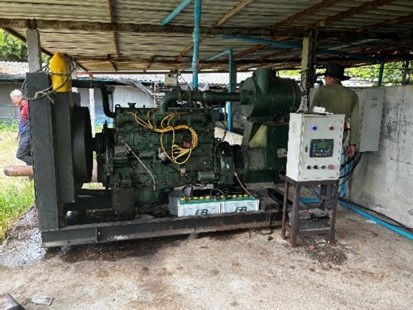
Biogas power generation at a pig farm
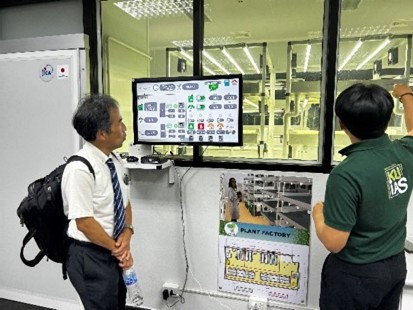
Duckweed plant factory at DHbRC, Kasetsart University
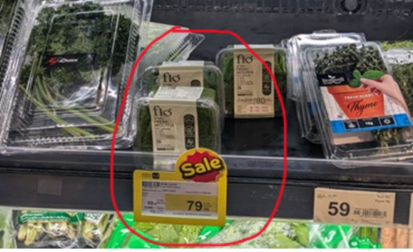
Duckweed Sales at a shopping mall in Bangkok
September 24, 2025
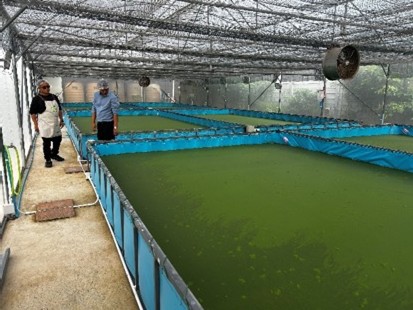
All the members participated in the 4th JCC meeting, where both the Thai and Japanese sides shared the view that the project has been progressing smoothly overall and has already achieved significant outcomes. After an internal meeting on G2 and G4 among the Japanese team, they visited Baan Khai Phum, a company established in June 2004 that engages in the production and sale of duckweed. They were briefed on the company’s history and innovations in production methods. Thai Wolffia operates six ponds of 32 m2 each, and in addition to offering food products such as cookies, pizza, rice seasonings, and ice cream, the company has established beer production and is preparing for commercial sales.
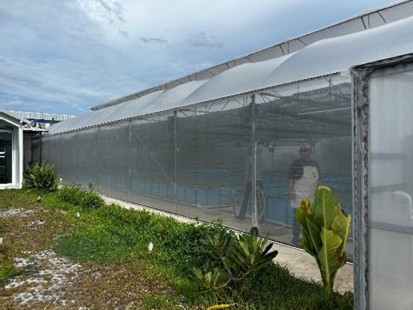
Duckweed production site of Baan Khai Phum
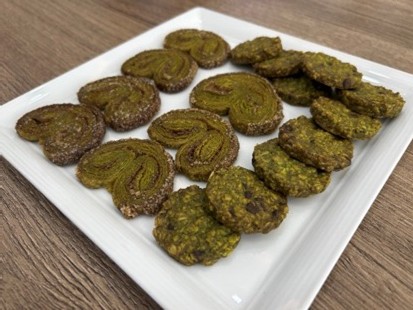
Cookies made with duckweed

Pizza made with duckweed
At Kasetsart University, we carried out maintenance on the bench-scale demonstration test for duckweed wastewater treatment and discussed future tests.
We also received a visit from Mr. T. Kajiwara, Minister and Mr. T. Kanenaga, First secretary, of the Japanese Embassy in Thailand. We explained about DHbRC and duckweed wastewater treatment at the demonstration site. After touring around facilities, we sit together and talked about social implementation activities (G6).
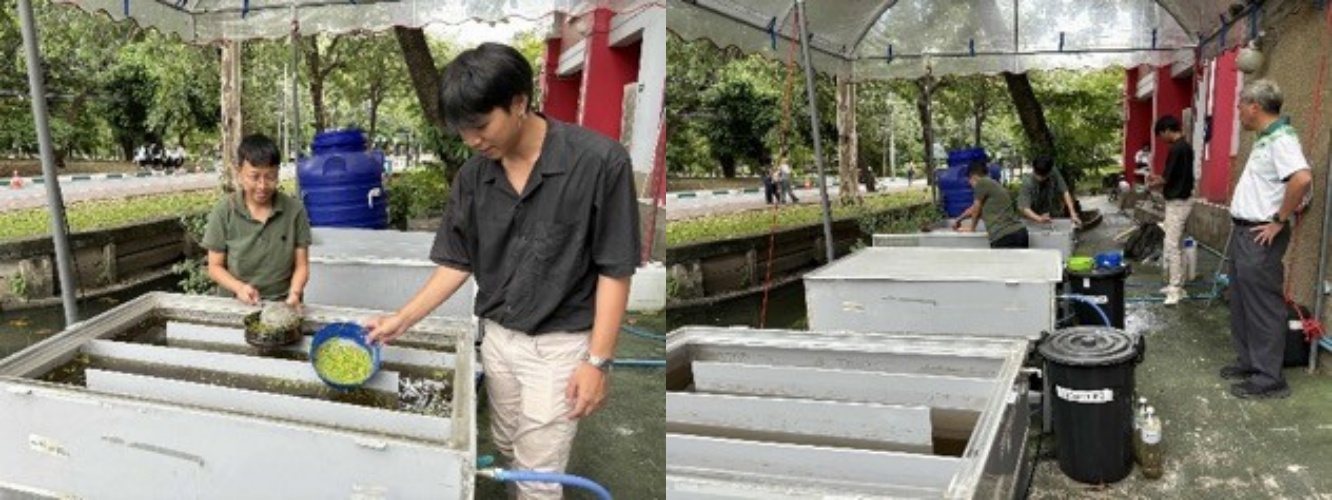
The bench-scale demonstration test for duckweed wastewater treatment
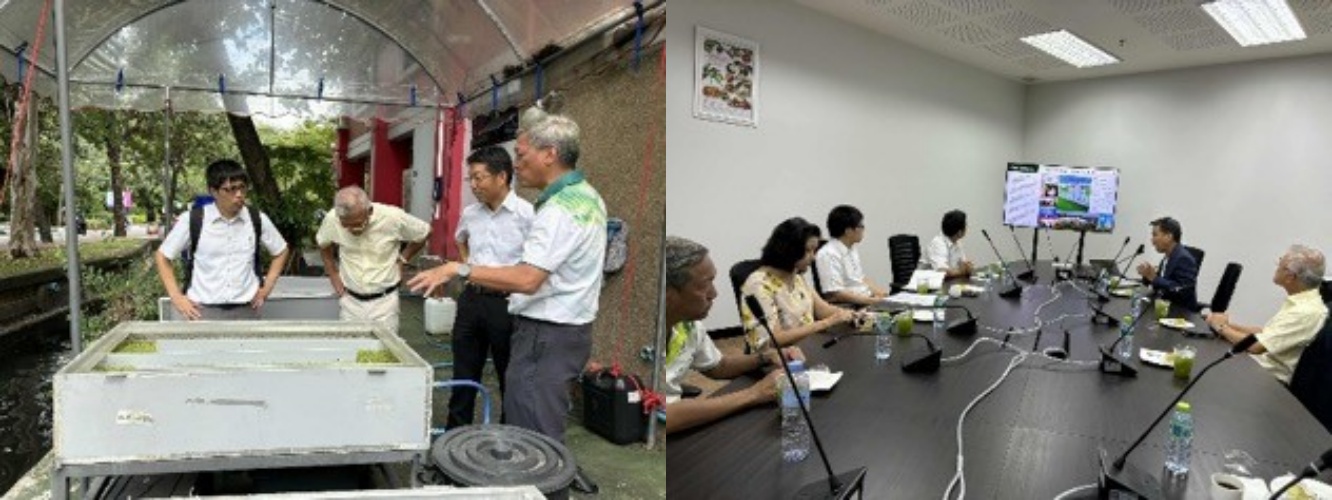
Visit from Embassy of Japan
Note
The project consists of six research groups namely: G1: Duckweed Holobiont Resource & Research Center (DHbRC). G2: Duckweed holobiont collection. G3: Duckweed holobiont analysis and biotechnology. G4: Duckweed biomass utilization. G5: Duckweed wastewater treatment technology. G6: Social implementation activities toward BCG economy.