

Community-led Self-visualization workshop in George: Now we can see in George-2
On 26–27 February 2026, two-day community-led self-visualization workshop on fecal contamination was conducted in George Compound, Lusaka. The workshop brought together 12 participants: 4 from the Lusaka City Council (LCC), 6 from the George Ward Development Committee (WDC), and 2 from the George Water Committee. The aim was to strengthen local capacity to understand invisible contamination pathways, awareness of the risk and motivate the community to improve WASH practices that can lead to promote sustainable WASH improvements.
In Zambia, recurrent cholera outbreaks highlight the urgency of improving both WASH infrastructure and community awareness. While access to shared taps may reduce contamination at source, stored household water and frequently touched surfaces often become contaminated. However, such fecal contamination is invisible to the naked eye, limiting risk perception at community level.
During the workshop, participants collected and analyzed environmental samples by themselves such as stored water, cups, kitchen and toilet floors, and hands etc. Using very simple E. coli test kits, they cultured and counted colonies after incubation. When results revealed fecal contamination in several key media such as stored water, cups and some food samples, the local participants were shocked and aware of WASH situation around their environment.
By visualizing contamination through their own measurements, participants deepened their understanding of fecal transmission pathways and discussed practical countermeasures. Feedback demonstrated strong impact: 54.5% of respondents rated the workshop as very effective and 45.5% as effective. Additionally, 90.9% reported feeling very confident to apply the knowledge in their community, while 9.1% felt confident.
The workshop reinforced that sustainable WASH improvement requires not only infrastructure, but also empowered and informed communities capable of identifying and addressing local contamination risks.
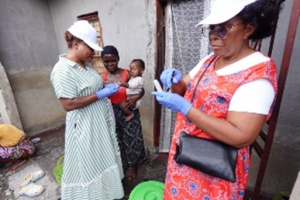
Local participants sampling by themselves around their environment
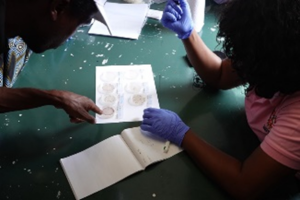
Local participants examining bacterial colonies
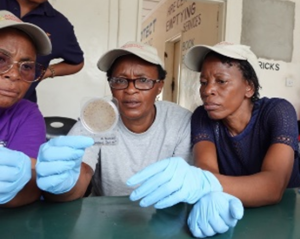
Local participants shocked from the contaminated sample
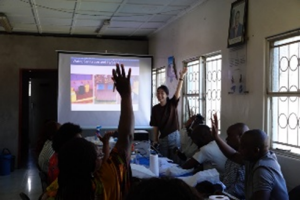
Local participants participating actively in discussions