


scroll


Improving Small-Scale Farmers’ Market-Oriented Agriculture Project (ISMAP)
Background and Objective
Agriculture is one of Egypt’s most important sectors, accounting for approximately 13% of GDP and 29% of the employed population. Its role is even greater in Upper Egypt, where around 53% of people work in agriculture and where 60% of Egypt’s poor population lives. In Minia and Assiut governorates, almost 90% of farmers are small-scale farmers cultivating less than 3 feddans (1.26 ha). Building on the findings of the Master Plan Study (IMAP) conducted by JICA in the two governorates from 2010 to 2012, the Improving Small-Scale Farmers’ Market-Oriented Agriculture Project (ISMAP) was implemented by the Ministry of Agriculture and Land Reclamation (MALR) in cooperation with JICA, with the objective of increasing the agricultural incomes of small-scale farmers in the target areas.
Project Summary
- Type of Cooperation: Technical Cooperation Project
- Record of Discussions signed in: December 2013
- Project Period: May 2014 to May 2019
- Implementing Agency: Ministry of Agriculture and Land Reclamation (MALR)
- Target Area: All 20 districts of Minia (9 districts) and Assiut (11 districts) governorates
The ISMAP Approach: From “Grow and Sell” to “Grow to Sell”
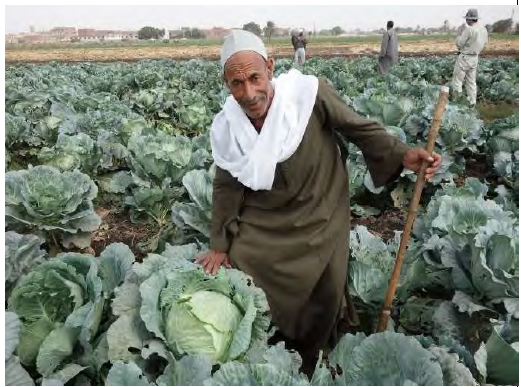
ISMAP was designed based on JICA’s SHEP (Smallholder Horticulture Empowerment and Promotion) Approach, which JICA first developed in Kenya and has since introduced in many countries. Adapting SHEP to the context of Upper Egypt, the project developed the “ISMAP Approach”, which focuses mainly on the capacity development of small-scale farmers to practice “farming as a business”, and on changing their mindset from the traditional “grow and sell” concept to the “grow to sell” concept. Instead of cultivating first and looking for buyers after the harvest, farmers learn to start from the market through a series of market-oriented activities, such as business dialogues with agribusiness stakeholders, market surveys carried out by the farmers themselves in wholesale markets, farming plans prepared on the basis of the survey results, technical training at demonstration farms, and contract farming with private companies for crops such as sweet potatoes and onions.
By adopting the ISMAP Approach, small-scale farmers can select crops and time their cultivation according to the needs of the market, and communicate with wholesale traders and agribusiness stakeholders to increase their farm income. For example, after learning during the market survey that potatoes planted in mid-September could be sold at high prices, farmers in Sahel Selem village in Assiut decided to cultivate potatoes for the first time. To sustain these activities at village level, the project also introduced “Marketing Committees” of active farmers, who lead the selection of crops, the request for technical assistance and the pursuit of contract farming opportunities.
A Gender Mainstreaming Approach Suited to Upper Egypt
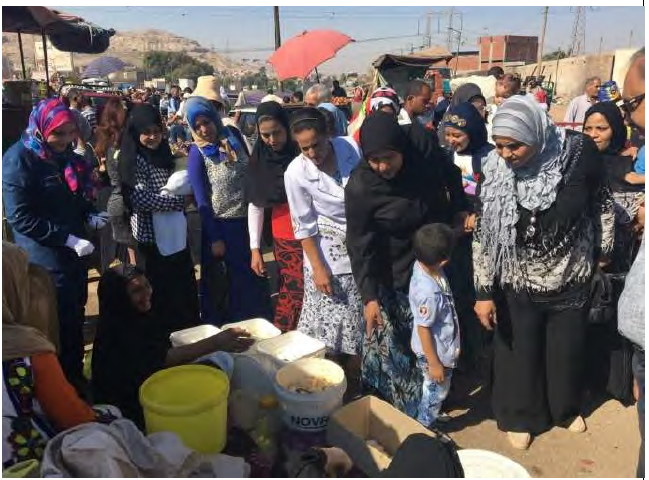
One of the most distinctive achievements of ISMAP was the development of a unique gender mainstreaming approach to address women in the targeted areas. The approach considers rural women’s needs to contribute to their household economy, while at the same time being sensitive to the traditional social norms and gender segregation found in rural communities in Upper Egypt. Separate workshops, business dialogues and market surveys were organized for women at times convenient for them, and were facilitated largely by female extension officers trained by the project. Rather than horticulture, the women chose home-based income-generating activities such as poultry, duck and pigeon raising and food processing, after carrying out a simple economic analysis of each option.
Following business training, market surveys and business planning, the women started their own businesses and met regularly to review their records and exchange experiences. In Bany Mor village in Assiut, for instance, a group of women launched a processed food business selling products such as bread and pies. They took customer orders in advance to avoid unsold products and recalculated their costs and prices regularly, and they received support from the Agricultural Directorate and the National Council of Women (NCW), which offered them places to sell their products. ISMAP shared this experience at a joint seminar with UN Women on women’s economic empowerment in rural Upper Egypt, held in Minia in February 2019 and attended by more than 100 participants.
Project Highlights
The terminal evaluation conducted in November 2018 rated the project’s relevance and effectiveness as high. Out of 20 target villages, 18 achieved the target of increasing the agricultural income of farmers practicing the ISMAP Approach by 6% to 37% at least once within two years. About 85% of target farmers in Minia and 89% in Assiut prepared farming plans based on the ISMAP Approach, and 52 of the 66 women who received business plan training (79%) started their own businesses. The approach also spread beyond the target farmers: among surrounding farmers who adopted it, between 55% and 70% reported an increase in their agricultural income.
To ensure the continuity of these results, the Minister of Agriculture and Land Reclamation approved the establishment of the ISMAP Implementation Unit in November 2018, with offices in Cairo, Minia and Assiut. The project activities were officially handed over to the Unit at the Project Completion Seminar held in Cairo on April 16, 2019. Under the governorate extension plan, the ISMAP Approach is expected to reach around 20% of the villages in the target governorates by 2030, in line with MALR’s Sustainable Agricultural Development Strategy 2030, and to be extended to Sohag governorate as well. Extension manuals on horticulture and women’s empowerment, together with booklets of farmers’ and women’s success stories, were also produced to support the wider dissemination of the approach.