
Third Country Training Programme (TCTP) in Zambia: Advancing STEM Education and Strengthening Regional Collaboration across Sub-Saharan Africa
2026.03.31







Third Country Training Programme (TCTP) in Zambia represents a strategic evolution in international development, transitioning from traditional bilateral aid to a dynamic model of South-South Cooperation. Supported by the Japan International Cooperation Agency (JICA), Zambia has transformed from a recipient of educational aid into a regional hub of excellence, exporting its pedagogical expertise to 29 countries across Sub-Saharan Africa.
Historical Evolution and Context
The foundation of the Third Country Training Programme (TCTP) is built upon Zambia’s decades-long dedication to enhancing teacher quality, beginning with the 2000 institutionalization of the School Programme of In-Service for the Term (SPRINT) framework. This commitment evolved significantly in 2005 through the launch of the (Strengthening of Mathematics, Science and Technology Education) project in collaboration with Japan International Cooperation Agency JICA, which focused on strengthening mathematics, science, and technology education. Since 2016, these domestic successes have been formalized into the TCTP, positioning Zambia as a "Third Country" host and a regional hub that provides a vital, context-specific training ground for educators across the African continent.
Core Philosophy: South-South Cooperation
Unlike traditional programs that require travel to overseas continents, TCTP leverages Zambia's Ministry of Education through National Science Centre (NSC) to train Teachers and Teacher Educators within the SADC and COMESA regions. By training educators within similar socio-economic and cultural environments, this approach ensures immediate contextual relevance and significant cost-effectiveness while building a sustainable, permanent professional network for long-term regional resource sharing.
Strategic Pillars of STEM Education
TCTP focuses on bridging the gap between high-level policy (such as Competency-Based Education) and practical classroom reality. It is built on three instructional pillars;
improvisation of low-cost experimental materials, the collaborative Lesson Study model for refining teaching quality, and the strategic integration of ICT tools adapted for African infrastructural realities.
Regional Impact
The TCTP has successfully scaled Zambia’s localized successes into a massive regional engine for reform. It has achieved a broad regional footprint by reaching 29 Sub-Saharan African countries and standardizing STE(A)M integration across the SADC and COMESA blocs through unified Competency-Based Education (CBE) frameworks. This impact is reinforced by "Afrocentric" capacity-building tools, such as national prototypes and rubric-based assessments, alongside a digital transformation involving a Learning Management Platform (LMP) that ensures professional development remains resilient to global disruptions.
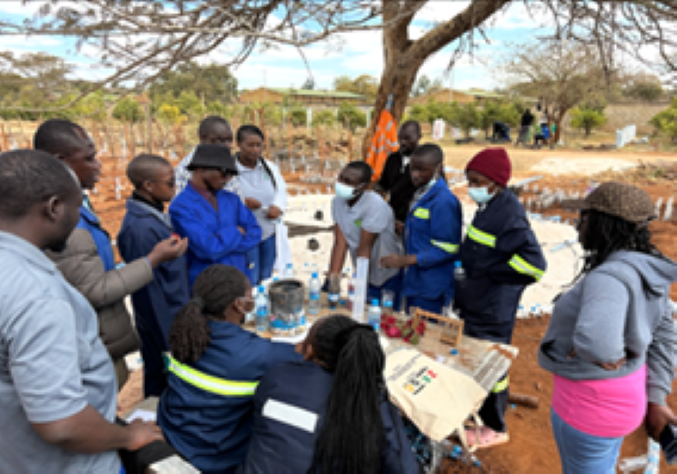
Discussing about lesson plans on the field
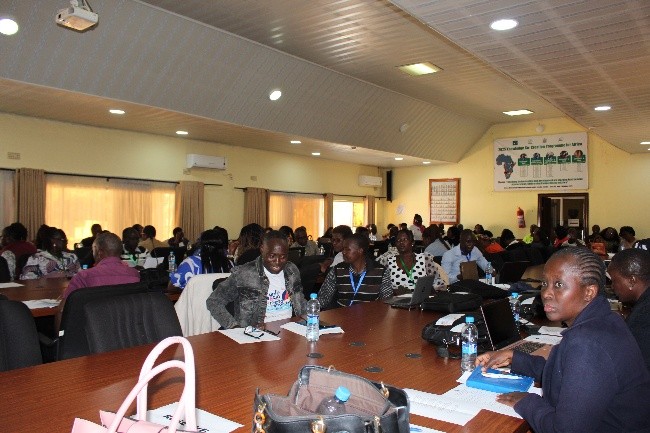
Lecture scene during TCTP
Sns share!


