




scroll


Tanaka Chisato
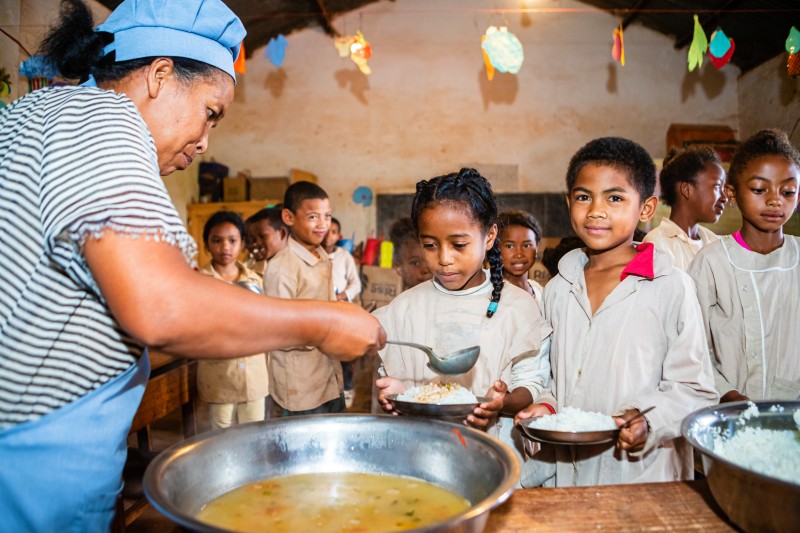
(Parents serve lunch to students at Ankadindambo Elementary School in Analamanga Region, Madagascar, April 2021/Photo: Minami Mayu)
Series : Africa in Focus
In the lead-up to the 9th Tokyo International Conference on African Development (TICAD9) in August 2025, JICA is sharing a series of stories that explore Africa’s challenges and promise. While showcasing JICA’s contributions, the series also brings attention to the broader efforts, ideas and potential across the continent. This instalment focuses on food aid and nutrition.
While schoolchildren in many countries struggle with rising rates of obesity, countless children in Madagascar spend their school days on an empty stomach, their minds dulled by hunger.
On this island nation off Africa’s east coast, nearly 40 percent of all children under five suffer from stunted growth due to chronic malnutrition, according to the Global Nutrition Report.
For years, nonprofit organisations have tried to ease the burden by providing free school meals. But these programmes are often temporary and short-lived. When funding runs out, so do the meals, and children are once again left with empty stomachs during the school day.
In 2016, the Japan International Cooperation Agency (JICA) decided to try something different.
Instead of relying on external aid, could the community itself provide meals for its children?
Rather than depending on short-term financial assistance, JICA launched a school lunch project led by school management committees that aimed to overturn the conventional aid model and encouraged local communities to take the lead in creating a sustainable school lunch system.
Each school runs its lunch programme in a way that fits its needs. Parents, teachers, and community members come together to decide who can contribute what and how. Some parents bring vegetables from their home gardens. Others, who may not have food to give, volunteer their time to prepare the meals.
Children sometimes bring small amounts of rice or money. At the beginning of each term, rice is collected and sold at a fair price in the market. The proceeds are used to buy other necessary ingredients. To save time and fuel, schools often serve one-pot dishes like stews.
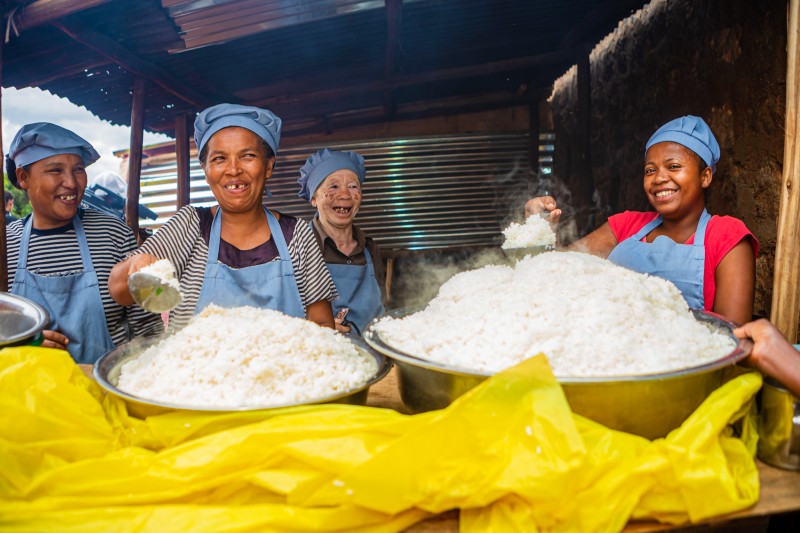
(Parents prepare meals for students at Ankadindambo Elementary School in Analamanga Region, Madagascar, April 2021/Photo: Minami Mayu)
“Each school does what’s realistic for them,” said Saito Yukiko, an associate project director for this project in Madagascar.
Saito has observed how well-meaning foreign aid can sometimes fall short, lack sustainability or lasting impact for local communities.
“When schools offer funded meals, families often move to those areas,” she explains. “But when the support ends, they leave again.”
This movement can lead to overcrowded schools in some areas and under-enrolment in others. It can also divide communities and increase inequality between families who are able to relocate and those who are not.
"It's important to ask whether the support we're offering on the ground is truly fair and equitable," said Saito.
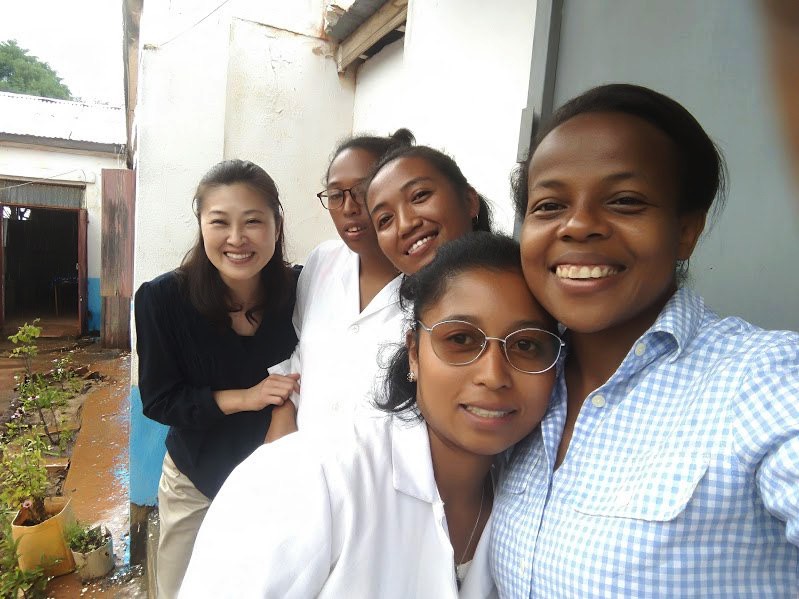
(Saito Yukiko poses for a photo with teachers at Ambohimandroso Elementary School in Analamanga Region, Madagascar, April 2021/Photo: Nirisoa)
Nearly eight years after its launch, JICA’s community-based lunch programme has expanded to more than 1,800 schools across Madagascar, according to Saito. About 87% of the monitored schools continue to run their lunch programmes independently, although typically only during the months of the year when food is scarce. Some school committees have even negotiated directly with NGOs to secure additional support, according to Saito.
Still, the meals are often basic—usually just rice and vegetable soup. Protein is a luxury.
“It’s rare for there to be meat in their soup, so we often add beans instead. The children love bean soup,” Saito said.
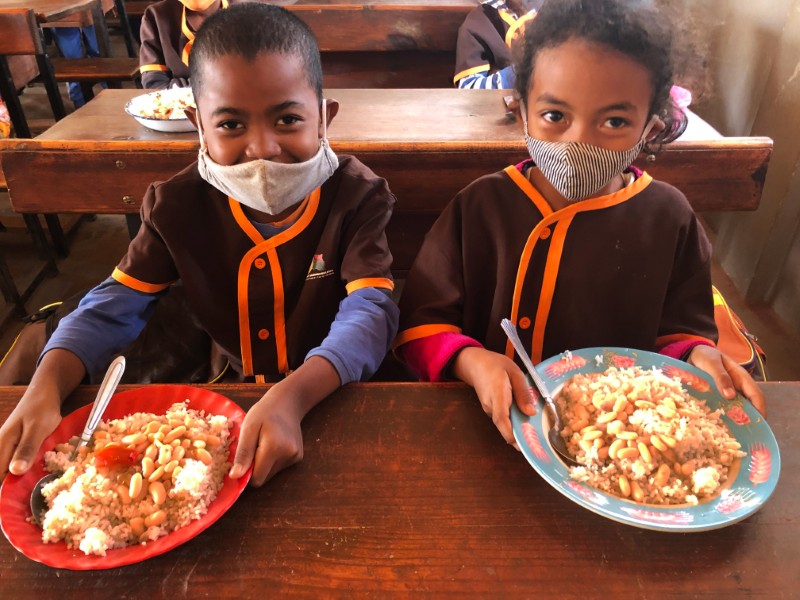
(Students eat lunch at Belanitra Elementary School in Analamanga Region, Madagascar, February 2022/ Photo: Saito Yukiko)
Food shortages remain a serious concern in Madagascar, especially during the lean season from January to March, when harvests are low. Climate change is making things worse, particularly in the drought-prone south. Rainfall is unpredictable. Crops fail. Hunger returns.
These challenges echo across Africa. Across the continent, communities lack knowledge about nutrition or have no access to a variety of foods. Even when people understand the need for a balanced diet, they often cannot afford the necessary ingredients.
To address this, JICA partnered with the African Union Development Agency - New Partnership for Africa’s Development (AUDA-NEPAD) to develop a mobile app that links nutritional needs with agricultural supply.
Community health workers and administrative officers in charge of nutrition or agricultural sectors use the app to record what people are eating, and share that data widely with locals, most of whom are also farmers. The idea is to encourage farmers to grow vegetables that the communities need most.
The app, called the Nutrient-focused Food Access Improvement Approach App (the NFA App), has been in development since 2015. It was piloted in countries including Zambia, Senegal, Ghana and Malawi in late 2024, with plans to carry out another field test in other countries.
“Some say this is exactly the app they’ve been waiting for,” says Miura Saitaro, a former programme officer involved in the project.
Miura, who oversaw the use of the app in Senegal, observed that there remains scope for improvement, particularly in streamlining the process of entering ingredients. Some local health workers still prefer to record ingredients on paper rather than navigate the app.
“It’s partly a matter of familiarity, but the app also needs to be user-friendly,” said Miura.
At present, the app is available in English and French, with Portuguese and Arabic versions planned for future development.
While such nutrition issues like this may feel far removed from daily life in wealthier nations, Saito believes the community-based solutions offer lessons that can resonate.
"Even if there are things you can't do alone, working with those around you can bring about the shift in perspective needed to move forward," said Saito.