




scroll


Suvendrini Kakuchi
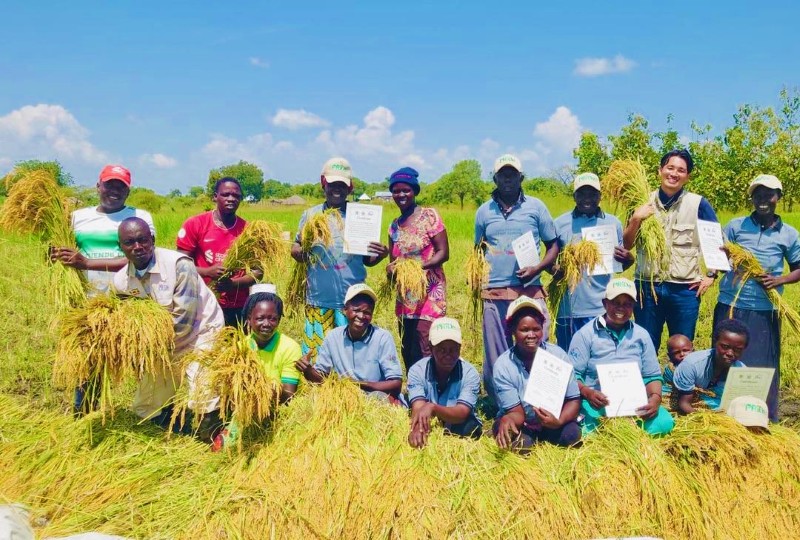
(Farmers showcase their harvest with Miyamoto Kisho at Rhino camp/ Photo: Miyamoto Kisho)
Series : Africa in Focus
In the lead-up to the 9th Tokyo International Conference on African Development (TICAD9) in August 2025, JICA is sharing a series of stories that explore Africa’s challenges and promise. While showcasing JICA’s contributions, the series also brings attention to the broader efforts, ideas and potential across the continent. This instalment focuses on refugee co-existence policy.
Mariah Chepkemoi, a seasoned Ugandan trainer in Japan’s refugee livelihood assistance programme in Africa, is a living embodiment of the collaborative spirit of international development. Her work focuses on agricultural initiatives designed to provide economic stability for refugee communities.
Uganda, with a population of 47 million, hosts over 1.8 million refugees, primarily from neighbouring countries such as South Sudan and the Democratic Republic of Congo. Renowned for having one of the world’s most progressive refugee policies, the Ugandan government grants refugees freedom of movement, the right to work, and access to education, actively encouraging their integration. Consequently, second- and third-generation refugees often speak the local language fluently.
Working as a monitoring and evaluation officer, Chepkemo has led the “farmer-to-farmer” training project since 2017, a flagship programme supporting small-scale cultivators. This initiative champions the adoption of NERICA (New Rice for Africa), a high-yield, drought resistant hybrid rice that has become a powerful economic tool for farmers. The crop’s market price is nearly double that of Uganda’s staple foods, cassava and maize, making it a lucrative cash crop for farmers.
The growing success of NERICA marks a turning point for Eco-PRiDe, Japan’s Sustainable Rice Promotion Project launched in 2024. It builds on the earlier PRiDe I and II initiatives, carried out under a Memorandum of Cooperation between JICA and UNHCR, the UN agency for refugees and the forcibly displaced. Since 2014, these programmes have trained more than 3,000 refugees and host community members with improved rice-growing techniques, strengthening both food security and household incomes.
The Eco-PRiDe initiative seeks to consolidate the achievements made during PRiDe I and II over the next five years.
For Chepkemoi, the programme highlights the key aspect of Japan’s humanitarian assistance. She sees Eco-PRiDe not merely as a provider of rice cultivation technology and storage facilities for refugees.
“Equally important,” she said “is the emphasis on building bonds between the refugees and the locals to create a peaceful co-existence contributing to improved livelihoods.”
Indeed, Japan’s refugee assistance model emphasises both agricultural skills and community integration as agriculture provides a lifeline for communities facing acceptance in protracted resettlement situations.
For Miyamoto Kisho, Eco-PRiDe’s chief advisor in Uganda for over a decade as a JICA agricultural expert, the stakes are high with rising refugee populations, the risks of food shortages and land disputes. A former JICA volunteer in Uganda, Miyamoto now leads a team of local experts, including trainers like Chepkmoi and government officials, to promote sustainable practices that combine technology with social development.
Refugee farmers receive NERICA seed and technology support, while locals learn specialised training methods that facilitate collaboration between landowners and refugees who depend on the owners for their cultivation.
“NERICA rice is widely accepted as a crucial income generator for refugee farmers,” Miyamoto said. “Our programme has created a 50 per cent increase in their household income and benefited the whole community.”
Chepkemoi travels extensively between refugee settlements, including the Rhino Camp and Bidi Bidi in the West Nile region, where upland NERICA rice thrives. Most refugee households are headed by single women who lost their partners in conflict, thrusting them into the role of breadwinners.
“The women, in their thirties and forties are the major rice producers and are determined to succeed,” said Chepkemoi. The results are encouraging: income from rice enables women to invest in small businesses such as grocery shops, and improve their children`s education and health.
Uganda’s “farmer-to farmer” training programmes have become a model for sustainable refugee acceptance. Some 70 per cent of refugee farmers share NERICA rice yields with landowners, others participate in collaborative saving schemes, and take on joint organisation responsibilities with host communities such as finding translators of the local language for other refugees. Chepkemoi highlights the importance of facilitating negotiations between refugees and landowners. “Our support is also about helping refugees conduct smooth negotiations with landowners, a priority for gaining economic stability,” she said.
Newly settled refugee households are large, averaging 19 members. While they are freely given small plots of land – typically a quarter to one acre – to cultivate, these are often reclaimed by landlords after a year. To support long-term self-reliance, Uganda's Office of the Prime Minister negotiates with landlords to secure land for block farming. In this model, multiple smallholder farmers cultivate individual plots within a single, large, contiguous area of land. Each farmer also receives about three kilograms of NERICA seeds and fertiliser.
“NERICA rice is popular across a broad spectrum, from wealthier consumers to ordinary farmers and with the affluent who can afford to pay the higher prices,” Miyamoto said. “Farmers are thus able to sell their whole harvest.”
Miyamoto emphasises that community development is key: “While emergency assistance for the displaced is important, supporting a collective approach eases fear and uncertainty for all.”
This method demands patience and trainers who know and respect the local culture. Chepkemoi says my experience in the JICA programme has exposed me to the Japanese model of building collectivity and trust. It is a cultural shift, but it demonstrates that success is possible when we work together.
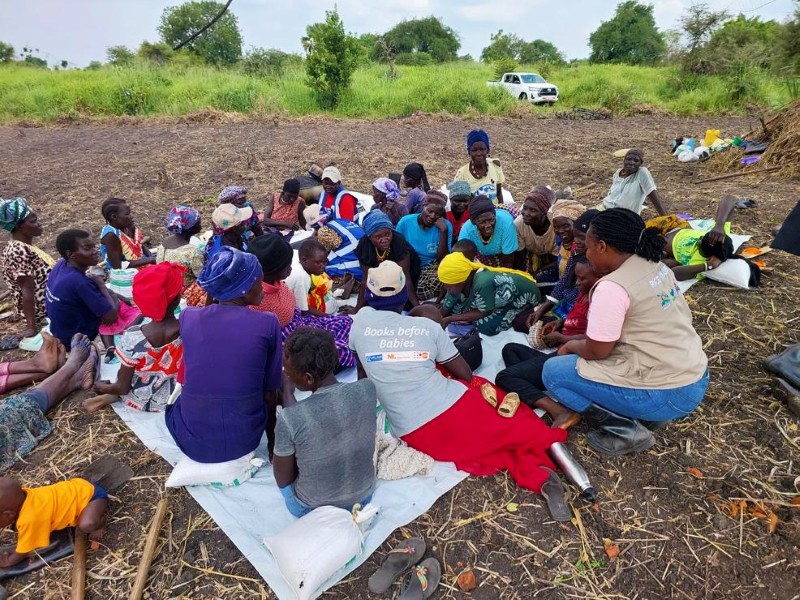
(Chepkemoi conducting gender training focused on tackling social discrimination/ Photo: Miyamoto Kisho)
Beyond agriculture, JICA is dedicated to strengthening the capacity of local governments to manage the complex challenges of hosting large refugee populations.
This is the goal of the Project for Strengthening Resilience in Refugee Hosting and Affected Districts in the West-Nile Sub-region (PROCEED), launched in 2021. The project aims to empower the 12 district governments in Uganda’s West-Nile Sub-region to better support and strengthen resilience in both host and refugee communities. Uganda’s progressive refugee policy, while recognised as the most generous, faces growing challenges. These include mounting pressure on public services, land, and the environment, as well as declining financial support and an increased influx of refugees, according to the UNHCR.
One of PROCEED’s pilot projects includes collecting and analysing data on the use of social services by refugees, from health facilities to schools, as well as food security. According to Mabuchi Yukiko, a JICA Expert for PROCEED, this data is "critical for local governments to visualise the impact of refugees and foreigners on the local social services and food production" and helps them advocate for additional funding and support from the central government and other donors.
JICA's PROCEED also introduced a new model for local government planning. It has implemented a second type of pilot project designed to identify workable and replicable ways for joint planning between host communities and refugees. The core output of this pilot project is a framework of procedures and tools for joint planning, which provides opportunities for refugees to participate directly in planning meetings.
In these forums, refugees can speak about their needs, discuss them alongside the host community’s needs, and work together to prioritise issues and build a consensus. The joint planning system, as developed by PROCEED, ensures that both groups have their voices heard and reflected in the planning process, thereby fostering the deeper integration of refugees into local society. As one participating refugee representative remarked, "This is the very first experience for me in participating in local government planning. It makes me feel at home.”
PROCEED pilot programmes have yielded valuable insights, which are being compiled into three comprehensive handbooks. These handbooks are designed as practical guides for local government officers, with the goal of institutionalizing and sustaining the lessons learned from the pilot projects. As JICA Expert Mabuchi Yukiko explained, the hope is that these handbooks will strengthen the capacity of local governments to support their communities in a more inclusive and resilient manner for the long term.
PROCEED also focuses on inclusive disaster preparedness, which is crucial, given the region's increasing vulnerability to floods and droughts related to climate change.
The project introduces climate-smart agriculture to help communities diversify their livelihoods and build resilience. This effort has led to improved communication, as host communities and refugees now trade vegetables and share agricultural knowledge.
In order to prepare communities for natural disasters, PROCEED introduced a unique and innovative approach: drama performances. This method was specifically designed to address issues like low literacy rates and language barriers between host communities and refugees. Community groups, composed of both refugees and Ugandans, received training in theatre and performed at local schools and markets.
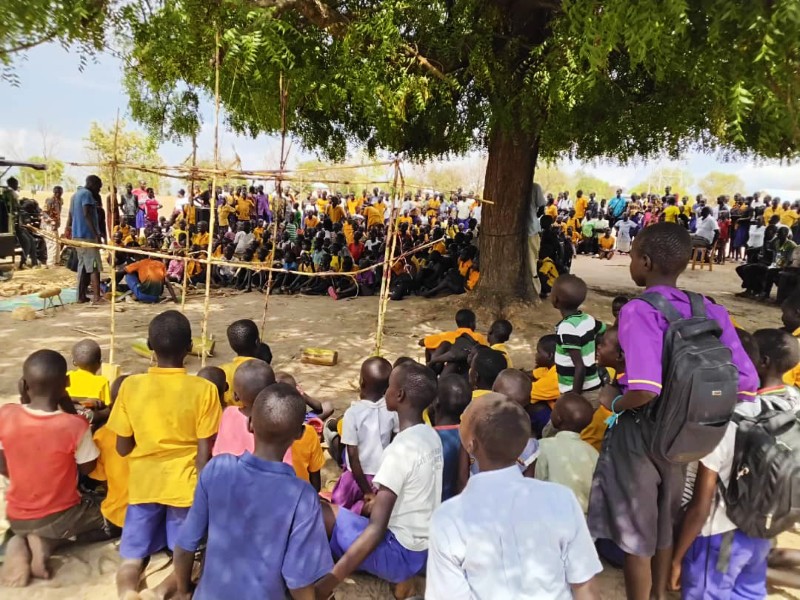
(Residents attend a disaster preparedness education drama organised through the PROCEED pilot project/ Photo: PROCEED)
These skits used humor and everyday scenarios to share key knowledge on disaster prevention and mitigation. By making people laugh, the dramas ensured that essential messages were easily understood and enjoyed by all, regardless of their background. This shared positive experience also helped to foster communication and build bonds between the two communities.
One drama group, made up of 13 refugees and two Ugandans, said the initiative significantly enhanced the refugees' self-esteem. As one member proudly stated, “We are not merely being supported, we can help others as well.”
JICA's PROCEED project is a powerful example of its guiding philosophy in action, demonstrating how JICA’s principle of Human Security and Co-Creation is put into practice. The project deliberately includes a wide range of people—women, the elderly, people with disabilities, refugees, and local government officials—in its pilot projects.
According to JICA Expert for PROCEED Naganeo Kazuko, this inclusive approach is essential for strengthening communities. "People in vulnerable situations often face more serious risks and tend to need a longer period to recover from the impacts of disasters," she explained.
This collaborative method is also a direct application of JICA's Co-Creation principle. It fosters a vital sense of trust and understanding between different groups. Naganeo noted that "knowing each other in person is crucial for living together in peace, fostering mutual understanding, and resolving issues through open and honest discussions." By bringing diverse voices to the table, the project empowers communities to develop solutions together, rather than receiving them as passive recipients of aid. The JICA Expert Team hopes these inclusive communities, built on trust and a foundation of shared understanding, will serve as a model for others.