
“Inside the World of JICA Students (Part 3)”
2025.12.10





At JICA Tokyo, we regularly feature JICA Scholars. We will sequentially share interview articles with international students conducted by Japanese university students participating in the JICA Internship Program.
Inteviewer: HASHIMOTO Rinka (Rikkyo University)

Mr. Hadebe, originally from Zimbabwe, learned about JICA’s long-term training program purely by chance. Before applying, he was not aware of JICA’s existence. However, during a visit to the Zimbabwe International Trade Fair with a friend, he came across JICA’s booth and discovered the program. Driven by a strong desire to “take on new challenges,” he seized the opportunity and decided to apply.
Currently, he is studying International Business at Rikkyo University, focusing on global markets, factors influencing corporate overseas expansion, and cultural aspects in cross-cultural business. His goal is to bring this knowledge back to Zimbabwe and contribute to advancing technology in his home country.
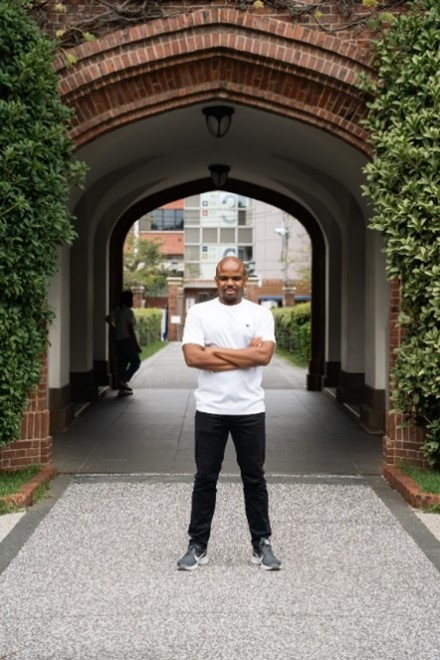
Taken on the campus of Rikkyo University
Through his life in Japan, Mr. Hadebe has strongly felt the differences in educational styles compared to his home country, Zimbabwe. In Zimbabwe, discussion-based classes led by students are common, emphasizing teamwork and active participation. In contrast, Japan primarily adopts a lecture-based approach led by professors, where classes progress even if students do not speak up.
There are also significant differences in the structure of the education systems:
While enjoying his university life and actively participating in rugby practice, Mr. Hadebe has faced one major challenge: communication with Japanese students. In Zimbabwe, where there are 16 official languages, he speaks six to seven himself, so communication was never an issue back home. However, in Japan, where few people speak English, he has struggled with the language barrier.
He was also surprised by differences in daily habits. In Zimbabwe, public buses are lively, filled with passengers chatting loudly. In contrast, Japan’s public transportation is quiet and orderly—a cultural shift that took him some time to get used to.

Commuter Omnibus in Zimbabwe

Typical Long-Distance Travel Bus
Drawing on his experience working for a medical device company, Mr. Hadebe was deeply impressed by the durability of Japanese products—particularly the advanced technology of sterilization equipment (autoclaves) used to clean surgical instruments after operations. “I want to learn this technology and bring it back to my country,” he says. This aspiration drives his studies every day.
His goal after graduation is to work for a Japanese company expanding into Africa. By combining the international business knowledge Mr. Hadebe has gained in Japan with the medical technologies he hopes to introduce in the future, he aims to become a bridge between Japan and Zimbabwe.
Sns share!


