
Inside the World of JICA Students (Part ⑫)
2026.02.25







The Graduate Course Program Division in JICA Tokyo is currently hosting Japanese university and graduate students participating in the 2025 JICA Internship Program. This article features an interview conducted by one of the interns with an international student from a developing country.
Interviewer: GOMI Soma (Tokyo University of Foreign Studies)

This time, I interviewed Ms. Nyam Lydia Ajiji (hereafter, “Lydia-san”), originally from Nigeria and currently studying at Shinshu University. Lydia-san works as a Principal Scientific Officer at the Federal Ministry of Agriculture and Food Security in Nigeria. I asked her about her life and studies in Japan, as well as her future goals.

speaking at the exchange seminar
While working at a Nigerian government ministry, Lydia-san was nominated for JICA’s Scholarship and thus gained the opportunity to study in Japan. Even before coming to Japan, she had a strong interest in Japan’s culture of thoughtfulness, sense of order, and awareness of nature conservation.
She was particularly fascinated by the Japanese custom of cars stopping to let wild animals cross the road—something she said would be unthinkable in Nigeria. Japan’s low crime rate was another positive image she held before arriving.
Lydia-san’s research theme is “Classifying Cattle Behavior Using GPS Data.”
With the decline in agricultural workers and the increase in abandoned farmland becoming major issues, she is researching efficient livestock management—a critical topic for livestock farmers. By tracking cattle behavior via GPS and analyzing the data, she aims to develop simple monitoring technologies.
She explained that this research could greatly contribute to labor-saving practices in agriculture and to sustainable livestock management.
Although she had no prior experience caring for animals before coming to Japan, she now visits the farm every day to take care of the animals and monitor their health.
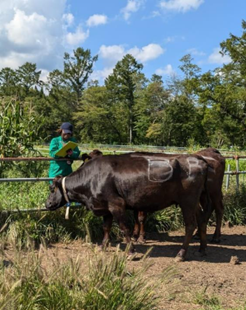
Researching at the farm in her university
When she first arrived, she particularly struggled with getting used to the traffic rules and dining manners and customs in Japan, such as using chopsticks.
Lydia-san came to Japan with almost no Japanese language ability, but by taking university Japanese classes and using apps, she gradually improved. She can now read hiragana, katakana, and some kanji, and her listening skills have noticeably improved. Her favorite kanji is “木 (tree)”, because it symbolizes the essence and spirit of nature and is simple yet beautiful.
One of her most unforgettable experiences was skiing in Nagano—her first time skiing in the snow. She also enjoys birdwatching as a hobby. The area around her university is rich in nature, making it an ideal environment for observing birds.

first time skiing at Norikura

birdwatching at Kamikochi
Lydia-san also participated in a JICA Development Studies Program held in International University of Japan, Niigata. The seminar focused on Japan’s development history—from the Edo period to the Meiji Restoration and postwar reconstruction. She completed an online course beforehand and later engaged in direct discussions with university professors on-site.
She learned how Japan overcame postwar challenges to achieve its current level of development. Comparing Japan’s experiences with Nigeria’s current issues, she said the seminar helped her deeply consider possibilities for international cooperation.
Additionally, she joined an exchange seminar with Nippon Veterinary and Life Science University, where she talked about her experiences presenting research, exchanging ideas, and gaining more on herd health security during field and farm tours in Yamanashi.
After returning home, Lydia-san plans to contribute to agricultural policy development as a government officer, applying the knowledge and experiences she gained in Japan. She also hopes to take part in international cooperation projects through JICA and strengthen collaboration with other African nations.
Moreover, she aims to bring back to Nigeria the Japanese values she learned—efficiency, leadership, and a culture of thoughtfulness—to create positive change in society.
What left the strongest impression on me during this interview was Lydia-san’s attitude of continuously learning and taking on new challenges even in a foreign country. From mastering chopsticks to learning Japanese and trying skiing for the first time, she bravely embraced experiences she could never have had in Nigeria. Seeing her take on challenges with such positivity made me want to become someone who can do the same when placed in new environments.
When Lydia-san said, “Cars stopping wild animals would hardly ever happen in my country,” I was deeply surprised. At the same time, it reminded me not to take Japan’s customs for granted and to always keep a broad perspective.
Sns share!


