
Inside the World of JICA Students (Part ⑭)
2026.03.06





The Graduate Course Program Division in JICA Tokyo is currently hosting Japanese university and graduate students participating in the 2025 JICA Internship Program. This article features an interview conducted by one of the interns with an international student from a developing country.
Interviewer: GOMI Soma (Tokyo University of Foreign Studies)
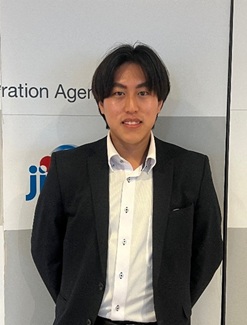
Gomi-san during his internship in JICA Tokyo
This time, we interviewed Mr. AUKLEYA Walter Greamah (hereafter “Walter-san”), a doctoral student at Toyo University from Papua New Guinea. Walter-san has dedicated his career to waste management in his home country, working as a specialist to reduce environmental pollution and promote sustainable development. We asked him about his studies and research in Japan, as well as his vision for the future.
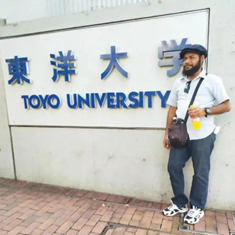
Walter-san decided to apply for the JICA Scholarship out of a strong desire to fundamentally improve waste management in Papua New Guinea.
While working as a waste management officer for a local government and participating in JICA’s waste management project, J-PRISM, he had numerous opportunities to see Japan’s technological strengths and environmental policy achievements. He was especially involved in landfill operations in his country that adopted the Fukuoka Method, a Japanese semi-aerobic landfill system. This experience made him realize the need to learn more advanced design and management techniques. He also learned that Japan’s waste management system was built through decades of overcoming environmental pollution problems. Inspired by this history, he believed that Japanese knowledge could help generate practical solutions for his own country—leading him to apply for the program.
Walter-san’s research focuses on “reducing landfill emissions through leachate recirculation and evapotranspiration.”
His study examines the Baruni Landfill in Port Moresby, the capital of Papua New Guinea. Simulating the generation and movement of leachate—the contaminated liquid produced in landfills—he aims to explore low-cost, chemical-free methods to reduce environmental impacts.
Ultimately, he seeks to organize design principles and management practices that help minimize landfill pollution, creating a system that can be implemented sustainably in developing countries.
This is Walter-san’s second time living in Japan. While he didn’t experience major culture shock, he shared many new realizations. He is particularly impressed by the kindness of Japanese people, the country’s high level of public safety, and Japan’s diverse food culture—especially tuna-mayo rice balls.
Although he still struggles with crowded trains, he actively enjoys traveling on weekends, having visited places like Mt. Takao, Okinawa, and Fukuoka. He also saw snow for the first time in Japan—an experience he recalls with a smile.
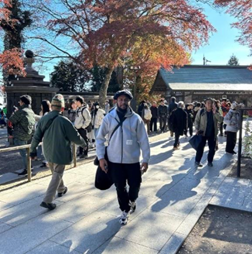
At Toyo University, Walter-san studies in an environment rich with international diversity. He especially enjoys seminar discussions in his laboratory, where students regularly share research progress and exchange ideas. He also participates in JICA Tokyo’s weekend programs, which include cultural events and regional visits. These experiences have further broadened his perspective.
After completing his program, Walter-san plans to return to Papua New Guinea and resume his work as a waste management specialist. He hopes to apply the knowledge gained in Japan to improve landfill operations and promote “low-pollution, sustainable waste management.”
He also expressed a desire to contribute to waste management across the entire Pacific region. Walter-san hopes to continue his research and share his findings widely to support local communities and environmental efforts.
Driven by a strong commitment to environmental preservation, Walter-san came to Japan and has spent three and a half years deepening his knowledge. Behind his calm and thoughtful manner lies a powerful passion for improving the future of his country and the Pacific region. We look forward to seeing Walter-san continue his journey, using the expertise gained in Japan to help build a cleaner and more sustainable environment for future generations.
Sns share!


