
Inside the World of JICA Students (Part ⑰)
2026.03.25







The Graduate Course Program Division in JICA Tokyo is currently hosting Japanese university and graduate students participating in the 2025 JICA Internship Program. This article features an interview conducted by one of the interns with an international student from a developing country.
Interviewer: GOMI Soma (Tokyo University of Foreign Studies)
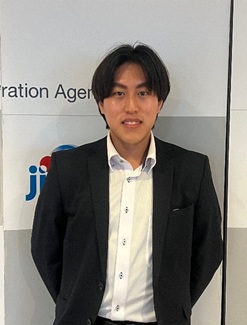
Gomi-san during his internship program in JICA Tokyo
This time, we interviewed Ms. De Guzman Unique Kristle (hereafter, Kristle-san), a master’s student at Toyo University from the Philippines. Kristle-san has been working as an agriculturist at the Philippine Department of Agriculture, supporting farmers and engaging in rural development. Motivated by her desire to “keep learning in order to support farmers,” she came to Japan and is currently conducting research on rural development through coffee production. We asked her about her life in Japan, her research, and her vision for the future.
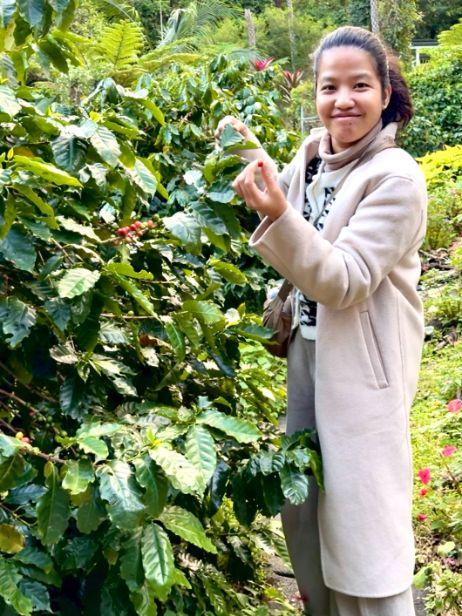
Kristle-san applied for JICA Scholarship program out of a strong belief that gaining specialized knowledge would enable her to contribute practical, expert-level advice for solving agricultural issues in her home country.
Through her work at the Department of Agriculture, she had seen firsthand the challenges faced by farmers and the limitations of existing systems. She realized that addressing these issues required deeper, more advanced expertise—leading her to pursue graduate studies.
She also shared that hearing the first experiences of one of her senior colleagues who studied in Japan through a JICA program greatly motivated her to take the leap.
Kristle-san’s research focuses on strengthening monitoring in the Philippine Rural Development Project (PRDP) and improving coffee production. PRDP is the agricultural project under the framework of ODA (Official Development Assistance). The primary funding source is a loan agreement between the World Bank and the Government of the Philippines.
Through I-REAP program, which is one of four major components of PRDP , she studies how to better support coffee farmers in the Soccsksargen region, which she is responsible for.
Her work emphasizes: strengthening monitoring systems to accurately understand farmers’ needs, building mechanisms that continue functioning even after a project ends and designing structures that enable improvements at the farm level to contribute to regional and national development.
Her research reflects her strong desire to support rural farmers who often have limited access to knowledge and technology.
When talking about her life in Japan, Kristle-san shared that she truly enjoys her daily routine because she genuinely loves studying.
Her favorite class is Presentation, which has helped her build confidence through regular presentations. One memorable experience was presenting on the differences between coffee in Okinawa and the Philippines.
Of course, she has also faced challenges—such as adapting to a different society and managing the responsibilities of living abroad. However, meeting new people, traveling, and enjoying her hobbies have supported her throughout her stay.
At JICA Global Plaza in Ichigaya, she participated in a multilingual storytelling event where JICA participants read picture books in their native languages to Japanese children. She felt not only it helped create opportunities for them to deepen their understanding of different cultures, but also it enhanced her own multicultural awareness. At university, she learns in an international environment where discussions in the laboratory and exchanges with classmates constantly inspire her and broaden her perspective.
She expressed that such experiences will be a significant asset when she returns to the Philippines to support farmers and contribute to public administration.
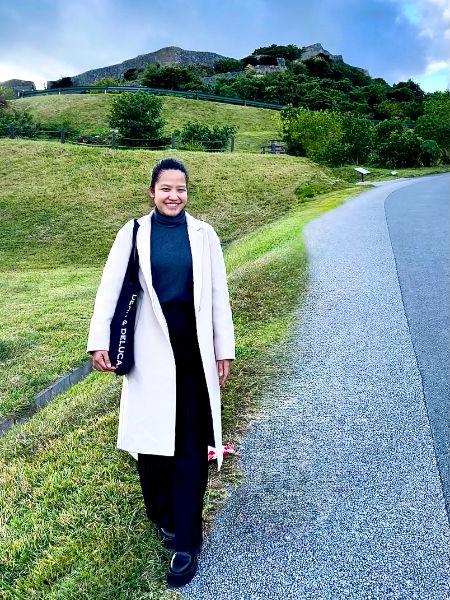
After completing her program, Kristle-san plans to return to the Philippines and resume her work at the Department of Agriculture.
Her goal is to promote bottom-up rural development that places farmers at the center.
She hopes to apply the knowledge gained in Japan to strengthen on-site monitoring and build a system that ensures farmers’ voices reach policymakers.
Moreover, she aims to incorporate not only technical expertise but also the Japanese qualities she has observed—such as precision, time management, responsibility, and organizational discipline—into public administration in the Philippines.
Through the interview, Kristle-san spoke with passion about her future vision and the joy she finds in her life in Japan.
Her dedication to continuous learning and her strong commitment to supporting farmers left a lasting impression. The experiences and perspectives she has gained in Japan will surely become a solid foundation for bringing positive change to rural development in the Philippines.
We sincerely look forward to Kristle’s continued success and to the new possibilities she will bring to the agricultural communities of her home country.
Sns share!


