
Inside the World of JICA Students (Part ㉒)
2026.06.15





The Graduate Course Program Division in JICA Tokyo welcomed Japanese undergraduates and graduate students participating in the 2025 JICA Internship Program. This article features an interview conducted by one of the interns with an international student from developing countries.
Interviewer: GOMI Soma (Tokyo University of Foreign Studies)
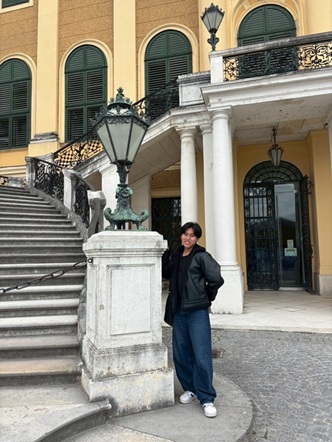
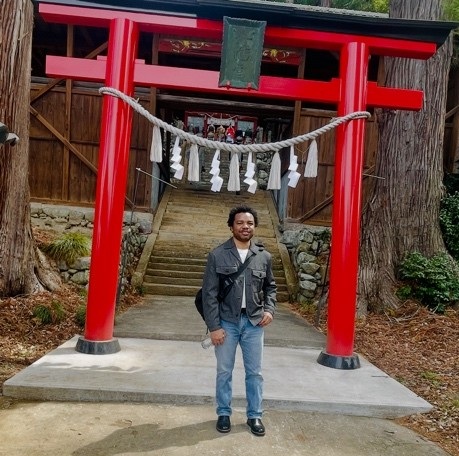
Gomi-san During his trip
This time, I interviewed Mr. BRAIMO Cassimo (hereafter, Cassimo-san), a master’s student at Hosei University from Mozambique. While working at National Hydrocarbons Company
as a data analyst in Mozambique’s oil and gas sector, he decided to come to Japan to acquire more advanced technical skills. I spoke with him about his studies and research in Japan, as well as his hopes for the future.
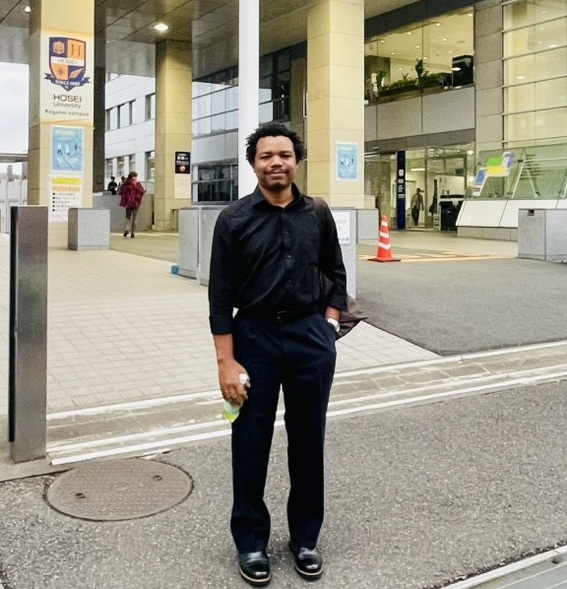
Cassimo-san shared that his motivation to apply for JICA’s training program came from a strong desire to contribute to his country’s development through technology. He was also influenced by colleagues who had participated in JICA training programs and studied in Japan.
Studying in Japan—known for its advanced technologies—felt like an opportunity for him to strengthen his expertise and bring new innovations to Mozambique’s industry.
He added that his long-standing interest in Japanese culture, history, and values further encouraged him to apply for the program.
Cassimo-san’s research theme is “Seismic Data Interpolation: A Study Comparing Deep Learning with Traditional Techniques.”
Seismic exploration data provides a critical “image” of subsurface geological structures; however, acquiring high-quality seismic data is both expensive and technically challenging, often resulting in incomplete or sparse datasets. To address this challenge, Cassimo-san applies advanced Deep Learning techniques, particularly models such as U-Net, to reconstruct and interpolate missing seismic data.
He explained that his research evaluates the performance of these AI-based approaches against conventional interpolation methods, with the objective of improving the accuracy, continuity, and reliability of seismic interpretation. He further highlighted that this research has significant practical relevance for the Oil & Gas industry, as it may contribute to reducing data acquisition costs, optimizing exploration workflows, and supporting more efficient and data-driven decision-making in Exploration & Production (E&P).
This is Cassimo-san’s first long-term stay abroad. While cultural adaptation was smooth, he initially faced challenges with the language barrier. However, through interactions with kind and supportive Japanese people, he has gradually overcome the challenge and can now communicate using simple Japanese.
Cassimo-san also has a deep interest in Japanese culture. He has visited many cultural sites, including Hiroshima Castle, various temples in Kanazawa, and shrines around Harajuku.
One of the most memorable experiences for him was seeing snow in Tokyo for the first time—an unforgettable moment in his life.
At Hosei University, he finds the active discussions in his laboratory highly stimulating. Through exchanges of ideas with his professors and fellow students, his research has deepened, and classes that teach presentation skills and academic writing have also proven extremely valuable.
In addition, through various JICA programs, he has further deepened his understanding of Japan by engaging in exchanges and cultural experiences within the country.
After completing the JICA Program, Cassimo-san plans to return to Empresa Nacional de Hidrocarbones (ENH) in Mozambique and contribute to the development of the energy sector by applying the data analytics and deep learning skills he has gained in Japan.
He also intends to maintain strong ties with Japan by staying connected with his professors, fellow researchers, as well as the JICA alumni networks. Through these connections, he hopes to exchange knowledge, explore future collaborations, and stay updated on technological advancements.
In addition, he would like to promote partnerships between Japanese and Mozambican institutions in areas such as energy and digital innovation. By continuing to study Japanese language and culture, and by embracing values such as professionalism, responsibility, and continuous improvement, he aims to build a lasting bridge between Japan and Mozambique.
Throughout the interview, I was impressed by Cassimo-san’s calm determination and strong sense of purpose as he pursues his studies for the future of his country.
His deep learning–based research has the potential to significantly contribute to resource exploration and industrial development in Mozambique.
I will continue to support and cheer for Cassimo-san as he applies the experiences and values cultivated in Japan to help build a brighter future for Mozambique and the broader African region.
Sns share!


