
Inside the World of JICA Students (Part ㉓)
2026.06.22






The Graduate Course Program Division in JICA Tokyo is currently hosting Japanese university and graduate students participating in the 2025 JICA Internship Program. This article features an interview conducted by one of the interns with an international student from a developing country.
Interviewer: GOMI Soma (Tokyo University of Foreign Studies)
This time, we interviewed Ms. María Angélica Jiménez Otálora (hereafter Angélica-san) from Colombia, who is currently studying at Waseda University. In Colombia, she worked as a Japanese language instructor and has devoted herself to promoting Japanese-language education and intercultural understanding. She shared with us her experiences living and studying in Japan, as well as her aspirations for the future.
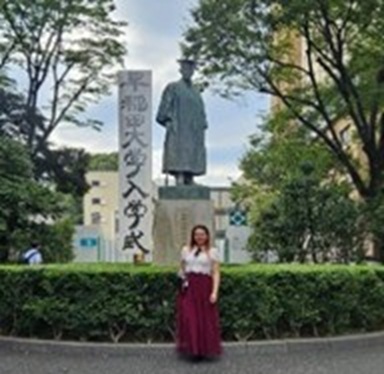
Angélica-san’s decision to come to Japan stemmed from her strong desire to deepen her expertise as a Japanese language educator. Having been familiar with Japanese culture from a young age—through anime, manga, J-Rock, and more—her passion for learning Japanese grew into a dream of studying “in the place where the language is actually used.”
After graduating from university, she worked as a Japanese language teacher in Colombia. As she considered pursuing graduate studies to gain more advanced teaching methods and deeper knowledge, she learned about the JICA long-term training program, which emphasizes “international cooperation” and “human resource development.” She felt a strong alignment with her educational values and decided to apply.
Her research focuses on phenomenologically examining the intercultural communication experiences of Colombians living in Japan and the Japanese-learning needs that arise in those interactions.
Angélica-san explained that Japanese language education is not just about grammar and vocabulary; it also requires understanding culture, values, and ways of communication. Being both a language learner and an instructor herself, she has long felt the importance of teaching the “real Japanese culture” that does not appear in textbooks.
By clarifying what Colombians find challenging and what skills they need to thrive in Japan, she hopes to create more practical and effective Japanese language education.
Since this is her second time living in Japan—the first being in 2018—she did not experience major culture shock. However, she still finds many uniquely Japanese differences. In particular, the reserved interpersonal distance during first meetings and the distinct food culture left a strong impression.
On the other hand, she is constantly amazed by Japan’s safety and says she is grateful to be able to walk anywhere at any time without worry. The only thing she still struggles with, she admitted with a smile, is the packed commuter trains.
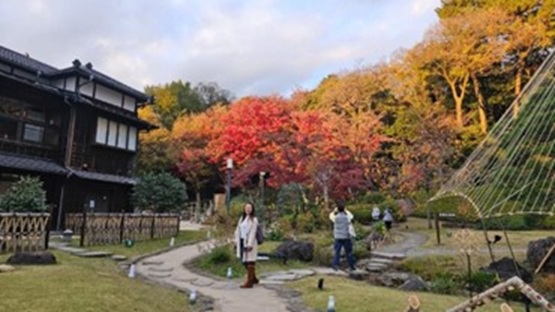
While discovering new things each day, she also enjoys spending her weekends visiting parks and other spots in Tokyo with friends, fully appreciating Japan’s seasonal beauty.
At Waseda University, Angélica-san belongs to the Educational Innovation and Communication Studies (EDICS) program, where she studies alongside students from all over the world. She finds the classes—centered on discussion and critical analysis—highly stimulating.
She also takes Japanese language courses to further refine her skills, engaging with literature, media, and a variety of academic fields.
In addition, she actively makes use of opportunities offered to JICA scholars, such as participating in short-term internships at Japanese companies and attending international conferences.
After completing her master’s program in Japan, Angélica-san plans to return to Colombia and continue teaching Japanese at the university level, applying the knowledge and experience she has gained in Japanese language education and intercultural communication. She hopes to help more Colombians develop not only Japanese language skills but also the ability to communicate in ways that respect cultural differences between Colombia and Japan while remaining true to themselves, so that they can become future “bridges” between the two countries. By continuing to collaborate with institutions such as universities and the Japan Center in Colombia, as well as with initiatives supported by JICA, she aims to promote educational and cultural exchanges that bring Japan and Colombia closer together. In the future, she hopes to pursue a PhD in Japan focusing on pedagogical and didactic issues in Japanese language education, so that she can contribute to improving Japanese language teaching in Colombia and, more broadly, in Latin America.
Angélica-san’s passion for education and her deep intellectual curiosity shine through in the way she approaches her studies in Japan. Her positive attitude toward growing within a different culture, as well as her aspiration to serve as a bridge between Japan and Colombia, is truly inspiring.
Her flexible perspective and rich sensitivity will undoubtedly influence and support the many students and individuals she will work with in the future. We sincerely look forward to seeing how she will continue to apply her experiences in Japan to contribute to the development of cultural exchange and Japanese language education between the two countries.
Sns share!


