
Are Kyrgyz and Japanese People Brothers?
[Goal 17] Partnerships for the Goals
2026.05.12
-

- Daiki Matsumoto, JICA Kyrgyz Republic Office







2026.05.12
When you hear the word “Kyrgyzstan,” what comes to mind?
For many people in Japan, the honest answer is probably “not much.” Whenever I tell friends back home that I work in Kyrgyzstan, there is often a short pause before they ask, “Remind me… where exactly is that?”
Kyrgyzstan became independent from the former Soviet Union in 1991. It has a population of about 7.2 million and a land area roughly half the size of Japan. It is a landlocked country surrounded by Kazakhstan, Uzbekistan, Tajikistan, and China. Towering mountains rising over 3,000 meters and Lake Issyk-Kul—about nine times the size of Japan’s Lake Biwa—define its spectacular natural landscape. Because of this, Kyrgyzstan is sometimes called “the Switzerland of Central Asia.”
Historically, it thrived as a key crossroads of the Silk Road, and even today nomadic traditions remain part of everyday life. The capital, Bishkek, is a city where past and present coexist. Soviet-era stone buildings and heroic statues stand alongside newly built high-rise apartments and amusement parks, reflecting rapid urban development and population growth. It is a city where history and modernization intersect.
Kyrgyzstan is also home to more than 60 ethnic groups. Ethnic Kyrgyz make up about 70 percent of the population, followed by Uzbeks (around 15 percent) and Russians (about 6 percent). Many others—including Dungan, Uyghur, Tatar, Kazakh, Tajik, Koryo-saram (ethnic Koreans), German, and Turkish communities—also live here. In rural areas especially, encounters with diverse cultures reveal the country’s remarkable depth and complexity.
Kyrgyzstan is full of stunning landscapes that look like AI images.Life moves at a slower, gentler pace here.Best time to visit: late May to August. Outdoor lovers—don’t miss it!
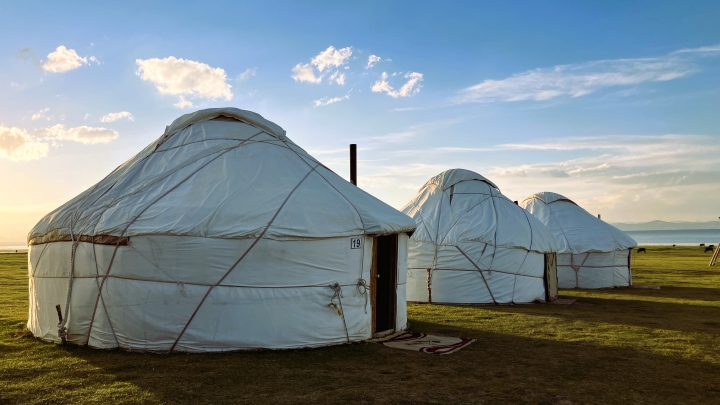
A traditional Kyrgyz nomadic dwelling, the Boz Uy (Боз үй)
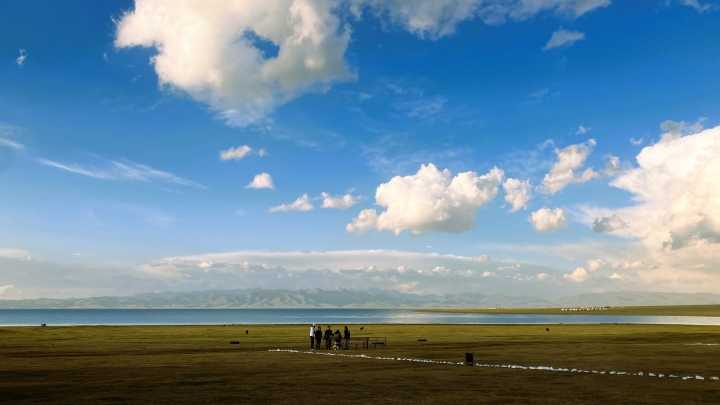
A glowing sunset at Song-Köl Lake
There is a well-known folk tale that goes something like this:
Long ago, two brothers parted ways. The older brother, who loved fish, traveled east and became the ancestor of the Japanese people. The younger brother, who preferred meat, stayed behind and became the ancestor of the Kyrgyz people.
This story—whose historical accuracy is unclear—was even introduced at the Kyrgyz pavilion at the Osaka Expo 2025. Despite its uncertain origins, it is warmly embraced both in Kyrgyzstan and by visitors.
Many Japanese who visit Kyrgyzstan are struck by how familiar the local faces look. I myself have often been mistaken for a local and asked for directions on the street. Beyond physical appearance, Kyrgyz people place great importance on respect for elders and hospitality toward guests, and they deeply value family and community ties. These shared values resonate strongly with Japanese sensibilities.
Perhaps this is the real reason people speak of us as “brothers.” As you walk through the streets, you may feel an unexpected sense of comfort—one that transcends geographical distance
Kyrgyzstan is geographically positioned among major regional players such as Russia, China, and its Central Asian neighbors. This location both defines and complicates its approach to international cooperation.
The economy depends heavily on remittances from migrant workers in Russia*1 , and the country maintains close military ties with Russia*2 as well. At the same time, China has made significant investments in infrastructure, including roads, energy facilities, and factories, leaving Kyrgyzstan with substantial debt obligations. Any international cooperation—JICA’s work included—must take these regional dynamics into careful account.
Cultural factors also play an important role. While urban areas are developing rapidly, local communities in rural regions—shaped by nomadic traditions—can be cautious toward external technologies and institutional reforms. In agriculture, the lack of a long-standing settled farming culture, combined with land fragmentation following the Soviet collapse, has resulted in small, scattered plots. Aging irrigation systems, limited access to machinery, fertilizers, and finance further constrain productivity.
In response, the Kyrgyz government is striving to reduce external dependence and promote sustainable, domestically driven growth. Priority sectors include mineral resources, manufacturing, finance and logistics, renewable energy, agriculture, and tourism. Efforts are also underway to strengthen infrastructure, advance digitalization, and reform education. The JICA Kyrgyz Republic Office works closely with the government through continuous dialogue to align its cooperation with these national policies.
You can follow our activities on Instagram at @jicakyrgyzrepublic.
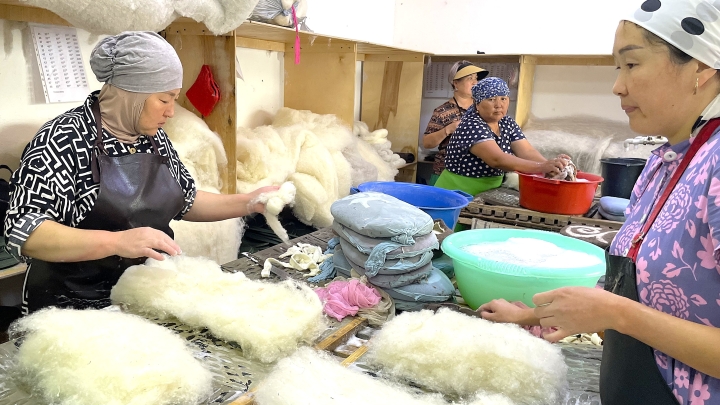
Traditional Slipper Making in Tamchy, Kyrgyzstan
Women making wool slippers as part of the OVOP project.By developing local specialty products, the project supports job creation and vibrant communities. I tried making slippers myself—it was tougher than it looks, but they’re warm and I love using them.

A Hitachi excavator supplied through The Project for the Improvement of Equipment for Irrigation Channel Operation and Maintenance.
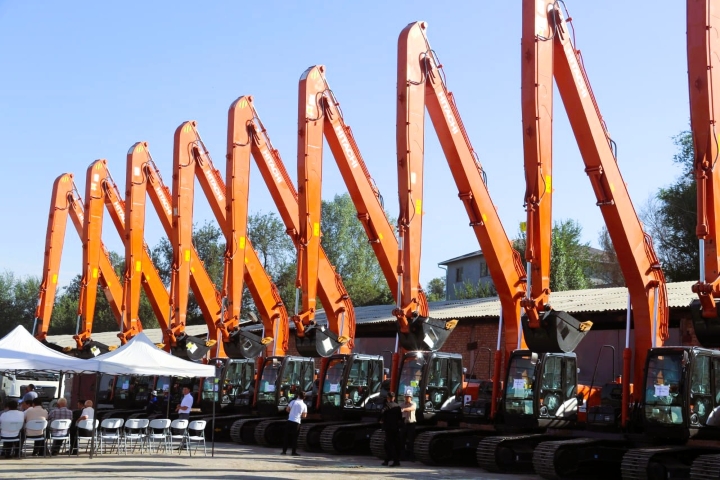
Neatly lined-up excavators
The project trained farmers in hygienic milk production and proper livestock management, while also focusing on trainer development
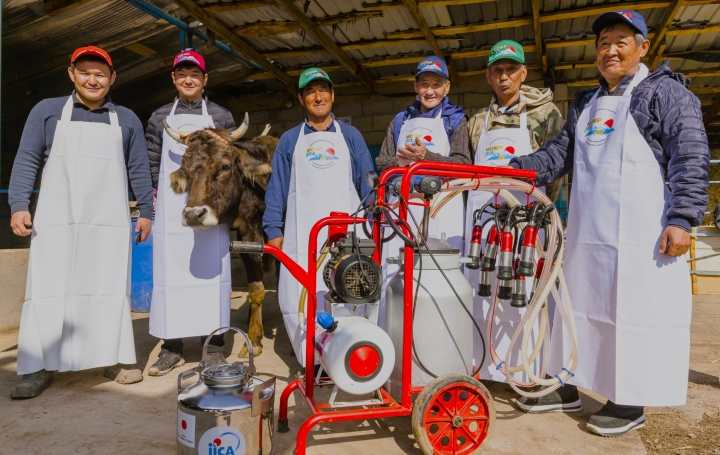
Project for Market Oriented Milk Production in Chuy Province
The “Sakura Bridge,” built under The Project for the Reconstruction of Urmaral River Bridge on Talas-Taraz Road, stands as a symbol of friendship between Kyrgyzstan and Japan.
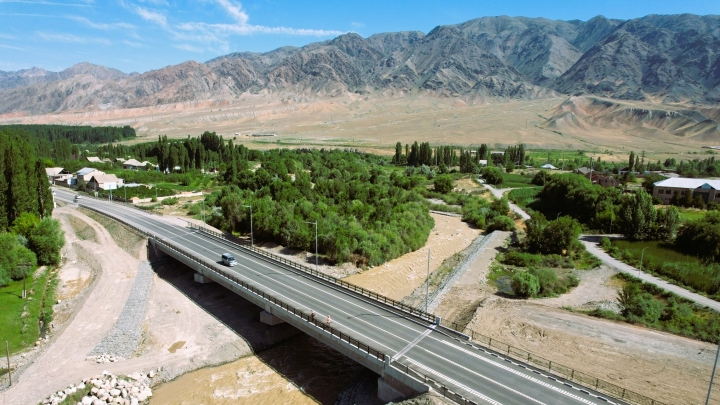
Urmaral Bridge (Sakura Bridge)
Around 40 JICA Overseas Cooperation Volunteers work in diverse fields such as education, healthcare, IT, and sports.
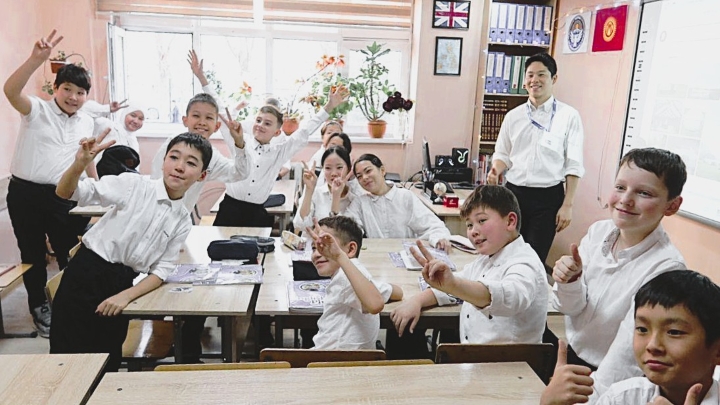
JICA Volunteer Kawai with children
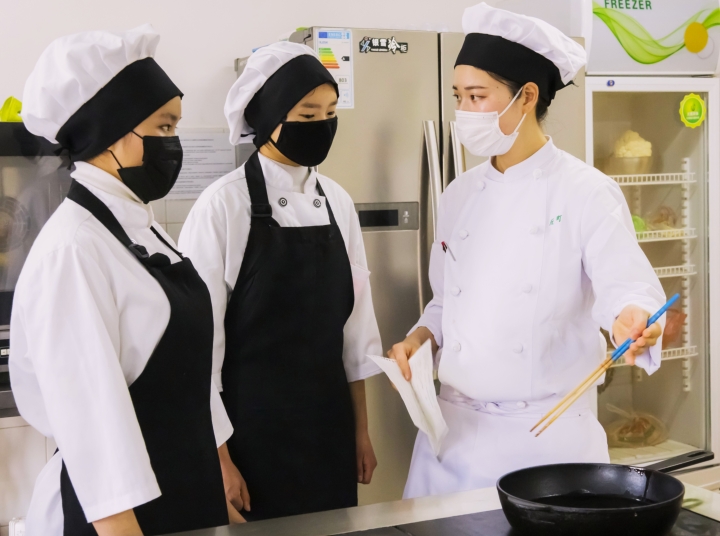
JICA Culinary Volunteer
A Japanese performer playing the traditional Kyrgyz musical instrument, the komuz (top), and a Kyrgyz performer playing Japanese taiko drums (bottom).
Mutual understanding and respect for each other’s cultures form the foundation of international cooperation.
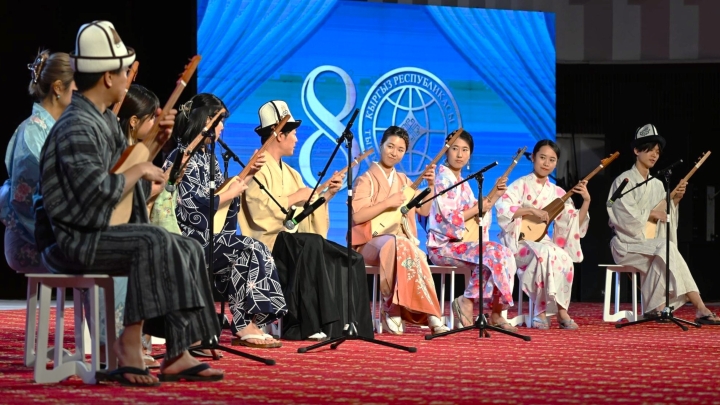
Scenes from the 80th Anniversary Commemoration of Kyrgyzstan’s Diplomacy
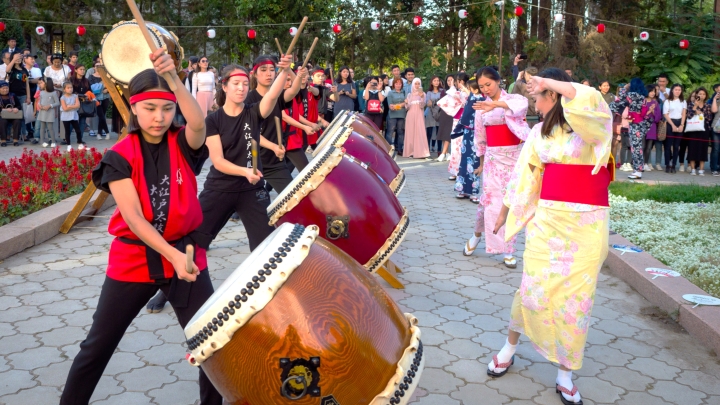
Bon Festival at the Kyrgyz Republic–Japan Center for Human Development (KRJC)
It has been about 2 years since I arrived in Kyrgyzstan. Without exception, every Japanese visitor leaves having become a fan of this country—moved by its vast natural beauty and the warmth of its people.
At just 34 years since independence, Kyrgyzstan is still a young nation. Surrounded by powerful neighbors, it faces many challenges, yet it is steadily working to shape its own future. Witnessing this determination firsthand is an inspiring experience.
JICA hopes to continue walking alongside Kyrgyzstan as a trusted “brother,” helping more people discover this remarkable country. By protecting its rich heritage while supporting its growth, we believe Kyrgyzstan can become an even more beloved place in the world.
If this article has helped the name “Kyrgyzstan” linger in your mind—or sparked even a small sense of curiosity—then it has served its purpose.
Sns share!


