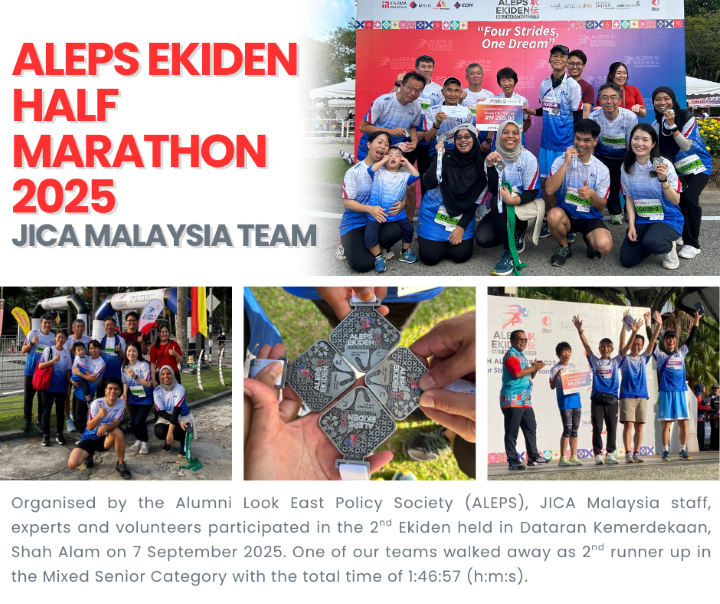
As a beautifully lit mosque emerged against the dark sky in the early morning, the “ALEPS EKIDEN Half Marathon 2025” began on the outskirts of Kuala Lumpur, Malaysia’s capital. Accompanied by the resonant call to prayer, teams of four runners set off to complete a 21 km relay, passing along the traditional Japanese tasuki sash (often used in Japanese relay races to pass from one runner to the next). “An EKIDEN in Malaysia?” one might wonder. Inspired by Japan’s ekiden culture, this event was organized by ALEPS—the Alumni Look East Policy Society—made up of Malaysians who previously studied in Japan, as a celebration of Japan–Malaysia friendship.
Behind this relay lies a long history of cooperation between the two countries. Central to this story is the “Look East Policy,” launched in 1981 by then–Prime Minister Tun Dr Mahathir bin Mohamad. The policy encouraged Malaysians to learn from the work ethic, technology, and values of rapidly developing postwar Japan and South Korea, with the aim of applying these strengths to Malaysia’s own development. Since then, more than 27,000 Malaysian youth have studied or trained in Japan. Many now serve as leaders in government, business, academia, and politics, building bridges between the two nations. During my visits to various institutions, it’s not uncommon to meet someone who fondly recalls, “I studied at Tokushima University 30 years ago,” or “I trained in Kyushu for three months.” These alumni—deeply familiar with Japanese culture, values, and ways of thinking—are invaluable partners for JICA. While both governments jointly promote the Look East Policy, JICA has supported the initiative through training, capacity building, and financial cooperation, and it continues to play an important role in Malaysia’s human resource development.
This collaboration has significantly contributed to Malaysia’s progress. Following independence, the country shifted from an agriculture-based economy to an industrialized one, becoming one of the first middle-income nations in ASEAN. Japan’s ODA played a critical role by establishing critical infrastructure such as power plants, ports, airports, and highways, as well as extensive human resource development through the Look East Policy. These efforts laid the foundation for the country’s current stability and economic diversity.
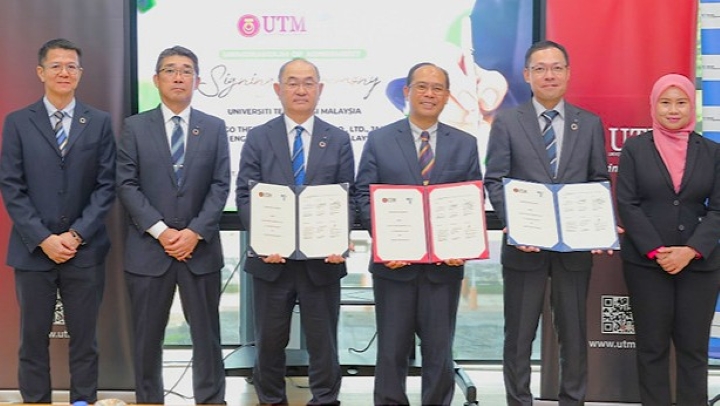
The latest major milestone in these cooperative efforts was the establishment of the Malaysia–Japan International Institute of Technology (MJIIT) in 2011 under Universiti Teknologi Malaysia. The institute incorporates Japanese-style engineering education and promotes advanced research in fields such as robotics and environmental technology. With support from 31 Japanese universities and research institutions, MJIIT conducts joint research and academic exchanges, and even offers joint degree programs with Yamaguchi University and the University of Tsukuba. Collaboration with Japanese companies is also flourishing, with satellite labs and joint industry–academic courses. To date, more than 2,400 students have graduated, equipped with skills aligned to industry needs. Among the alumni are professionals working with Japanese companies on decarbonization initiatives across ASEAN, as well as a leader heading a regional office that supports deep-tech start-ups. MJIIT has now become a true symbol of Japan-Malaysia partnership, and JICA is proud to have supported its curriculum development, equipment provision, and industry collaboration. Going forward, MJIIT is expected to develop as a regional hub for engineering talent, research, and corporate expansion into Southeast Asia.
Alongside government-sponsored scholarships, many self-funded Malaysians have also studied in Japan. These people-to-people ties have become an important foundation for trade, investment, and cultural exchange. Today, more than 1,600 Japanese companies operate in Malaysia, and over 40,000 people are studying Japanese language—the highest number ever recorded. Japanese culture is deeply woven into daily life, from the popularity of anime to the widespread love of Japanese cuisine, such as sushi and ramen noodles.
2026 also marks the 60th anniversary of JICA Volunteer Program, Japan Overseas Cooperation Volunteers (JOCV), in Malaysia. Since the first dispatch in January 1966, more than 1,660 volunteers have contributed to various fields such as social welfare, environment conservation and education, technical and vocational education (TVET) and sports. The largest group by far has been Japanese-language teachers—160 in total—who laid the foundation for Japanese-language education in Malaysia’s full boarding schools beginning in 1984. Mr Hafiz Othman, Senior Program Manager of the JICA Malaysia Office, is one of many who once learned Japanese from a JOCV Japanese language teacher. Recently, when his former teacher visited Malaysia to see him, Mr Hafiz brought along his old and heavily annotated Japanese textbook, which actually handcrafted decades ago by a group of JOCVs striving to build Japanese-language education in Malaysian schools.
In 2026, it will be 70 years since Japan began ODA cooperation with Malaysia. Today, as Malaysia continues to grow as a key ASEAN nation and aims for high-income status, it is beginning to share its own development experiences with other developing countries. Through joint programs between Malaysia Technical Cooperation Program under the Ministry of Foreign Affairs Malaysia and JICA, Malaysia now provides training in maritime security, Muslim Friendly Tourism, vocational education, trade and investment promotion and more. Built on the strong interpersonal relationships forged over decades, Japan and Malaysia now work together as equal partners to address global challenges.
“ALEPS EKIDEN Half Marathon 2025” brought together about 1,200 participants, including three mixed teams from JICA composed of JICA volunteers, JICA experts, and JICA staff. One of the teams earned the third place in the mixed senior category. Under the banner of our shared vision—“Leading the world with trust”—we hope to keep passing the tasuki from Japan to Malaysia, from Malaysia to Japan and beyond, from today into the future, without ever letting it fall from our grasp.