
The Women I Met in Jordan and the Questions That Stayed with Me
[Goal 5] Gender Equality
[Goal 10] Reduced Inequalities
2026.07.03
-

- ISAWA Hitomi, Jordan Office





2026.07.03
Before joining JICA, I worked in Japan supporting children with disabilities through education that focused on developing their learning abilities and social skills. I was not deeply aware of the concept of “social participation.” My focus was entirely on the children in front of me—doing everything I could to help them gradually build skills so that they could look forward to a brighter and more fulfilling future.
It was my experience in Jordan that led me to think more deeply about the “environment” and “social conditions” underlying the idea of social participation.
This realization began when I worked as a Japan Overseas Cooperation Volunteer (JOCV) at a facility for children with disabilities in a refugee camp in Jordan. The facility operated with limited funding, and many of my colleagues—primarily young women—supported children’s learning as volunteers. Having just graduated from school, they did not necessarily have sufficient professional knowledge or experience, yet each of them engaged with the children through constant trial and error.
Through these everyday interactions, I also came to learn more about their lives. It was difficult for them to go out alone; it was considered natural to be accompanied by their fathers or brothers. After graduating from school, it was common for these young women to work briefly, then marry and dedicate themselves to family life—this life course was spoken of as an entirely ordinary choice.
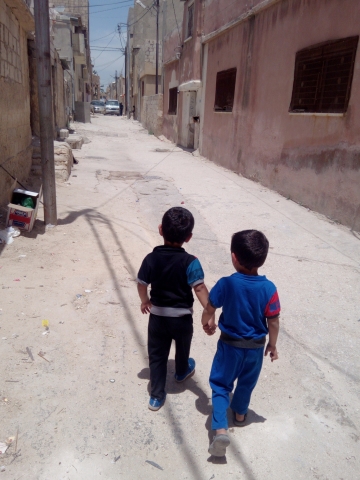
The refugee camp where the author worked
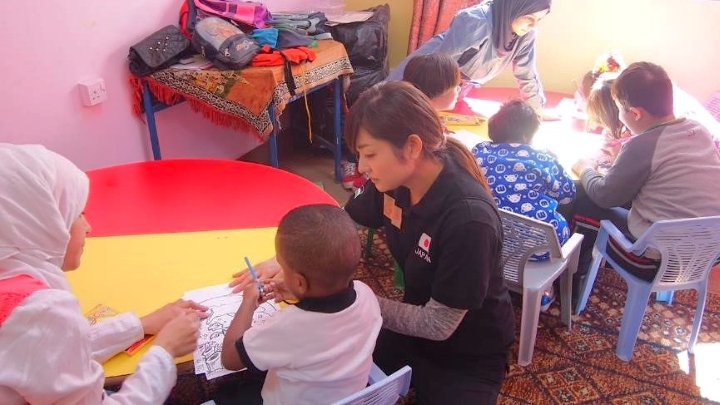
The author teaching children together with colleagues
At one point, we planned a domestic trip exclusively for female staff members. However, differences in values between one colleague and her family surfaced through this plan. As a result, she found it difficult to continue working and eventually resigned. While I was continually puzzled by these situations, my colleagues, in turn, described me—living alone far from my family—as “pitiful.” It was a moment that made me realize that what I had considered “normal” could appear entirely different in another cultural context.
Looking back on my experiences in Jordan, I feel they cannot be described through a single, unified narrative. In the capital, where I now work, many of my colleagues do not wear the hijab (an Islamic headscarf), and it is not uncommon to see women traveling abroad alone for business.
At the same time, when organizing training programs in Japan for Jordanian government officials and experts, there are cases where women require permission from their families in order to participate. There is also a widely shared assumption that childcare is primarily a woman’s responsibility.
These contrasting realities—signs of progress alongside complexities that cannot be simplified—coexist at the same time, something I have come to recognize through my daily work.
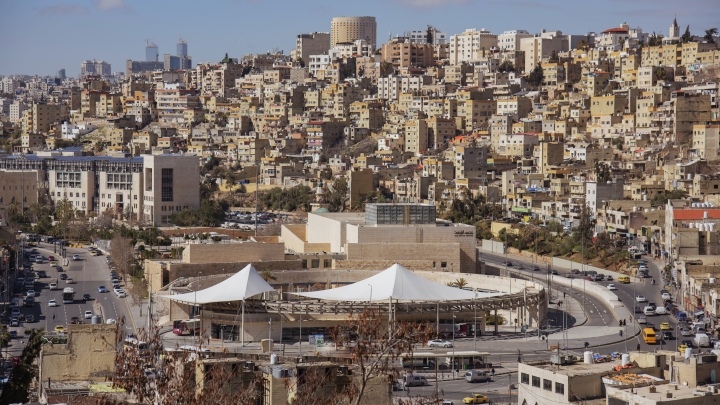
The cityscape of Amman, Jordan’s capital and largest city
In my work with children with disabilities, I encountered many moments that made me reflect on this notion. For example, I encountered a girl with mild intellectual disabilities who had no access to education until the age of nine and only began attending a support facility at that age. I also met a girl who used a wheelchair but had to climb up the stairs in order to leave her home. Witnessing these realities made me deeply aware that “social participation”—including learning and going out into society—cannot be achieved through individual effort alone.
Reflecting further on the lives of the women I had met, I also came to understand that social participation is shaped by less visible factors, such as whether one can truly choose one’s own actions. These choices, too, are influenced by various social constraints.
Every society has its own underlying assumptions. What is considered “natural” or “normal” varies depending on one’s upbringing and values. In contexts where being a woman and having a disability intersect, I continue to ask myself: how is it possible for individuals to truly “choose” and “decide” for themselves? This question remains with me to this day.
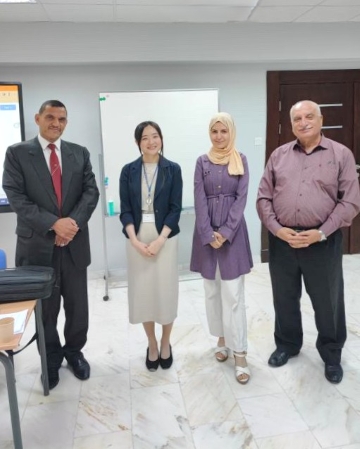
At a public seminar held after the ex-participant returned from JICA training program in Japan
Currently, while working at the JICA Jordan Office in areas such as administration, procurement, and public relations, I am also pursuing my own academic research on the social participation of women with disabilities at the graduate level. Focusing on multiple regions within Jordan, I conduct interviews with women with disabilities and their families, carefully listening to the experiences they share about their daily lives.
I examine how factors such as access to education, family relationships, religious perspectives, and connections to local communities intersect and influence the range of choices available to individuals. My daily work involves the steady, behind-the-scenes efforts that support the field of international cooperation. At the same time, the experiences I had in the past continue to serve as the starting point of my thinking.
Remaining engaged in the field of international cooperation while continuing to question and reflect—within this ongoing exchange, I feel I am finding my own way of contributing .
Sns share!


