
Learning, Enterprise, and the Path to Peace in BARMM — Two Stories from JICA’s Human Resource Development Initiatives —
[Goal 16] Peace, Justice and Strong Institutions
2026.04.24





2026.04.24
In the Bangsamoro Autonomous Region in Muslim Mindanao (BARMM)—a region in the southern Philippines long affected by conflict—human resource development has become key drivers of social stability and sustainable development.
Through its technical cooperation, JICA has continuously supported the capacity development of personnel in both the public and private sectors in the region.
In this article, we speak with Yed and Ronnie, both of whom participated in JICA-supported training at different times and in different roles. They share their personal journeys, their experiences in Japan, their current activities, and their hopes for the future.
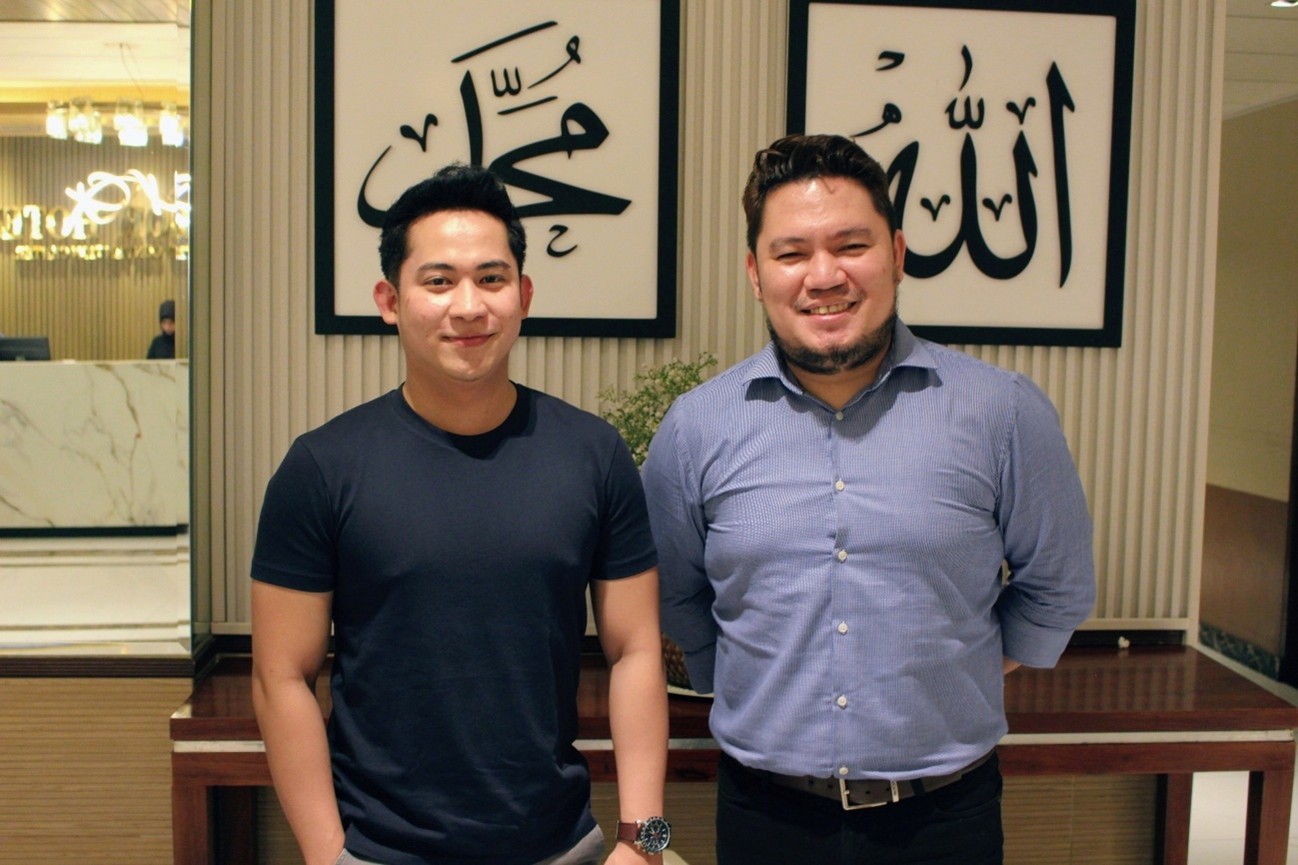
Yed (left) and Ronnie (right), who shared their experiences through JICA-supported training programs
Yed
I am originally from Pikit Municipality in North Cotabato Province. During my childhood, the area was heavily affected by what was known as the ‘All-out War.’ When I was seven years old, my family evacuated to Cotabato City. In Pikit at that time, even children were expected to learn how to handle firearms to protect themselves. In that situation, my father made a deliberate choice—not guns, but education. Looking back, I strongly believe that this decision fundamentally changed the direction of my life.
Ronnie
I was born and raised in Cotabato City. The school building where I studied as a child had been constructed with assistance from Japan. I did not think much about it at the time, but in retrospect, Japan’s support was already a natural part of my educational environment.
Yed
In 2023, I participated in a Training of Trainers (ToT) program on industrial promotion and entrepreneurship support under the technical cooperation project Capacity Development Project for Bangsamoro (CDPB). In 2024, I joined a training program in Japan and spent about one month at the JICA Kansai Center in Osaka. Having grown up as an internally displaced person amid conflict, I never imagined that decades later I would represent my region in a training program in Japan. During my stay, I visited a range of government institutions, companies, facilities, and factories, and learned about their approaches to management and operations.
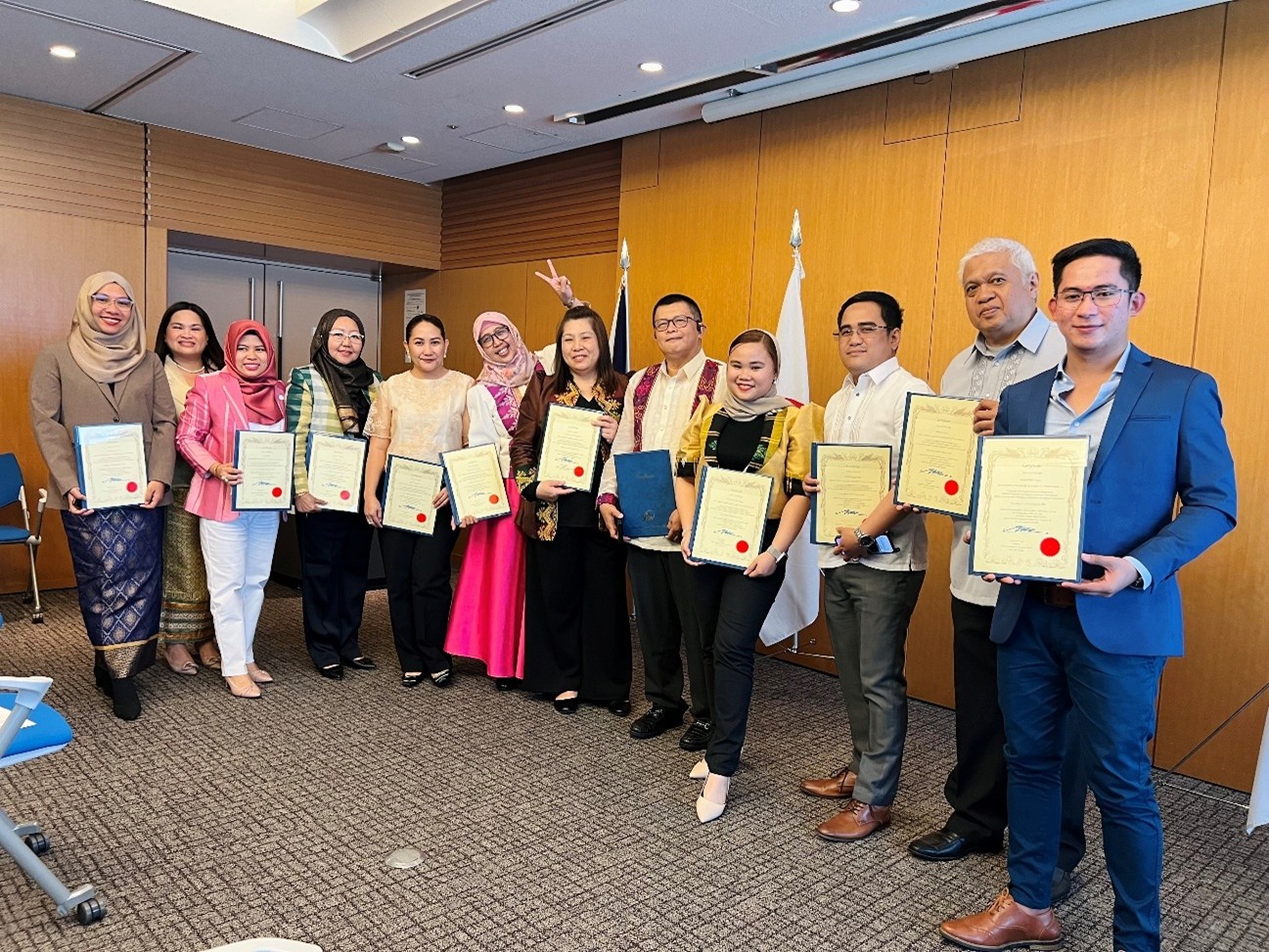
Yed (right), who completed training at the JICA Kansai Center, and administrative officers and entrepreneurs from BARMM who participated in the program.
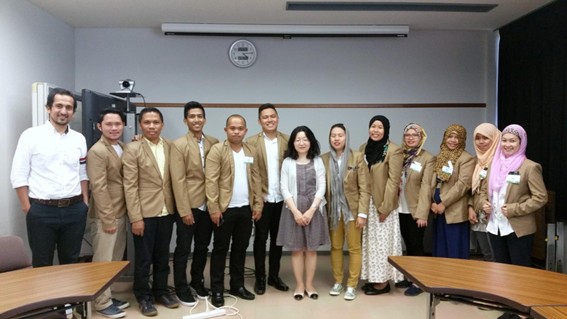
Ronnie (center), who received training at Hiroshima University.
Ronnie
In 2016, I visited Japan as a trainee under the Grassroots Technical Cooperation Project, Strengthening Human Resource Development of the Bangsamoro Autonomous Government in Mindanao, implemented by Hiroshima Prefecture and Hiroshima University. Having studied in a school supported by JICA and then being able to come to Japan for training was truly a ‘dream come true.’ In Japan, I gained practical knowledge in public administration, budget planning, organizational systematization, and time management.
Yed
The concepts I learned in Japan regarding organizational management and operations are things I actively apply in my own business. After the training, I began providing pro bono bread-making vocational training to the families—particularly wives and daughters—of former combatants (including those associated with MILF, MNLF, and Abu Sayyaf) in Basilan Province. This area is supported under a Japan-funded grant aid project implemented in partnership with UNDP, focusing on the management and reduction of small arms and light weapons in BARMM. In addition, on a personal basis, I provide interest-free financial support to MSMEs and entrepreneurs within BARMM. Repayments are used to support others, creating a cycle of assistance.
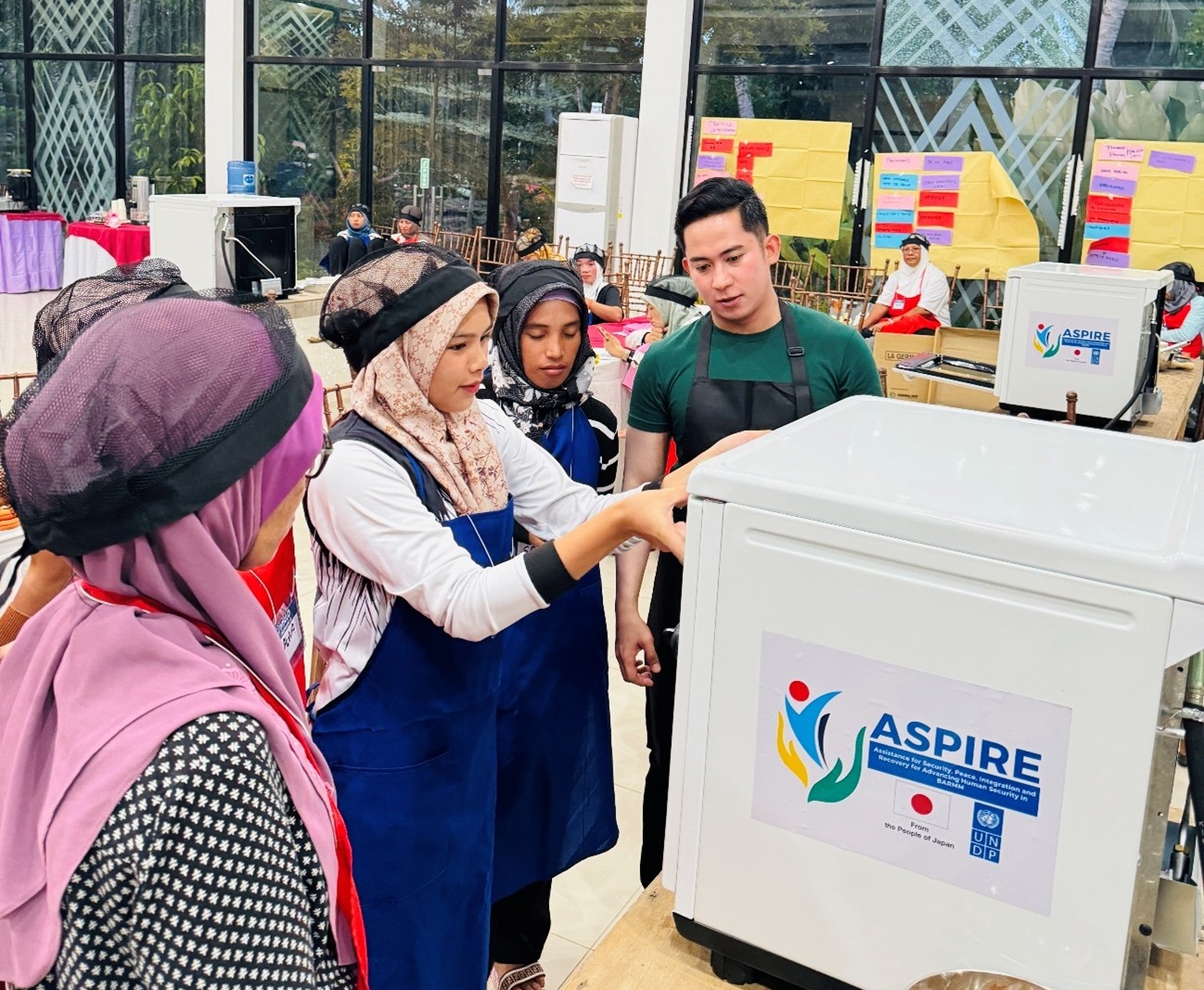
Yed (right), providing skills training to the families of former combatants under the ASPIRE project supported by the Government of Japan.
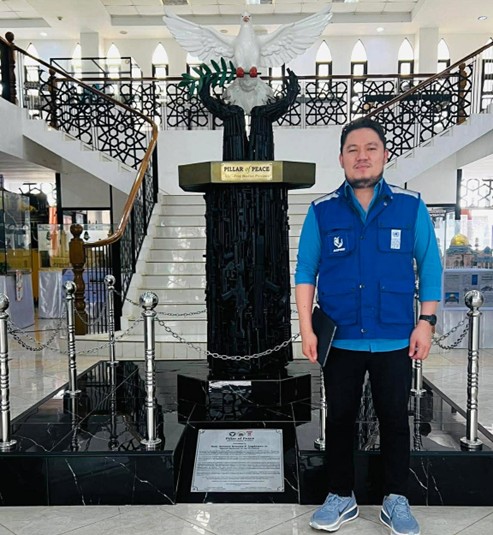
The “Pillar of Peace,” created from weapons collected through the ASPIRE project.
Ronnie
I work as a UN staff member supporting the Mindanao peace process, and in my current role working on the ASPIRE project, I apply the perspectives and knowledge gained through the training in my daily work. In particular, the mindset of ‘how to make things feasible’ has become a crucial guiding principle in my work. In conflict-affected areas, limited human capacity and knowledge can lead to dependence on weapons, social instability, and delays in development; this is precisely why human resource development is so important.
Yed
I believe that JICA’s support has contributed to tangible development in the region, allowing people to feel a ‘peace dividend.’ Through my activities, I have witnessed a growing change in mindset—more people are now saying that weapons do not improve lives; education and training do. Looking ahead, I hope BARMM will become a region like Japan, where people cherish their own culture and history, where social systems funcition effectively on that foundation, and where integrity is highly valued. I also dream of a future where peace has progressed to the point that tourists can safely and confidently visit the region.
Ronnie
I see JICA’s support not as an imposition of Japan’s way, but as an approach that fully respects and understands the BARMM context. Donor assistance will eventually come to an end. To prepare for that moment—and to reach it—we must build sustainable institutions and systems that function effectively, so that society can be supported by our own efforts. In the future, I hope BARMM will be able to give back to Japan for the support it has received.
Yed
For me, peace means being able to live without fear.
Ronnie
For me, peace is like a moment—sitting with a cup of coffee, feeling content and at ease. I believe peace starts from within ourselves.
Human resource development does not yield visible results overnight. Yet, as people who have gained knowledge and skills give back to their communities—and as that change is passed on to the next generation—a foundation for sustainable peace is gradually built. JICA will continue to support the people of BARMM as they forge their own future through human resource development.
Sns share!


