
JICA pledges greater support for Africa’s resilient food systems
2026.09.02





JICA Vice President Inoue Seisuke (second left) participates in a panel discussion on lessons learnt from the implementation of the Africa Emergency Food Production Facility at the Africa Food Systems Forum in Kigali on Wednesday, September 2, 2026. Courtesy photo.
The Japan International Cooperation Agency (JICA) has reaffirmed its commitment to supporting Rwanda and other African countries in building more resilient food systems amid growing climate and global economic shocks.
JICA Vice President Inoue Seisuke said the agency would continue working with Rwanda to strengthen agriculture, particularly through irrigation, market-oriented farming, agricultural extension services, nutrition and value-chain development.
Inoue made the commitment on Wednesday, September 2, while speaking at the Africa Food Systems Forum (AFSF) 2026 in Kigali, where he participated in a panel discussion on lessons learnt from the implementation of the Africa Emergency Food Production Facility.
He said building resilient food systems requires more than responding to immediate crises, noting that countries need sustained investment to prepare farmers for climate change and other shocks.
“To make the food system more resilient, we need a very long-term investment,” Inoue said.
He added JICA has been supporting African countries to ensure agriculture that is resilient to climate change and other external shocks.
“Agriculture in Africa has to prepare for such shocks and uncertainty. That is the main point why resilience is needed,” he said, expressing JICA’s commitment to support sustainable food systems on the continent
Four pillars supported
JICA’s support for food security in Africa, Inoue said, is built around four key areas, including the Coalition for African Rice Development (CARD), the Smallholder Horticulture Empowerment and Promotion (SHEP) approach, small-scale community-based irrigation and nutrition.
ALSO READ:
Farmers pledge to sustain gains under JICA’s SMAP project
Through CARD, JICA works with African countries and development partners to strengthen rice production and related systems, including irrigation, water management, post-harvest practices, human resources and private-sector participation.
The SHEP approach, meanwhile, encourages farmers to make production decisions based on market demand, shifting from simply “growing and selling” to “growing to sell”.
“SHEP motivates farmers to do market-oriented agriculture and tries to increase their incomes,” he said.
On nutrition, he said JICA takes a multi-sectoral approach that brings together agriculture, health, education and community development such as The Initiative for Food and Nutrition Security in Africa (IFNA).
The agency also places emphasis on small-scale irrigation as a way of improving farmers’ ability to produce despite changing weather conditions.
JICA’s support to Rwanda
In Rwanda, JICA has been supporting agricultural development through several interventions, including sustainable irrigation management and agricultural value-chain development.
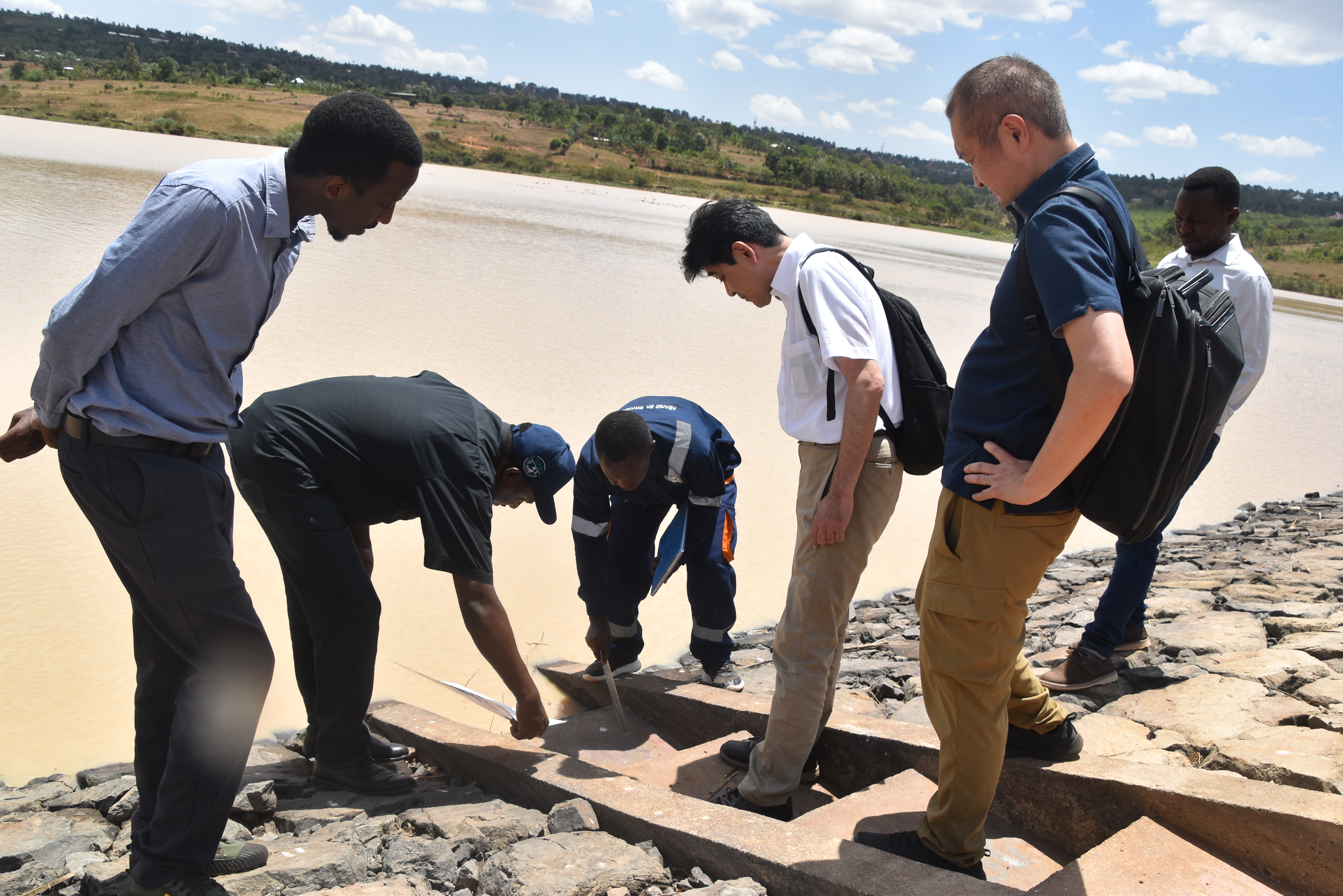
Through the Water Management and Capacity Building Project (WAMCAB2), JICA works with The Ministry of Agriculture and Animal Resources through Rwanda Agriculture and Animal Resources Development Board (RAB), and Districts at the implementation target sites and Irrigation Water Users’ Organisations (IWUOs) to strengthen their ability to operate and maintain irrigation infrastructure.
“The project also promotes improved water management and market-oriented agriculture, with the broader objective of supporting farmers’ livelihoods and making irrigation systems more sustainable,” he said.
JICA Vice President Inoue Seisuke (fourth from left) feeds fish in a pond belonging to irrigation water users together with them, on September 1, 2026. Courtesy photo
JICA is also supporting Rwanda’s coffee sector through the Coffee Upgrading Project (CUP2), which focuses on improving coffee quality, marketing and coordination among actors across the value chain.
ALSO READ:
A 12-year journey in coffee sector with JICA: Rwandan farmers share experience
The objective is to strengthen the value added and competitiveness of Rwanda’s coffee industry.
Inoue said JICA’s work in Rwanda is backed by a strong commitment from its staff working in the country.
“The staff of JICA, including those who work in Rwanda, have very strong motivation to help the development of Rwanda,” he said. “I hope we can help [further] the development of Rwanda in the future,” he added.
Sns share!


