






scroll


Sector Overview
Despite improvements in access to medical care, the young pregnancy rate and HIV prevalence are high, and non-communicable diseases (NCDs) are expanding. Challenges include improving the quality of maternal and child health and universal health coverage (UHC), eliminating gender inequality, and developing medical infrastructure and pushing institutional reforms.
The maternal mortality rate (238 of 100,000 live births, target 180) and the infant mortality rate (33 of 1,000 live births; target 30) have continued to improve, but the government targets have not been reached. In addition, the neonatal mortality rate remains unchanged, and it is necessary to provide high-quality maternal and child health services and secure high-quality medical personnel and equipment.
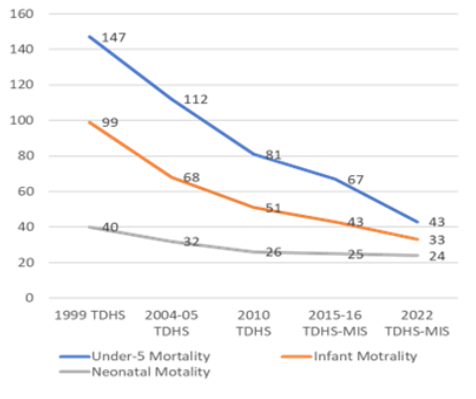
Infant and Neonatal Mortality Rate
(Source: The DHS Program -Tanzania: DHS, 2022 -Final Report (English))
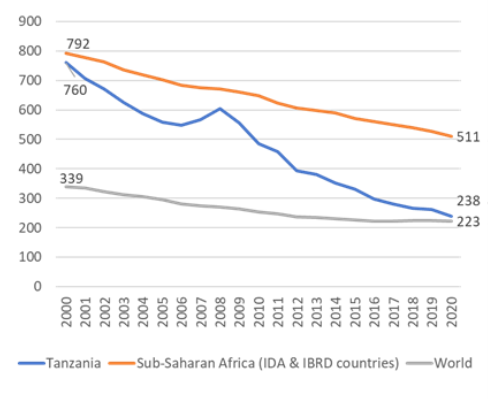
Maternal Mortlity Rate
(Source: The DHS Program -Tanzania: DHS, 2022 -Final Report (English))
UHC is one of the priorities of Tanzania's Health Sector Strategic Plan (2021-2026). However, the insurance coverage rate among the population was 15.3% in 2022, far from the government's target of 58% (2025/26). Further institutional reforms and the strengthening of infrastructure are required so that the entire population can receive high-quality health services. In Tanzania, life expectancy has steadily improved from 42.9 years in 1960 to 66.2 years in 2021. However, while the proportion of HIV/AIDS as the leading cause of death has shown a decreasing trend, approximately half of all deaths are caused by non-communicable diseases (NCDs).