






scroll


Aragaki Ken
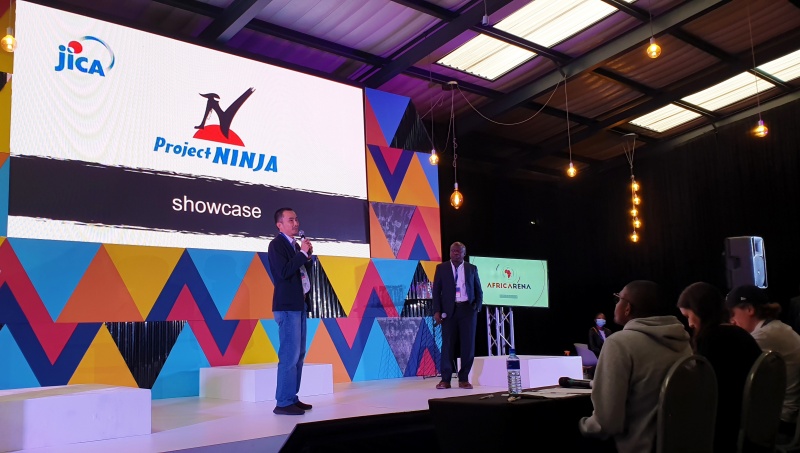
(Fuwa Naonobu, pictured left on the stage, a JICA expert on start-up ecosystem enhancement, speaks about Project NINJA at the AfricArena Grand Summit in Cape Town in 2021/ Photo: Fuwa Naonobu)
Series : Africa in Focus
To mark the 9th Tokyo International Conference on African Development (TICAD9), JICA is publishing a series of stories that explore Africa’s challenges and promise. While showcasing JICA’s contributions, the series also brings attention to the broader efforts, ideas and potential across the continent. This latest instalment focuses on how Africa and Japan are joining forces to shape a shared future through entrepreneurship.
Born and raised on a small farm in Simba, a village on the outskirts of Nairobi, Samuel Munguti’s childhood dream was to join the Kenyan government and help small farmers like his parents.
In 2016, at the age of 36, part of his dream came true—but in a way he hadn't expected.
After completing his master’s degree in marketing and working for various multinational corporations, such as Coca-Cola and L'Oréal, for almost a decade, Munguti chose to return to his home village to buy a farm and cultivate watermelons and tomatoes.
Nevertheless, Munguti encountered several problems, such as counterfeit seeds and agrochemicals sold by “agrovets”, the local dealers of agricultural products in Kenya. His farming venture failed, and he ended up giving up his farm in less than a year.
Realising the agricultural supply chains in the country were broken, Munguti and his wife, Nancy Mutuku, co-founded Shamba Pride. This agritech start-up aims to connect small farmers with reliable dealers and products.
“I saw an opportunity and thought, ‘I can actually fix a lot of things and build a business,’” Munguti said.
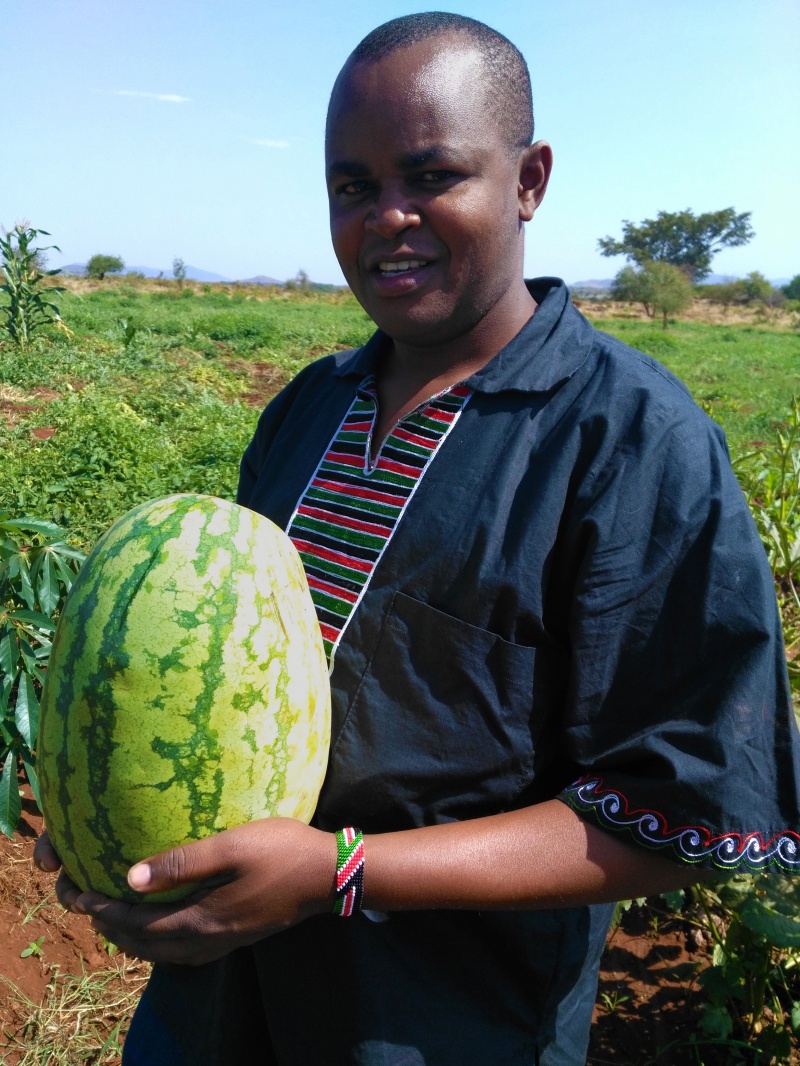
(Samuel Munguti holds a watermelon at his farm in Simba, Kenya in 2016/ Photo: Samuel Munguti)
Shamba Pride's mobile app has now connected tens of thousands of small Kenyan farmers with verified agrovets, bringing greater transparency to product pricing and quality since its inception in 2016.
However, after five years, Munguti concluded that the start-up required improved efficiency and organization. That is when he came across Project NINJA (Next Innovation with Japan) by the Japan International Cooperation Agency. Unlike traditional aid programmes, Project NINJA focused on tailored support designed around the needs of entrepreneurs. For Munguti, it was not just about learning skills—it was about refining his business model, expanding his vision, and unlocking funding opportunities with a clear path to scale.

(Munguti, CEO and founder of Shamba Pride, second from the left in the navy blue suit, attends NINJA Accelerator in Kenya in 2021/Photo: Samuel Munguti)
Project NINJA was launched in January 2020 to support entrepreneurs like Munguti and foster business innovation in emerging countries. The initiative aims to build and strengthen a start-up ecosystem where innovative businesses can be continuously and independently created and developed.
As Fuwa Naonobu, a JICA expert in strengthening start-up ecosystems and a founding member of Project NINJA, explains, the programme is built on three key pillars: creating supportive legal and policy frameworks for start-ups; encouraging structured partnerships between local start-ups, Japanese companies and investors; and running incubator and accelerator programmes that help turn technology into viable, scalable businesses.
What sets NINJA apart is its holistic approach—from shaping the policy environment to providing hands-on support for business growth. Its local-first philosophy puts African founders in the driver’s seat, empowering them to shape their own paths to impact.
As of fiscal 2023, Project NINJA has supported 824 start-ups in developing countries worldwide – ranging from a healthcare start-up in Indonesia and a fintech company in Laos to a women-owned coffee business in Uganda and an agritech start-up in Nigeria. Of the total, over 760 are concentrated in Africa.
With start-up founder experience in Japan and fieldwork in Uganda and Ethiopia, Fuwa and his colleagues at JICA launched Project NINJA with a clear guiding idea: Africa’s population of around 1.4 billion is the youngest in the world. That demographic advantage, combined with a generation raised in the digital age, makes the continent well placed to adopt and develop new services rapidly. Now based in Nigeria, Fuwa observes that this translates into real and scalable demand for solutions driven by start-up.
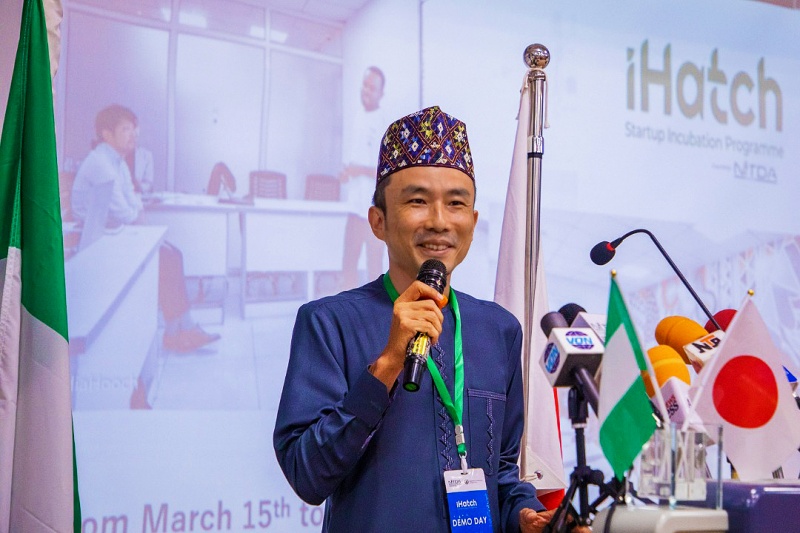
(Fuwa speaks at Demo Day in Abuja, where the five Nigerian finalists pitch to an audience of angel investors, venture capital firms, and other funding agencies and institutions in 2022/ Photo: Fuwa)
Having been chosen for the second cohort, or round, of the NINJA Accelerator in Kenya, Munguti took part in a 12-week intensive training programme in 2021. He found the programme, which selected a total of five Kenyan start-ups, to be both educational and helpful for his business.
In particular, Munguti said the workshops on practical business skills, including how to manage one’s finances and write a pitch to potential investors, helped him improve and expand his company further.
“After that (NINJA programme), we got significant growth in (the number of) farmers, agro-dealers and also in revenue,” he said. Since Munguti participated in the program, his company has seen 20% annual growth in the number of registered users for their app.
Shamba Pride now employs 58 staff members and has registered more than 66,000 farmers and 4,500 agrovets from all over the country.
Munguti also raised $3.7 million in pre-series A funding in 2024 and plans to expand its business into other neighboring counties, including Tanzania, Uganda, and Zambia.
But Project NINJA has not only been providing African entrepreneurs with practical business skills, it has also been fostering an entrepreneurial and leadership mindset through its programmes.
One such participant is Blen Hailu, 35, CEO and co-founder of Kabba Transport, a tech start-up in Ethiopia. During the 2024 NINJA Acceleration Programme, she learned the importance of building support systems and planning for long-term growth.
“It was a transformative experience that not only elevated our business but also strengthened our leadership as founders,” Hailu said.

(Blen Hailu, pictured on the right, and her brother Leul, co-founder of Kabba Transport, pose for a photo together in 2021/ Photo: Blen Hailu)
After a decade working at the Commercial Bank of Ethiopia, Hailu left to co-found Kabba Transport in 2021 with her younger brother, Leul Hailu, and his friend, Nahom Mekonen, now both 27 years old.
The company aims to improve local transportation in Addis Ababa by safe and reliable rides for passengers, including school children and corporate employees, through its app, using a fleet of vans and minibuses.
To grow and scale the business, Hailu joined the three-month NINJA acceleration programme, which combined in-person and online training, personalised mentorship, pitch preparation, and peer learning with fellow Ethiopian entrepreneurs.
After completing the programme, she immediately set an ambitious goal of increasing the number of app users from 1,000 to 30,000 by 2030. To reach that target, she and her team have been actively pitching to potential investors and are close to securing some funding.
Hailu also highlighted the value of connecting other participants during the programme. The NINJA programme included six business owners: three women and three men. Even after the programme ended, she continues to meet with other female participants regularly to share challenges and exchange business ideas.
She highlighted the importance of building strong support systems for business leaders, particularly women entrepreneurs.
According to the 2024 African Tech Startups Funding Report published by Disrupt Africa, 18.5% of funded African tech start-ups in 2024 had at least one female co-founder, while just 12.5% were led by female CEOs. These figures highlight there is a long way to go in closing the gender gap in the continent’s start-up ecosystem.
Beyond funding or workshops, Fuwa believes the real strength of the programme lies in entrepreneurs supporting one another. Participants share hard-earned lessons, and their peers pass them on in turn. “I look for the ripple,” he says. “One small win, shared widely, can build momentum across the entire ecosystem.”
With TICAD9, Project NINJA is showing that real change happens when governments and local entrepreneurs work together—driving not only economic growth, but meaningful, lasting impact in people’s lives.