





scroll


Nithin Coca
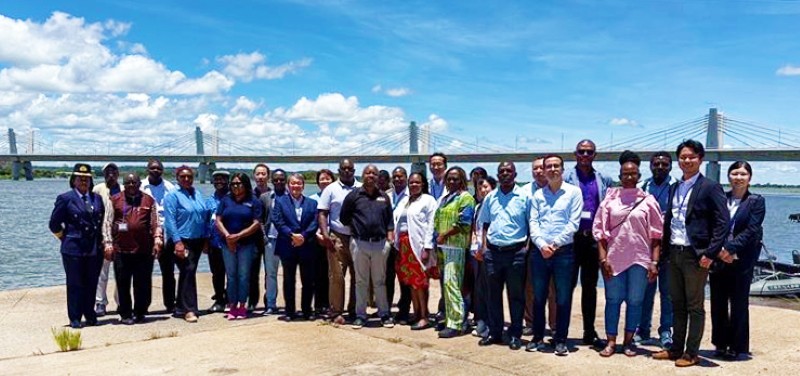
(Participants from JICA, African Union Development Agency (AUDA-NEPAD) and African Continental Free Trade Area (AfCFTA) Secretariat in front of the Kazungula Bridge near the Kazungula One Stop Border Post between Zambia and Botswana/ Photo: AUDA-NEPAD)
Series : Africa in Focus
In the lead-up to the 9th Tokyo International Conference on African Development (TICAD9) in August 2025, JICA is sharing a series of stories that explore Africa’s challenges and promise. While showcasing JICA’s contributions, this instalment brings attention to the broader efforts, ideas and potential across the continent. This story focuses on trade and economic development.
Japan’s role as a development partner stretches back more than six decades, beginning when Japan joined the Colombo Plan in 1954. Back then the focus was on nearby nations in Asia. Today, JICA, which grew out of Japan’s initiative with the Colombo Plan, has grown into one of the world’s most innovative and effective development organisations, with projects spanning the globe. Over the past 11 years , it has forged a unique partnership with the African Union Development Agency (AUDA-NEPAD).
"There is a growing demand within AUDA-NEPAD to understand the development trajectory of Southeast Asia and Japan's role in it. We believe this knowledge and experience can serve as a valuable reference for our partners in Africa." explained Homma Toru, a senior advisor at JICA.
The comparison is compelling, though Africa presents challenges on a much larger scale. ASEAN, the Southeast Asia regional bloc, has 11 member countries. The African Union, by contrast, brings together 55 countries across a continent three times the size of Europe, with widely different cultures, levels of infrastructure, and economic development.
One of Africa’s biggest challenges is limited regional trade and integration. Poor connectivity and costly logistics often stifle investment and slow the growth development of African businesses. For JICA, this was exactly where its expertise could make a difference.
“Because Africa is huge, a corridor approach is very important,” said Homma. “That means linking together countries, especially landlocked ones, through infrastructure development to ports or big markets.”
This thinking laid the groundwork for a model of cooperation designed not only to benefit Africa, but also to create trade and investment opportunities for Japanese companies in the future.
“Nothing is for the benefit of Africa alone, it always benefits both parties,” said Amine Idriss Adoum, Director of economy, infrastructure, industrialisation, trade and regional integration at AUDA-NEPAD. “As Japanese companies establish themselves more in Africa, there is a good chance that Japanese exports to Africa will grow too.”
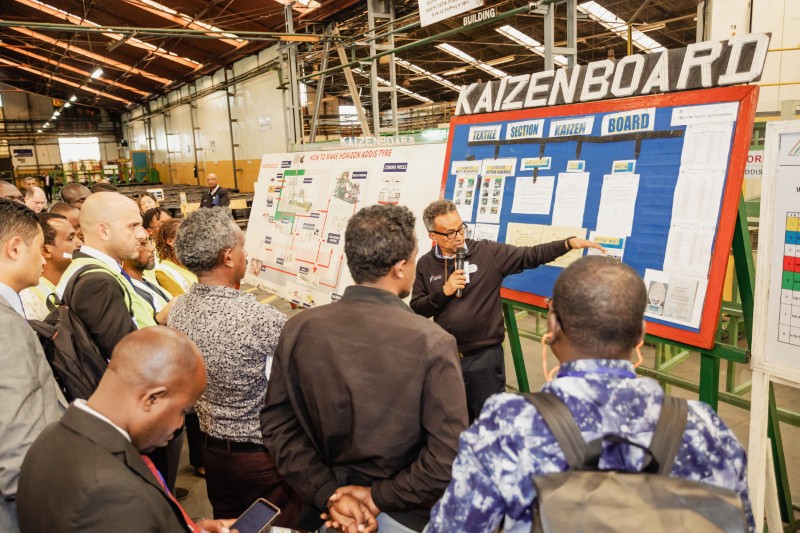
(A Kaizen demonstration in Ethiopia. The Africa Kaizen Initiative helps African enterprises make continuous improvements in quality and productivity/ Photo: JICA)
JICA and AUDA-NEPAD’s Collaboration
In 2014, JICA and AUDA-NEPAD launched a groundbreaking partnership, one unlike anything JICA has attempted before. Traditionally, the agency has worked bilaterally with individual countries. But this partnership also was an opportunity to expand on JICA’s goals of widening the scope of support with multilateral partnerships among developing countries and through a continent-wide approach aimed at building a lasting, equal partnership.
“We are fully embedded in the AUDA-NEPAD headquarters, the only organization that provides five stationed advisors,” said Homma.
At the same time, the African Union, AUDA-NEPAD’s parent organization, had adopted Agenda 2063 in 2015, a sweeping blueprint for Africa’s future covering infrastructure, trade, agriculture and more. For Adoum, JICA’s commitment stood out.
“They're very consistent and very predictable,” said Adoum about JICA. “We work very closely together and our cooperation is around some of the most strategic areas of development for Africa,
Five pillars now define collaboration: regional integration, the Africa Kaizen Initiative, the Initiative for Food and Nutrition Security in Africa, the Home Grown Solutions Accelerator programme, and the Policy Bridge Tank. Within these areas are projects like the One-Stop Border Post, which simplifies cross-border trade and reduces delays.
It was not an easy shift, Homma admitted.
“We had to think about the bigger picture, and perhaps we lacked that knowledge (at first), but we learned a lot about thinking on a continental scale,” said Homma.
Among the most consequential is the Africa Kaizen initiative, launched in 2017. Kaizen, Japanese for ‘improvement’, is a management philosophy based on small, continuous changes that enhance quality and productivity. In Africa, it has been localised to fit different cultural and economic contexts, helping small and medium enterprises overcome inefficiencies.
“The Kaizen approach can improve quality and productivity without requiring big investments,” said Homma. “It allows many small improvements to add up.”
So far, Kaizen programmes have reached 41 African countries, training 1,400 Kaizen trainers and benefiting more than 18,000 enterprises. Each country, or region, adapts Kaizen to its own reality, while JICA and AUDA-NEPAD create platforms for sharing lessons across borders.
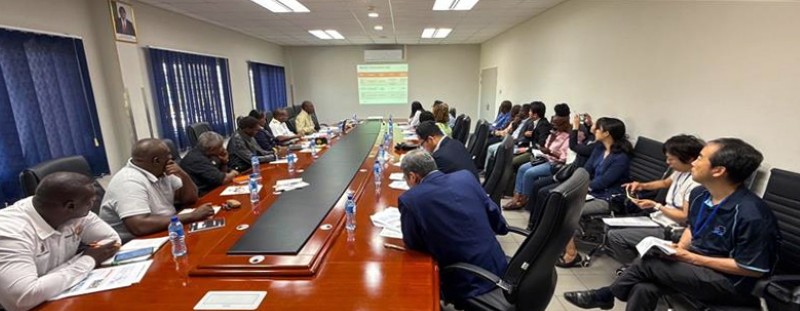
(A meeting held at the Kazungul One Stop Border Post in January 2025 a the border between Botswana and Zambia/ Photo: AUDA-NEPAD)
Facilitating Regional Integration
Another cornerstone of the partnership is regional integration, especially through One Stop Border Posts (OSBP).
“Before JICA came on board, we did not have the framework to accelerate and facilitate trade across the continent,” Adoum recalled. “Today we have a very strong, solid, well-designed tool, the widely read OSBP Sourcebook.”
Delays and inefficiencies at land borders, according to AUDA-NEPAD, have long hindered Africa’s trade. The OSBP Sourcebook addresses this by streamlining procedures, cutting costs, and making the movement of goods far smoother.
“With OSBP, you go beyond (border controls), you educate, you train, you build capacity, and help reshape the economic system,” said Adoum. “It’s a homegrown solution that really supports the development of local businesses in Africa.”
The results are tangible, according to Adoum: shorter transaction times, more predictable logistics, and greater confidence for traders. The impact has been so striking that he is now writing a book about the initiative.
“It's fascinating,” Adoum said. “It shows that when development cooperation focuses on things that matter and partners listen to you, you can get quite tangible results on the ground.”
For Africa, the stakes are high. Success at the border can help lay the foundation on a far bigger goal – the African Continental Free Trade Area, which aims to unlock the benefits of regional trade much like ASEAN, or the European Union have done.
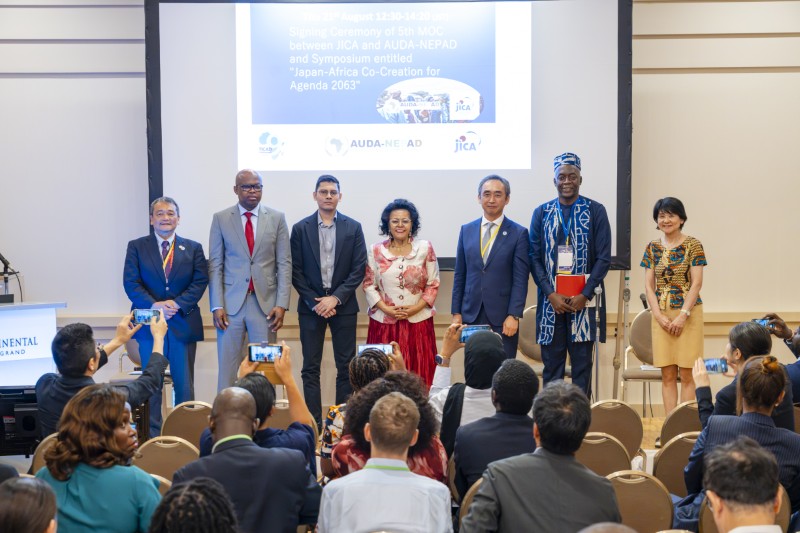
(JICA Senior Advisor, Homma Toru (far left), AUDA-NEPAD Director of economy, infrastructure, industrialisation, trade and regional integration, Amine Idriss Adoum (second to left) and AUDA-NEPAD CEO Nardos Bekele-Thomas (centre) and Senior Vice President of JICA Ando Naoki (third from the right) pose for photographers after the Memorandum of Cooperation between AUDA-NEPAD and JICA was renewed at TICAD9 in Yokohama, Japan, August 2025/ Photo: JICA)
10 Years and more to Come
The TICAD9 conference, held this past August in Yokohama, Japan, was a chance for JICA, AUDA-NEPAD, and their partners to take stock and plan ahead.
“Our main goal was basically to demonstrate that this cooperation, between JICA and our African and Japanese partners, is working and showing results,” said Adoum.
At the conference, over three hundred new cooperation agreements were signed, including a fifth memorandum of cooperation between JICA and AUDA-NEPAD. This JICA/ AUDA-NEPAD deal expands their work into 12 new sub-themes, all aligned with Agenda 2063.
"It is crucial to deepen cooperation within the global community. We want to work alongside Africa as it emerges as a beacon of innovation and resilience that propels global growth,” said JICA President Tanaka Akihiko, at the conference.
For Adoum, the partnership is not just successful. He sees JICA and AUDA-NEPAD as a model where Africa can show the world a path forward.
“When we build stronger cooperation, that means that we can find solutions to some of the world’s most pressing issues,” said Adoum.