






scroll


Fujimoto Masaru
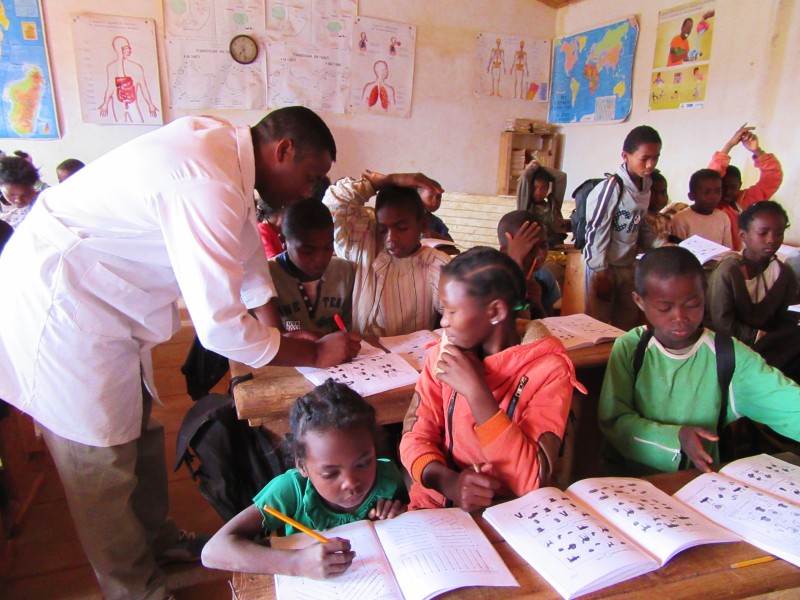
(Children in Ghana attend a class organised under JICA’s "School for All" project/ (Photo: JICA)
Series : Africa in Focus
To mark the 9th Tokyo International Conference on African Development (TICAD9), JICA is publishing a series of stories that explore Africa’s challenges and promise. While showcasing JICA’s contributions, the series also brings attention to the broader efforts, ideas and potential across the continent. This instalment focuses on how JICA utilises Japan's unique historical development to provide valuable insights and practical tools for global development, especially in Africa, while acknowledging that not all lessons are universally applicable.
The journey of Japan's modernisation, which began with the Meiji Restoration in the late 19th century and continued through its post-World War II economic boom, often serves as a guide for the Japan International Cooperation Agency (JICA). JICA draws upon this history, recognising that Japan's distinct evolution into the first industrialized non-Western nation provides valuable lessons and potential solutions for the challenges facing Africa today.
Professor Takahashi Motoki of Kyoto University, a prominent scholar in African development and co-author of "African Economic Development" (published January this year), says that many of Japan’s success stories and even failures “can serve as a reference and provide lessons” in economic support for Africa. However, he advises against a blanket application of Japan's experience, emphasising that every nation, particularly those in Africa, has distinct characteristics formed by unique historical and social circumstances.
Takahashi describes Japan’s modernisation as an overall success story that begins with the Meiji Restoration, where a series of reforms in the late 19th century made Japan the first industrialized non-Western nation. Then, following the complete devastation of World War II, Japan once again rapidly re-emerged as an economic powerhouse.
However, Japan’s and Africa’s histories are worlds apart. “We need to drop the assumption that our development experience can be useful for any country," Takahashi cautions.
One major challenge facing many African nations lies in establishing robust financial systems, particularly tax collection. Takahashi highlights the stark contrast with Japan, where a stringent tax system was established as early as 645 A.D. following the Taika Reform - a set of political and administrative changes aimed at strengthening the Emperor’s central authority. This ancient reform created a strict system of taxes on rice, labour, and local specialties, laying the foundations of a fiscal framework centuries before the nation’s modern industrialisation. In contrast, in Kenya, for example, where territorial boundaries were drawn during colonisation in 1895 and independence was gained in 1963, a sense of national identity remained absent for decades, making it difficult to establish effective tax collection even today.
This challenge is exacerbated by the prevalence of informal businesses. In Kenya, 85% of roughly 1.6 million manufacturing workers are employed in unregistered, often small-scale operations. These businesses, ranging from a few employees to one-person operations, operate outside official registration, making it difficult for governments to collect corporate and income taxes, leading to financial shortages. Japan's experience, encompassing its early, centralized tax system and meticulous record-keeping, highlights the crucial role of a formalised economy in nation-building and industrial growth. However, this model may be difficult for many African nations to replicate, as it took Japan centuries of historical development to establish such institutional frameworks.
JICA agrees and clarifies that it is not trying to impose a Japanese model. Instead, it draws inspiration from its own development history to support locally appropriate solutions that promote formalisation and economic inclusion, while respecting each country’s unique historical, cultural, and political context.
Yoshizawa Kei, Senior Advisor at JICA’s Africa Department, noted that during Japan’s modernisation, while Western countries served as models, rather than simply adopting their foreign technologies and ideas, Japan sought to adapt and integrate them with its own cultural context. He explained that the principle of self-reliance, often referred to as the "bootstraps" approach, was shaped by this experience and played a key role in Japan's post-war rapid economic growth. This ethos has since become a cornerstone of Japan’s Official Development Assistance (ODA) philosophy.
In practice, Yoshizawa said, ODA projects require active participation from recipient countries, including contributions such as allocating local personnel and sharing costs. The aim is to encourage independent, sustainable, long-term development, rather than placing the entire burden on the Japanese government or JICA. This approach contrasts sharply with the “full package” model often used by Western donors in sectors like disease prevention,where aid typically involves the direct delivery and distribution of medicines and vaccines to achieve quick results.
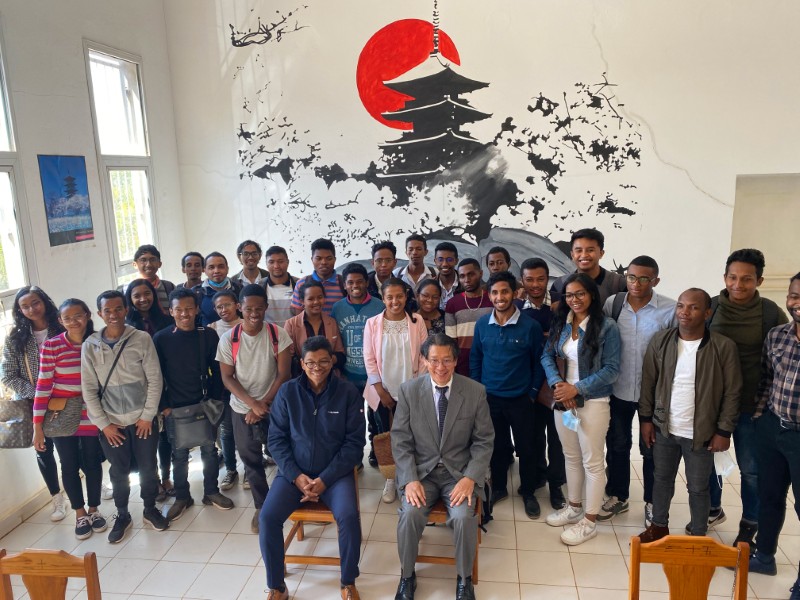
(Professor Takahashi Motoki (front row at right) poses for a photo with students attending his lecture on Japan’s experience of modern industrialisation at the University of Antananarivo in Madagascar/ Photo: Takahashi Motoki)
Ancient Wisdom and Modern Ingenuity: The Meiji Era's Selective Adaptation
While Japan was never colonised like most African states in the 19th century, the newly established Meiji government (1868-1912) harboured a deep sense of inferiority towards Western powers. The Iwakura Mission, a government-led fact-finding delegation that toured the United States and Europe from 1871 to 1873, was struck by the technological advancement of the West. In response, Japan made the import of foreign expertise in fields such as education, the military, and medicine as a central pillar of its modernisation efforts.
However, in a key lesson for Africa, Japan consciously opted not to import Western rice cultivation techniques which were not necessarily more developed than Japan, relying instead on generations of accumulated domestic knowledge. Japan, often referred to as "a rice country," has spent centuries improving its agricultural technology, beginning with a review of traditional production methods. Takahashi believes Africa can draw a similar lesson: leveraging their indigenous wisdom for industrial development. He points to high-quality products, such as sofas crafted from waste materials, frequently observed in open-air worksites along streets in Kenya, as examples of ingenuity. He advocates for an environment where such manufacturing can scale into larger enterprises, mirroring Japan's strategic blend of adopting foreign best practices while nurturing its unique, inherent strengths.
Beyond Corruption: Forging National Loyalty in Post-Colonial States
Meanwhile, Takahashi challenges the common narrative that corruption is the root cause of poverty in Africa, calling it an oversimplification. He points out that Japan has also grappled with serious corruption scandals, such as the Siemens case in 1914 and the Lockheed Affair in the 1970s, which both triggered major political crises and public outrage. What sets Japan apart, he suggests, is that these incidents were often met with stronger public condemnation and reinforced by a robust legal framework - a legacy of the country's long-established system of governance.
The relatively short history of many African nations, most gaining independence around 1960, means society often remains centred on family or kinship rather than a broader national identity. While this is evolving, Takahashi says that even public servants may still prioritize familial or kinship loyalty over national allegiance, sometimes leading to less adherence to social norms. This contrasts with Japan's long development of a national identity, forged over centuries and particularly shaped by school education, fair and equitable distribution of public resources, and shared experiences including wars during the process of modernisation, which fostered a collective loyalty essential for integrated national development.
Takahashi identifies four critical areas for future African development, each with implicit ties to Japan's own historical trajectory:
Gender Inequality Issues: Beyond Elite Advancement
While some African nations appear to fare well in the World Economic Forum's Gender Gap Index (GGI), with Namibia (8th), Cape Verde (30th), South Africa (33rd), Rwanda (39th), Liberia (40th), Burundi (44th), Eswatini (46th), and Zimbabwe (49th) among the top 50 in 2025 (Japan ranked 118th out of 146 countries), a different picture emerges from the UN Development Programme's Gender Inequality Index (GII). In the GII for 2025, Japan ranked 22nd out of 193 countries. Sub-Saharan African countries ranked lower, with Cape Verde at 77th, followed by South Africa (95th), Rwanda (99th), Namibia (116th), and Mozambique (120th).
This disparity stems from the GGI's focus on the advancement of elite women, utilising 14 indicators in economy, education, health, and politics. In contrast, the GII assesses the general public's perspective using five data points: maternal mortality rate, birth rate for mothers aged 10-19, secondary education completion rates, parliamentary representation, and labour market participation. Takahashi points out that despite having female presidents, Africa still grapples with a high maternal mortality rate, a reality not fully captured by the GGI on its own. Similarly, he says, Japan should reflect on its failure to provide elite women with the right positions in politics and business.
That said, Japan's own modernisation initially saw women's roles largely confined to the domestic sphere, but its post-war development gradually led to greater female participation in education and the workforce, highlighting a long-term societal shift necessary for comprehensive gender equality beyond just elite representation.
Stagnation of Manufacturing: Avoiding Japan's Resource Curse Pitfalls
According to Takahashi, Africa faces the challenge of premature deindustrialisation, or the shifting to service industries without a robust manufacturing base. This results in small informal companies and a continued reliance on imported industrial goods from countries like China and India. While China's rapid growth since 2003 was partly fueled by its purchase of African mineral resources, this increased foreign exchange earnings in Africa has inadvertently led to the "resource curse," where dependence on resource exports hampers the development of domestic manufacturing. Takahashi stresses that for African nations to truly develop, "agriculture and industry need to grow like the two wheels of a vehicle; the service industry alone will not be enough." This echoes Japan's own carefully cultivated dual growth strategy during its post-war economic miracle, where heavy industry developed in tandem with agricultural improvements, creating a diversified and robust economy rather than relying on a single sector or resource.
Population, Land, and Environment: Learning from Japan's Resource Scarcity
Since the "Year of Africa" in 1960, when many nations gained independence, the continent's population has surged nearly sixfold to approximately 1.5 billion in 2025. This explosive growth, particularly among children, has strained educational resources, leading to shortages in personnel, classrooms, and equipment. To put it simply, rapid population growth may have contributed to environmental degradation, as forests were cleared for farmland and firewood production, and overgrazing by livestock led to desertification. To address environmental concerns, governments urgently need to establish effective tax systems for funding, while continued support from developed nations remains crucial. Japan, a resource-poor nation with a high population density, has historically faced similar pressures on land and environment. These challenges drove innovations in resource efficiency, sustainable agriculture (like its intensive rice cultivation) and, later on, the development of advanced environmental policies through a process of trial and error. Africa can draw lessons from Japan's long-term strategies for managing finite resources under population stress.
Domestic Division and Conflict: The Meiji Era's Unification Blueprint
The nascent national consciousness in many African countries, often still prioritizing family prosperity and ethnic ties, contributes to fragile political systems, rampant armed conflicts, and corruption. Takahashi's book, "African Economic Development," posits that civil wars are not merely ethnic conflicts but rather a failure of political systems to resolve disagreements among leaders, leading them to resort to violence. Japan, burdened by the legacies of feudalism, underwent a profound process of national unification during the Meiji Restoration. Through this process, it dismantled regional factionalism in favor of a centralised state and a cohesive national identity. Effective measures included the adoption of a fair and merit-based system for recruiting public servants, and the equitable development of basic infrastructure such as schools, health care services, and roads. This historical precedent underscores the fundamental importance of fair, inclusive, and robust governance in reducing internal rivalries and conflicts, and in promoting cohesive development.
Japan's Unique Approach to African Development: Sharing Practical Solutions
Mindful of these complex issues, JICA has leveraged Japan's development cooperation experience, including lessons learned within Asia, to forge a unique approach to supporting Africa. To mark TICAD 9, JICA is reviewing several of its past development projects from the eight previous TICADs.
Emerging Rice Initiative: Applying Japan's Agricultural Mastery
Drawing on Japan's long-standing expertise as a "rice country" – a heritage deeply rooted in its history and food culture – JICA launched the “Coalition for African Rice Development” (CARD) Initiative in 2008 to help strengthen food and agricultural security across rapidly growing populations in Africa.
The ambitious goal was to double rice production in Sub-Saharan Africa within a decade. While JICA’s Yoshizawa initially expressed doubts, output rose from 14 million tons in 2008 to 28 million tons by 2018, a twofold increase. The project, which began in just a dozen countries, now spans 32. Its second phase aims to double production again, reaching 56 million tons by 2030. At its core, the initiative transfers Japan's centuries-old rice cultivation know-how, central to its own agricultural transformation, to support Africa's growing food needs.
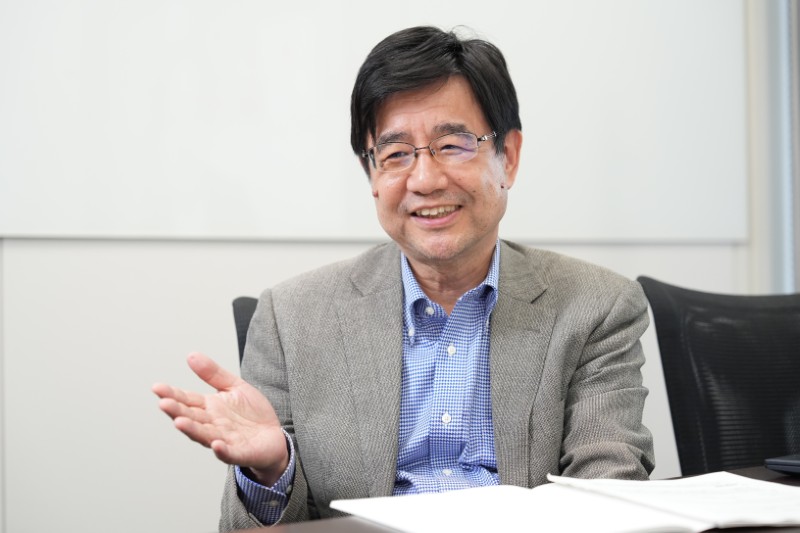
(Yoshizawa Kei, JICA Africa Senior Adviser says he was skeptical at first about doubling rice production in Africa/ Photo: Moritz Brinkhoff)
Improving Maternal and Child Health: A Public Health Legacy
To tackle persistently high maternal mortality rates across Africa, JICA is currently promoting the use of Japan's signature "Maternal and Child Health Handbook." Originally developed in the post-war period to support Japan’s recovery through improved public health, the handbook offers a simple yet effective way to monitor maternal well-being during pregnancy and track a child's growth, vaccinations, and medical history after birth. Alongside its dissemination, JICA is also investing in the training of midwives to strengthen frontline care. The initiative reflects Japan's long-standing belief in practical, community-based health interventions that helped dramatically reduce infant mortality and maternal care, while building human capital at home - and could now do the same abroad.
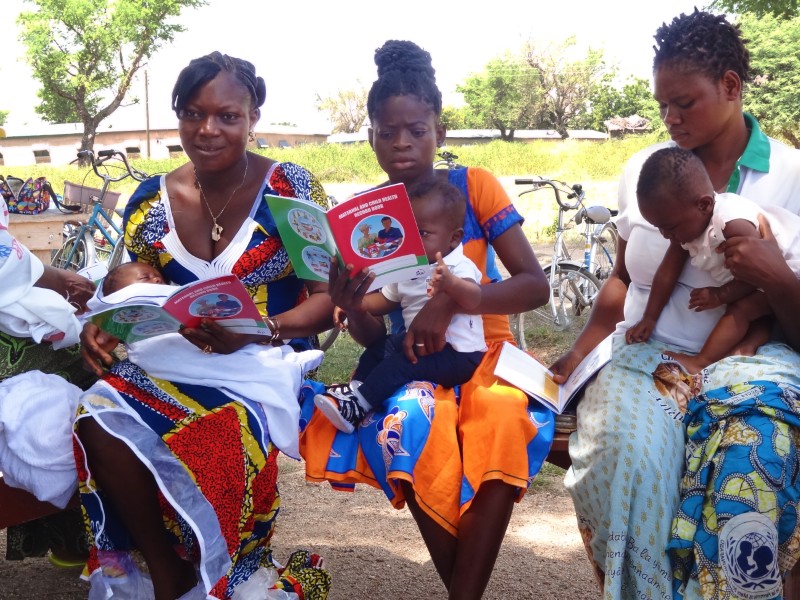
(Women in Ghana check their Maternal and Child Health Handbooks while holding their children/ Photo: JICA)
Education: Building Human Capital, the Japanese Way
In the education sector, JICA has prioritised the training of science and mathematics teachers, a long-standing strength of Japan, launching dedicated programmes for middle and high school instructors in 2008. This initiative reflects Japan's own reliance on STEM (Science, Technology, Engineering, Mathematics) education as a foundation for its industrial and technological rise. To deliver universal and quality education to African children, JICA also introduced the "School for All" project. This community-participation school management initiative has helped establish around 70,000 schools across nine African countries, aiming to strengthen children's basic skills in reading, writing and arithmetic. The approach draws from Japan’s own experience during the Meiji era, when universal education was seen as essential to modernisation and economic growth.
Kaizen: Japan's Efficiency Philosophy for Global Productivity
The Japanese concept of Kaizen, which promotes continuous improvement in business processes, rose to prominence during Japan's rapid economic growth in the 1960s and 70s. Based on the principles of "sort, set, shine, standardise and sustain," Kaizen focuses on enhancing productivity, improving quality control, and reducing costs.
After being adopted by Singapore in the 1980s, and later by several other Asian nations, Kaizen was introduced to Africa by JICA, starting in Ethiopia in the late 2000s under what became known as the "Kaizen Initiative." According to JICA, the results have been impressive. Companies that adopted the approach saw productivity rise by 64%, defective products fall by around 56%, and operating costs drop by approximately 20%.
Rooted in Japan’s post-war industrial transformation and drives for efficiency, Kaizen offers a practical and adaptable management philosophy that continues to address productivity challenges in emerging economies.
Broader Support and Future Prospects: A Mutual Path Forward
Beyond its core initiatives, JICA has carried out a wide range of activities across Africa. In Rwanda, the agency supported post-genocide reconstruction by providing vocational training, contributing to the country’s rapid development, often referred to as "Africa's trajectory." In the Democratic Republic of the Congo, JICA partnered with the UN peacekeeping mission to train police officers, and helped construct the 722-meter-long Matadi Bridge, the only suspension bridge spanning the Congo River, Africa’s second -largest waterway. The bridge’s construction began in 1979 and opened in 1983. In South Sudan, JICA completed the Freedom Bridge in 2022, a symbol of resilience following years of conflict and pandemic-related disruptions.
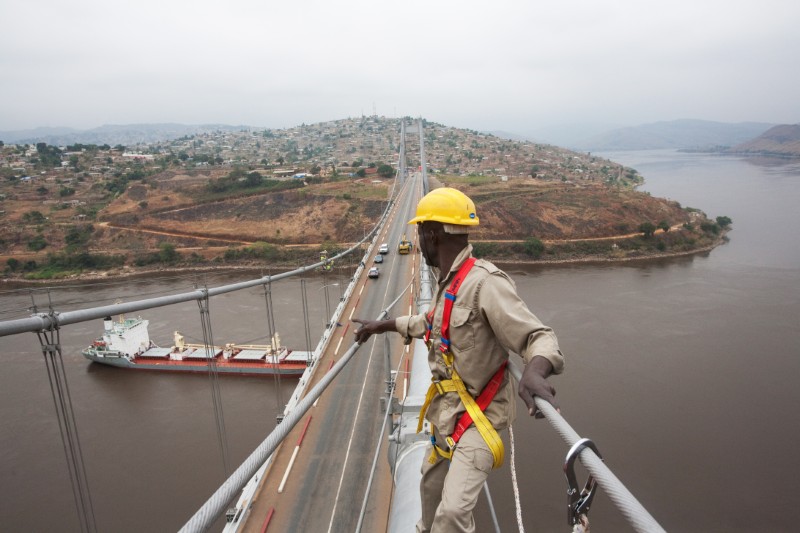
(The Matadi Bridge spans the Congo River in the Democratic Republic of the Congo/ Photo: JICA, Kuno Shinichi)
Takahashi highlights the importance of reciprocal understanding in Japan-Africa relations, encouraging more people from both regions to learn about each other. This mutual awareness, he argues, strengthens Japan's own security. He points to the support Japan received following the 2011 Great East Japan Earthquake, when a rescue team was dispatched from South Africa and 31 African nations offered assistance to the disaster-affected areas.
The Tokyo International Conference on African Development (TICAD), a Japanese-led initiative, has enabled a wide range of support programmes, helping to build a strong partnership between Japan and Africa. Takahashi describes TICAD as "Japan's diplomatic asset," reflecting how the country’s distinct historical path continues to offer meaningful lessons and practical strategies across Africa and beyond.