




scroll


Thank you for visiting the JICA Madagascar Office website.
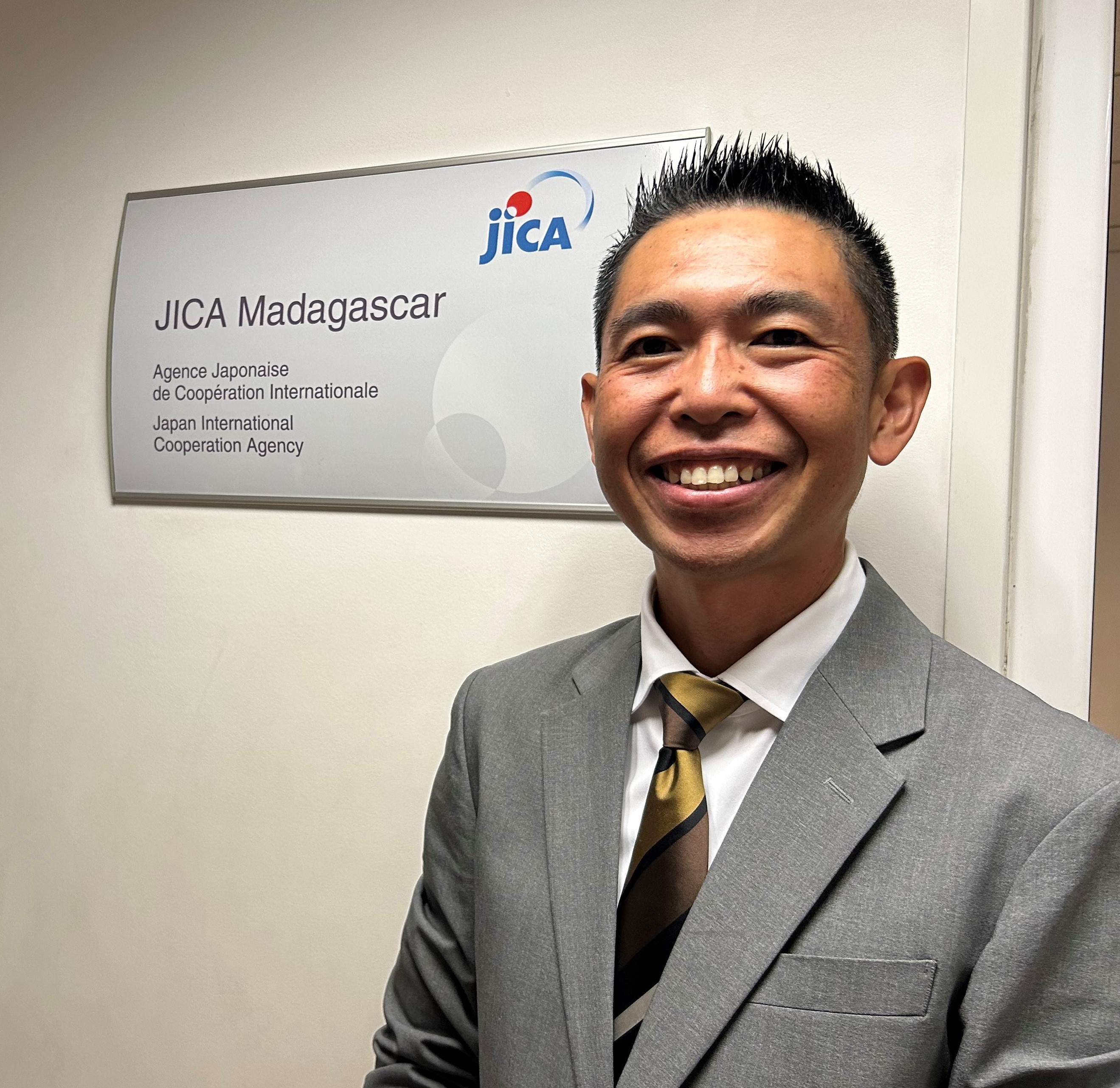
This is Kosuke Odawara, Chief Representative since May 2025.
Madagascar is the fourth largest island in the world, located in the Indian Ocean in southeastern Africa, with a population of about 32 million people (World Bank, 2024) living in a vast land area about 1.6 times that of Japan.
When you hear “Madagascar”, what comes to your mind? Is it a land full of endemic species of plant and animal such as baobabs and lemurs, as well as Madagascar vanilla and cacao that you see in ice cream and sweets? In addition, many people may know this country for its mineral resources such as nickel and cobalt produced from mining and refining operations, in which Sumitomo Corporation is the largest investor, we also find various jewelry.
On the other hand, Madagascar has abundant natural resources, but it is one of the countries in the African region that is struggling from the perspective of economic and social development. A representative indicator is that the GNI per capita is 510 US dollars, which is one of the lowest among the 49 countries in Sub-Saharan Africa, and about 70% of the people live below the 3 US dollar a day poverty line (World Bank, 2024). In addition, the Human Development Index, which indicates the status of health, education, etc., ranks the country 183rd out of 193 countries (UNDP, 2025). Furthermore, political crises, which are said to be major factors in socio-economic recession, recur every 10 to 15 years. Moreover, the Island is exposed to natural disasters such as cyclones from the Indian Ocean and droughts in the southern region.
In response to Madagascar’s challenges, which is vulnerable to economic, social, political, and climate change, the Japan government's development cooperation policy aims to "support sustainable development in a balanced manner between economic and social development." Under this policy, JICA is developing cooperation with particular emphasis on "agricultural and rural development", "social development", and "infrastructure development".
First of all, in the field of agriculture and rural development, it is said that about 80% of all employees are farmers, and about 90% of them are rice farmers, which is a staple food, so we are mainly developing rice cultivation cooperation (CARD) centered on technical guidance and research by Japan experts. In addition, we are also working on market-oriented agriculture (SHEP) and nutrition improvement (IFNA) to contribute in improving the livelihoods of farmers and country’s food self-sufficiency.
In the field of social development, we are also cooperating mainly on human resource development, such as improving the quality of primary education (School for All) and improving health and medical services (Clean Hospital Program).
In the field of infrastructure development, as a contribution to the development of the economic zone formed by the capital Antanarivo, the port city of Toamasina, which handles about 90% of the country's international cargo, and National Highway No. 2 connecting the two cities, we cooperate for formulate a comprehensive development masterplan (TaToM), expand the port of Toamasina, and renovate bridges on the National Highway No. 2, and develop cooperation in improving the urban environment, such as water supply and solid waste management.
On top of that, the cumulative number of JICA Overseas Cooperation Volunteers, which began dispatching in 2002, exceeded 290 in the first half of FY2025, and about 35 members are currently active in various fields such as life improvement, nutrition, education, health, youth development, sports and Japanese language education, and have gained high trust from local people and institutions.
Furthermore, we are working with Japan's universities, research institutes, technical colleges (KOSEN), NGOs, private companies, foundations, etc., to solve social issues in Madagascar and contribute to Japanese society as well. Besides, we are collaborating with the World Bank, the African Development Bank, and UN agencies to leverage their respective strengths in the fields of agriculture, education, health, and infrastructure development.
In this way, through collaboration and co-creation with various actors in Japan and overseas, we are developing cooperation based on the discussions and directions at the Tokyo International Conference on African Development (TICAD), which is held every three years.
In addition, we are also responsible for the neighboring countries, namely, Mauritius and the Union of Comoros. They are small island countries in the Indian Ocean, but their ethnicities, histories, politics, society, and economic conditions are completely different.
Mauritius is an upper-middle-income country that is attracting attention as an investment base for Africa (World Bank, 2024) but based on its vulnerability to climate change and disasters, we have been developing cooperation mainly in the fields of fisheries promotion, marine environmental management, meteorology, and disaster risk reduction. In addition, as response to the oil spill accident from grounding ship occurred in August 2020, we are cooperating in environmental monitoring, blue economy, and oil spill control. To the Union of Comoros, we are also cooperating mainly in fields such as blue economy and health, by focusing on human resource development.
Along these lines, through cooperation on common issues in sub-region, including mutual learning among countries, in addition to individual issues of each country, we would like to contribute to the development of each country and the sub-region, the strengthening of trust in Japan, the realization of the Sustainable Development Goals (SDGs) and a Free and Open Indo-Pacific. We would appreciate your interest in and support for JICA's activities in Madagascar, Mauritius and Comoros.
Chief Representative, JICA Madagascar Office
ODAWARA Kosuke