

scroll


1. Peacebuilding Efforts by the Government of Japan and JICA
Japan’s ODA for conflict prevention and peacebuilding places emphasis on seamless cooperation from conflict prevention to reconstruction and development, from the perspective of human security. Its objective is to contribute to peace and stability in the world through non-military means. Japan also actively addresses humanitarian issues such as assistance for mine clearance and refugees, and provides support that contributes to Japan’s own security and prosperity through cooperation with the international community. [1]
JICA works toward peaceful and just societies free from fear and violence. In order to realize peaceful societies where no one is left behind, JICA carries out activities in countries across Africa, the Middle East, Asia, Europe, and other regions, contributing to the development of resilient countries and societies that prevent the outbreak and recurrence of conflict.
JICA’s main peacebuilding initiatives are as follows.
1. To prevent the outbreak and recurrence of conflict, JICA supports the development of resilient and inclusive societies and promotes trust-building through the strengthening of local administrative capacity and social cohesion.
2. JICA places emphasis on the humanitarian-development-peace nexus, including mine and unexploded ordnance action and assistance for refugees, and works to reduce disaster and conflict-related risks while promoting social participation.
3. From the perspective of human security, JICA provides support that combines protection, empowerment, and solidarity, adopting a comprehensive approach to addressing the root causes of violent conflict.
For more information on JICA’s peacebuilding support, please see here.
2. JICA’s Journey in Supporting Peace and Development in Mindanao
JICA’s Early Cooperation for Peace in Mindanao through Infrastructure Development
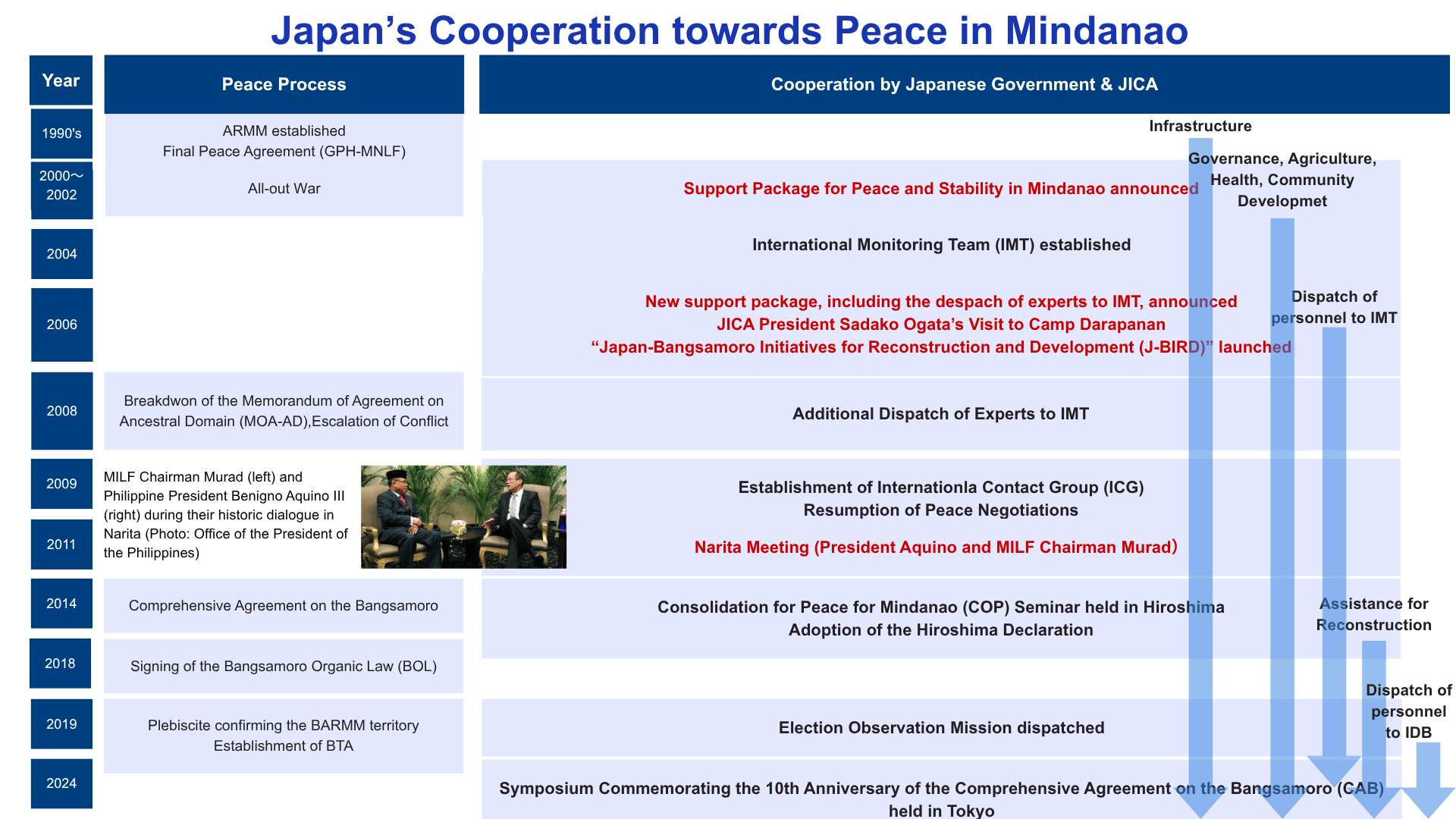
JICA’s cooperation for peace in Mindanao began in 1990. At the outset, this support was aligned with the national development policies of the Government of the Philippines and aimed to address delays in infrastructure and economic development in Mindanao, as well as narrowing the development gap with other regions. In areas particularly affected by many years of conflict, the urgent need was to build stable foundations for people’s lives. In response, JICA provided support centered on infrastructure development, including electricity and irrigation.
One important framework during this period was the Special Zone of Peace and Development (SZOPAD), established based on the peace agreement in 1996 between the Government of the Philippines and the Moro National Liberation Front (MNLF). In SZOPAD, JICA supported road improvement by providing road construction equipment. In particular, by supporting road development by local government units (LGUs) in areas where poor road conditions had seriously affected people’s lives, JICA helped improve local mobility and logistics, thereby supporting the peace process between the Government of the Philippines and the MNLF.
At a time when other donors were hesitant to provide direct assistance to LGUs in conflict-affected areas, JICA staff visited LGUs within SZOPAD, gathered information on local challenges and needs, and proceeded with project formulation. This field-oriented approach was a symbolic example of how JICA’s cooperation was grounded in the actual circumstances of local communities.
Commitment to Peace: President OGATA’s Visit and the Birth of J-BIRD
In December 2002, then Prime Minister Junichiro Koizumi announced the “Support Package for Peace and Stability in Mindanao.” Later, in July 2006, to commemorate the 50th anniversary of the normalization of diplomatic relations between Japan and the Philippines, then Minister for Foreign Affairs Taro Aso announced a new package of assistance for Mindanao. Japan also began dispatching personnel to the International Monitoring Team (IMT) which had been established in 2004, thereby launching more comprehensive support by the Government of Japan.
International Monitoring Team in Mindanao (IMT)
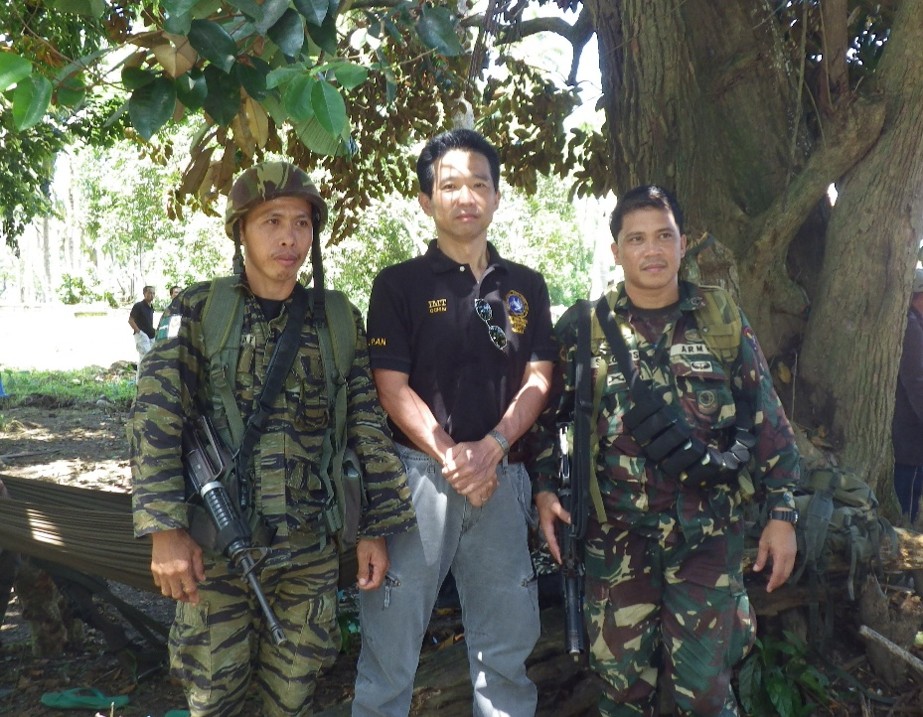
IMT Japanese personnel with a Philippine Army soldier (right) and an MILF combatant (left)
(Photo by OCHIAI Naoyuki, 2011)
Based on the ceasefire agreement concluded in 2003 between the Government of the Philippines and the Moro Islamic Liberation Front (MILF), the International Monitoring Team in Mindanao (IMT) was established in October 2004. It was initially composed of military personnel, police officers, and civilians dispatched from Malaysia, Brunei, and Libya. Japan joined in 2006, followed by the European Union and Norway in 2011, and Indonesia in 2012. Four international and local NGOs, including Nonviolent Peaceforce and the Mindanao Human Rights Action Center, also participated and worked together with the member countries.
The IMT consisted of four components. The first was Ceasefire Monitoring, conducted by Malaysia, Brunei, Libya, Indonesia, and Norway, to monitor the implementation of the ceasefire agreement. The second was Civilian Protection, carried out by NGOs to protect internally displaced persons. The third was Humanitarian Assistance, led by the EU, to provide support to victims of the conflict. The fourth was Socio-Economic Assistance, aimed at promoting social and economic development in the region.
Japan was solely responsible for the Socio-Economic Assistance component. Under this component, Japan worked to assess socioeconomic conditions and development needs in conflict-affected areas, support the formulation and implementation of comprehensive regional development plans, and promote the implementation of development assistance projects by the Government of Japan and JICA under the Japan-Bangsamoro Initiatives for Reconstruction and Development (J-BIRD). Since 2006, Japan dispatched a total of nine personnel to the IMT, all of whom were JICA staff members.
The IMT was characterized by the fact that it was not led by the United Nations, was composed mainly of sovereign states in Asia, and was unarmed. Before the establishment of the IMT, more than 500 violations of the ceasefire agreement occurred annually. After 2004, however, the number fell sharply to just over a dozen cases per year. Although unarmed, the visible presence of the IMT directly monitoring the situation on the ground served as a deterrent to both the Armed Forces of the Philippines and the MILF.
The Socio-Economic Assistance component undertaken by Japan also played an important role. By delivering the peace dividend to residents of conflict-affected areas even before the conclusion of the peace agreement, it helped nurture people’s aspirations for peace and served as a bridge between the Government of the Philippines and the MILF.
A key event that led to the further expansion of JICA’s support for Mindanao was the visit by then JICA President Sadako Ogata to Camp Darapanan, a major MILF base, in September 2006. President Ogata personally traveled to a conflict-affected area and held direct talks with MILF Chairman Al Haj Murad Ebrahim. The fact that the head of JICA visited, on her own initiative, a military stronghold that was inaccessible even to government forces demonstrated a strong commitment to peace. The MILF, in turn, expressed both its seriousness toward the peace process and its expectations for JICA’s support. Reflecting on the visit after leaving office, President Ogata recalled, “By talking directly with one another, we were able to build mutual trust.” [2]
In Manila, President Ogata also met with then President Gloria Macapagal Arroyo. Through these discussions, both the Government of the Philippines and the MILF shared the understanding that development assistance could help advance peace in Mindanao. This series of actions marked a major turning point, positioning JICA’s efforts in Mindanao as a strategic initiative that links peace and development.
In December of the same year, during then Prime Minister Shinzo Abe’s visit to the Philippines, the launch of the Japan-Bangsamoro Initiatives for Reconstruction and Development (J-BIRD) was officially announced. Designed as a framework for systematically promoting assistance that links peace and development through Japan’s ODA, J-BIRD targeted conflict-affected areas and the then Autonomous Region in Muslim Mindanao (ARMM). It helped clarify and strengthen the direction of JICA’s support for Mindanao.
During this period, JICA also dispatched a regional development expert to ARMM and launched technical cooperation aimed at institution-building and strengthening the administrative capacity of the autonomous government. Through efforts to improve services in sectors such as health, education, and agriculture, JICA sought to improve the quality of life of people living in conflict-affected areas, while pursuing both the consolidation of peace and sustainable development through assistance tailored to local needs.
A Leader Rooted in the Field - OGATA Sadako’s Commitment to Mindanao -
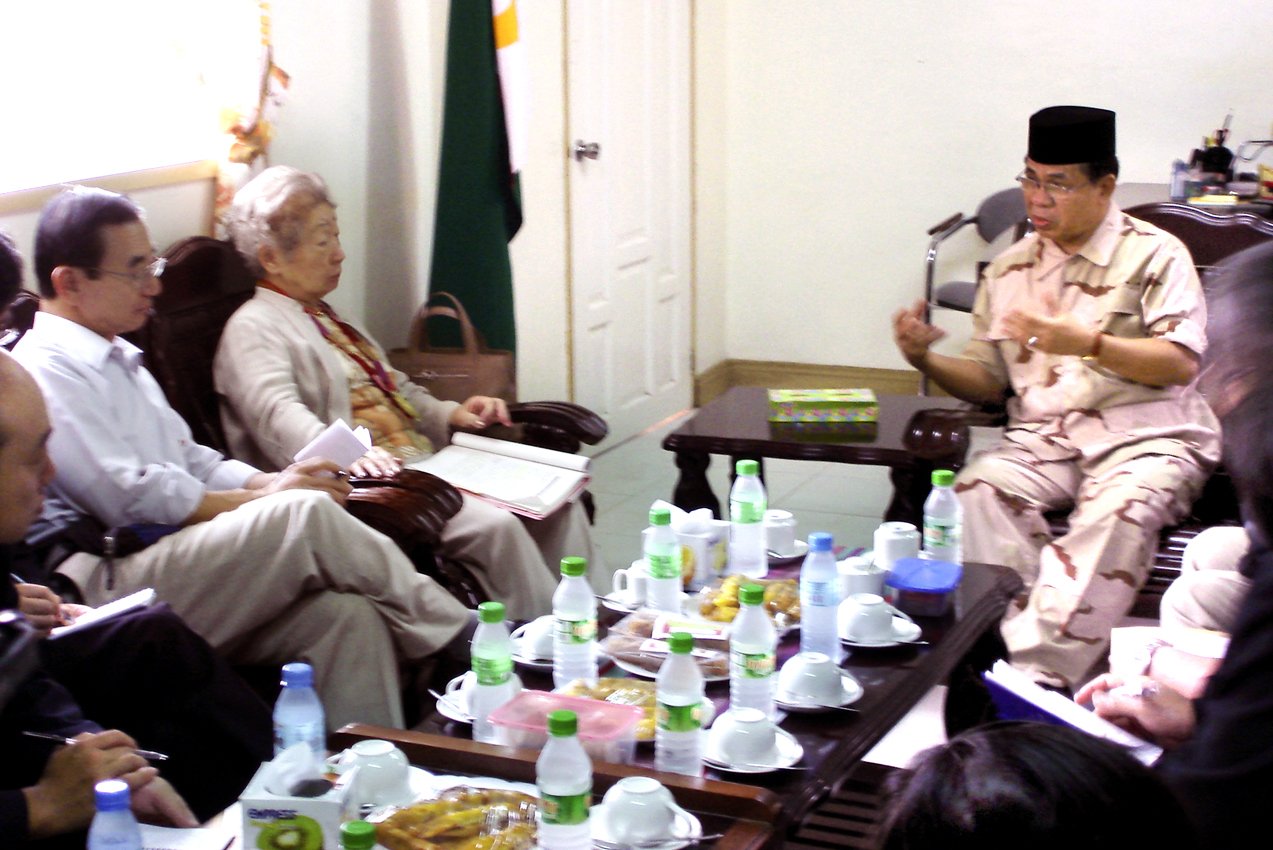
Former JICA President OGATA Sadako (center) during her visit to Camp Darapanan, in dialogue with MILF Chairman Murad (right)
(Photo by JICA, 2026)
Former JICA President OGATA Sadako was a pioneer in international humanitarian assistance who consistently upheld a “field‑oriented approach” throughout her career, including her tenure as United Nations High Commissioner for Refugees (UNHCR). This principle continued to guide her leadership at JICA.
In 2006, President OGATA visited Camp Darapanan, the stronghold of the Moro Islamic Liberation Front (MILF) where even government forces could not enter at the time. There, she held a direct dialogue with Chairman Murad, demonstrating JICA’s strong commitment to supporting the peace process.
Two years later, the peace process faced a serious crisis. Following the Philippine Supreme Court’s ruling that the “Memorandum of Agreement on Ancestral Domain (MOA‑AD)” was unconstitutional, some MILF commanders launched armed uprisings. The ceasefire effectively collapsed, and the International Monitoring Team (IMT) decided to temporarily withdraw due to security concerns.
Amid these developments, discussions emerged within JICA Headquarters about withdrawing JICA staff assigned to the IMT. President Ogata, however, responded firmly:
“It is precisely when others step back that we must step forward.”
She then added, “Let us send one more staff member. Since we have the opportunity, dispatch a young officer so they can gain experience in the field.” With this, she instructed not only the continuation but the strengthening of JICA’s support.
This decision remains a well‑known episode within JICA, symbolizing the organization’s field‑oriented approach and unwavering commitment to peace.
Even today, people in the Bangsamoro region recall President Ogata’s visit to Camp Darapanan and the fact that JICA continued—and even reinforced—its assistance at a time when other actors were withdrawing. Their trust in JICA has been built steadily through cooperation grounded in the realities of the field.
Behind the Scenes of Diplomacy: The Historic Narita Meeting
In the late 2000s, peace negotiations between the Government of the Philippines and the Moro Islamic Liberation Front (MILF) made some progress. However, the process suffered a major setback when the Memorandum of Agreement on Ancestral Domain (MOA-AD), which had come close to being concluded in 2008, was ruled unconstitutional by the Supreme Court of the Philippines.
The ruling held that key provisions concerning autonomy and territory in Mindanao had not fulfilled the necessary constitutional procedures and lacked sufficient national consensus. As a result, distrust emerged between the government and the MILF, and the peace process remained deadlocked for several years.
Despite these challenges, JICA continued to provide development assistance that served as a foundation for peace in conflict-affected areas of Mindanao through technical cooperation involving JICA staff and Japanese experts. Its field-based engagement and neutral position earned the trust of both the Government of the Philippines and the MILF, allowing JICA to play an increasingly important role in building confidence between the parties.
At the same time, the Government of Japan supported peace in Mindanao through diplomatic efforts. One notable example was its participation in the International Contact Group (ICG), established in 2009. Composed of four countries, Japan, the United Kingdom, Türkiye, and Saudi Arabia, together with four international NGOs, Conciliation Resources, the Centre for Humanitarian Dialogue, Muhammadiyah, and The Asia Foundation, the ICG was the world’s first hybrid peace support mechanism bringing together diplomatic actors and NGOs. [3]
As a member of the ICG, Japan helped facilitate peace negotiations, build trust between the parties, and provide information and advice to support consensus-building between the Government of the Philippines and the MILF. Working in tandem with JICA’s field-level assistance, these efforts contributed to sustaining momentum in the peace process.
Against this backdrop, a historic meeting between Philippine President Benigno Aquino III and MILF Chairman Murad took place in Narita City, Chiba Prefecture, in August 2011. Organized as an informal dialogue in a third country, the meeting was made possible through the efforts of the Government of Japan and JICA, both of which played important roles in facilitating and coordinating the discussions. The two leaders exchanged views on accelerating the peace process and linking peace with development, taking a significant step toward building mutual trust.
The Narita meeting symbolized how the trust built through years of field-level engagement by the Government of Japan and JICA could also be leveraged diplomatically at a critical moment in the peace process. It became an important milestone that helped build momentum toward the signing of the Comprehensive Agreement on the Bangsamoro (CAB) in 2014.
After the Peace Agreement: Supporting the Transition from ARMM to BARMM
In March 2014, the Comprehensive Agreement on the Bangsamoro (CAB) was signed between the Government of the Philippines and the MILF, marking a major milestone in the Mindanao peace process.The agreement formally laid out the transition from the Autonomous Region in Muslim Mindanao (ARMM) to the Bangsamoro Autonomous Region in Muslim Mindanao (BARMM) and set the stage for the establishment of a new autonomous government, creating the foundations for a lasting framework of self-governance.
Even before the CAB was signed, JICA had supported institution-building and improvements in public service delivery in ARMM. Following the agreement, JICA further strengthened its assistance to support the transition to BARMM.In the early stages after the signing of the CAB, JICA also implemented Quick Impact Projects (QIPs) to help local communities experience the peace dividend. Through small-scale infrastructure development and the provision of social services aimed at emergency recovery and reconstruction in conflict-affected areas, these projects sought to deliver the benefits of peace directly to people’s daily lives and contributed to promoting peace and stability in local communities.
In the area of security, the Independent Decommissioning Body (IDB), composed of both international and domestic experts, was established in 2014 to oversee the verification and decommissioning of MILF combatants. [4] Japan joined the effort in 2022 and dispatched personnel until 2025.
In addition, the Government of Japan has implemented numerous Grant Assistance for Grass-Roots Human Security Projects through local and international NGOs, local governments, educational institutions, and medical organizations. Working with international organizations, Japan has also continued to deliver support to areas where travel by Japanese nationals is restricted through projects on decommissioning, women’s empowerment, voter education, and other initiatives.
JICA’s Current Support for the Transition to Autonomy: Advancing Both the Political and Normalization Tracks
In 2018, the Philippine Congress enacted the Bangsamoro Organic Law (BOL). Following a plebiscite in 2019, BARMM was formally established as the new autonomous region replacing ARMM.This was accompanied by the establishment of the Bangsamoro Transition Authority (BTA), marking the beginning of the transition toward a new autonomous government.
The BOL identifies two key pillars for implementing the peace agreement: the Political Track and the Normalization Track. The Political Track focuses on establishing a democratic system of governance through institution-building and the enactment of key legislation for the autonomous government. The Normalization Track focuses on helping communities recover from the effects of conflict and promoting social stability through decommissioning, the reintegration of former combatants, security arrangements, and transitional justice initiatives.
Today, JICA provides support along both tracks to help strengthen BARMM’s institutional foundations and promote regional stability. Under the Political Track, JICA advances technical cooperation aimed at strengthening the administrative capacity of the BTA, supporting policy development, improving public financial management, and developing human resources so that the autonomous government can provide stable and inclusive public services to its residents. JICA also continues its support in sectors such as education, health, agriculture, and infrastructure, while ensuring alignment with the Bangsamoro Development Plan (BDP). Under the Normalization Track, JICA supports the reintegration of former MILF combatants and the stabilization of their communities through vocational training and livelihood assistance.
More details on JICA’s current support are presented in the following pages.
*This page mainly refers to the “Comprehensive Review of JICA’s Assistance in Mindanao
” published by JICA, in 2021.
Other references are listed below.
[1] Ministry of Foreign Affairs of Japan, “International Trends in the Field of Peacebuilding Support.”
[2] Nakatsubo Hiroaki, “From the Frontlines of Peacebuilding Support in Mindanao,” International Development Journal, 2015.
[3] Conciliation Resources, “International Contact Group on Mindanao.”
[4] Independent Decommissioning Body, “Detailed Verification and Decommissioning Process.”