
The Wantok Spirit Learned in PNG A Former JICA Volunteer Supporting Vanilla Farmers in Papua New Guinea
[Goal 1]No Poverty
[Goal 8] Decent Work and Economic Growth
2026.09.25



2026.09.25
The JICA PNG Office is pleased to share an English translation of a story recently featured on the JICA Japan website.
The article introduces Mr. Masaki Itoh, a former JICA Volunteer who served in Oro Province, and how the Wantok spirit he experienced in Papua New Guinea inspired him to establish PapuVani, a business that supports PNG vanilla farmers and connects their products to the Japanese market.
Although the original article was published in Japanese, we wanted to make this story accessible to our colleagues and friends in PNG, whose support and friendship helped shape this remarkable journey.
We hope you enjoy reading how the bonds created through volunteer service continue to contribute to the development of both Papua New Guinea and Japan.
Masaki Itoh, the founder of PapuVani, imports and sells vanilla beans from Papua New Guinea (PNG) in Hakodate, Japan. The inspiration behind his work comes from the two years he spent in PNG as a JICA Volunteer and, in particular, from the PNG value of Wantok, a culture of mutual support and strong human connections.
In 2011, Itoh was dispatched to Popondetta General Hospital in Oro Province as a JICA Volunteer physiotherapist.
At the time, the hospital had doctors, nurses, and other medical staff, but there was no physiotherapy department. Itoh was entrusted with the task of helping to establish one. When he was dispatched to Popondetta, his counterpart was absent. As the only senior physiotherapist at that time, he worked closely with staff from various departments to create the foundation of the Physiotherapy department. In addition to physiotherapy, he shared knowledge on pressure sore prevention, patient positioning, the use of cushions, nutritional support techniques, and the handling of sterilized medical equipment. After about a year of continuous effort, the foundation of the physiotherapy department was established.
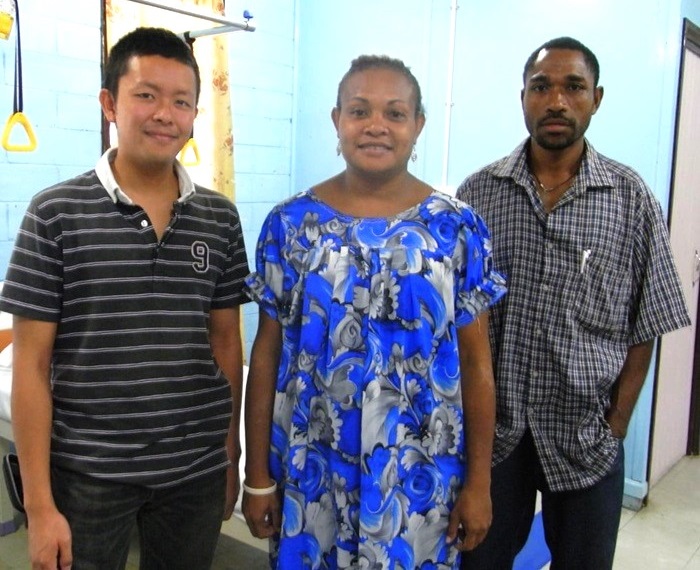
Mr. Itoh (left) with his colleagues during his time as a JICA Volunteer. Beyond his work at the hospital, he visited schools, community facilities, building relationships with local people, and gaining a deeper appreciation of PNG's Wantok spirit.
In addition to working at the hospital, he visited local health centres,schools and actively engaged with communities throughout the province. Through these experiences, he developed a deeper understanding of PNG society. One concept that particularly impressed him was the Wantok system, a system of mutual support based on family, community, and social ties.
During his two years in PNG, Itoh felt that he had been accepted almost as a member of the community himself.
“When I left PNG, I strongly hoped that I would have the opportunity to work there again.”
Later, Itoh was scheduled to work at the JICA Papua New Guinea Office and subsequently on a project in the Philippines. However, the COVID-19 pandemic prevented him from travelling overseas, and he remained in Japan. It was during this period that he learned about the difficulties faced by vanilla farmers in PNG.
Before the pandemic, many farmers sold their vanilla beans to Chinese buyers. However, when international travel was disrupted, buyers were no longer able to visit PNG thus leaving many farmers without access to their usual market.
He learned about the situation through his wife, Joyce, who is from PNG.
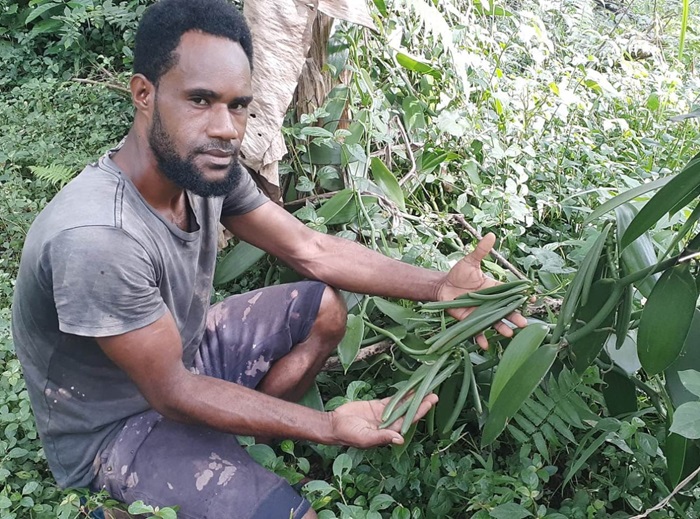
Vanilla plantations are often owned by individuals or small families. This is one of their means of income to support their families.
When Itoh heard about the difficulties faced by vanilla farmers, he thought of the Wantok spirit he had experienced in PNG. The idea was also closely connected to the relationship he had built with his PNG family. When he married Joyce, her mother and sister told him:
“Even if you marry and move far away, we hope you will always remain part of our family.” Those words stayed with him.
During his time in PNG, Joyce's family welcomed him warmly and even allowed him to stay with them for several months free of charge. Over the years, they had continued to support one another and built a relationship based on trust. Remembering those experiences, he felt that he had to do something to help them.
He asked Joyce's brothers to visit local farmers, collect vanilla beans, and send them to Japan. Itoh then began selling the products in Japan. This became the beginning of PapuVani.
As the business developed, Itoh continued to benefit from the support of people around him. His first customers were confectionery shops in Hakodate, introduced by his father. Through personal recommendations and local business networks, his customer base gradually expanded.
Today, PapuVani mainly sells vanilla beans through distributors serving high-end confectionery shops in Hokkaido, whilst continuing direct sales to smaller businesses.
According to Itoh, the spirit of Wantok is not only unique to PNG.
“One of the attractive aspects of PNG society is that people stay connected and support one another. Sometimes Japanese society can feel lonely, but in reality, businesses and local communities in Japan also depend on relationships based on mutual support.”
PapuVani remains a small business, and Itoh is committed to building a bridge between the farmers in PNG and the confectionery community in Japan. Supporting the farmers by paying a fair value for their products while maintaining a sustainable operation.
In 2025, imports totaled approximately 80 kilograms, partly because of delays in road and bridge maintenance and flooding in PNG. His current goal is to increase imports to 100 kilograms this year and to 200 kilograms annually within the next five years. He has also begun producing and selling processed products such as vanilla powder.
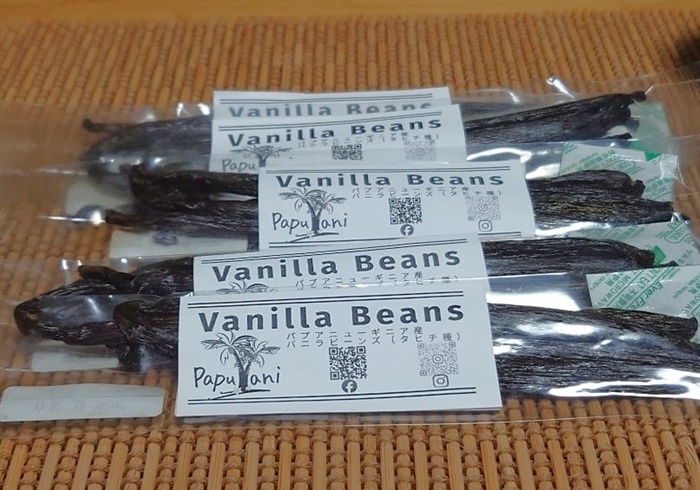
PNG-grown vanilla beans sold through PapuVani. What began with the Wantok spirit now helps connect vanilla farmers in PNG with the Japanese market.
Reflecting on his journey, Itoh says:
“PNG taught me the importance of supporting one another. For the sake of the people and communities that helped me, I want to continue growing this business and supporting PNG into the future.”
For him, PapuVani is more than a business. It is a way of maintaining the connections he built in PNG and continuing to support the vanilla farmers who inspired him through the spirit of Wantok System.
Related Link
・Contributing to strengthened logistics infrastructure through landslide reduction on the Kokopo-Rabaul Trunk Road - Signing of Grant Agreement with Papua New Guinea
・JICA-PNG Sends Off more public servants to Japan for Post-Graduate Studies
・Advancing Sustainable Agriculture in Papua New Guinea
Please also visit our Facebook for our latest activities and events news
JICA Facebook Page
Sns share!


