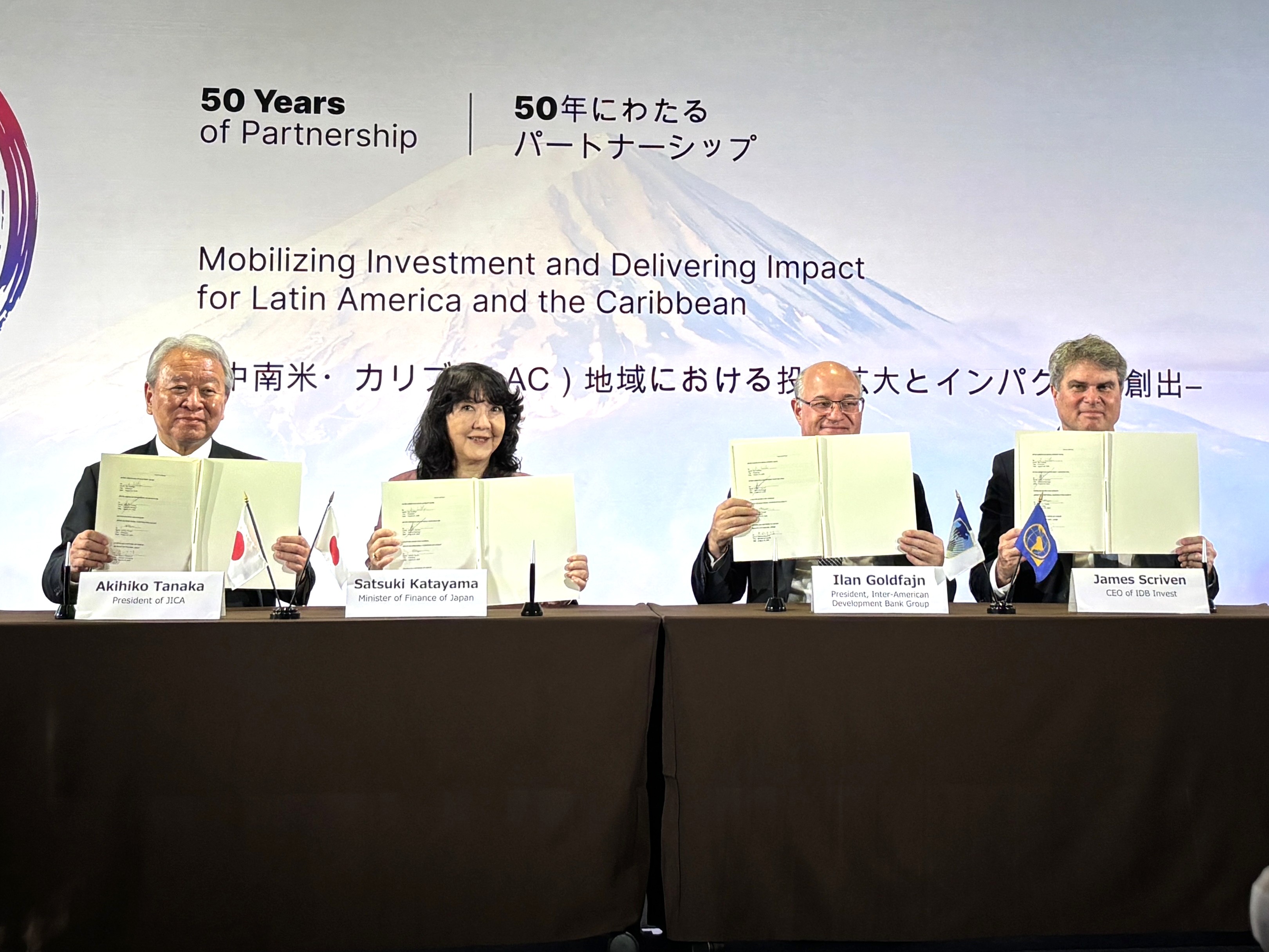
On August 24, the Japan International Cooperation Agency (JICA) signed three documents to strengthen collaboration with the Inter-American Development Bank Group (IDB Group) for sustainable economic and social development and the promotion of private investment in Latin America and the Caribbean. The signed documents are a Memorandum of Collaboration to expand the co-financing framework “CORE (Cooperation for Economic Recovery and Social Inclusion),” a Memorandum of Collaboration to establish a framework for collaboration in the areas of long-term care, health system strengthening, and digital health, and a Letter Agreement to increase the contribution ceiling for the Trust Fund Achieving Development of Latin America and the Caribbean (TADAC).
The signing ceremony was attended by JICA President Tanaka Akihiko, Minister of Finance Katayama Satsuki, Inter-American Development Bank (IDB) President Ilan Goldfajn, and IDB Invest CEO James Scriven. Regarding the Memorandum of Cooperation in the areas of long-term care, health system strengthening, and digital health, the agreement was signed by all four parties. In addition, Minister Katayama signed two other agreements as a witness.
Through CORE, JICA and the IDB Group have promoted co-financing in areas such as high-quality infrastructure investment, resilience to natural disasters (disaster risk reduction), and improved access to quality healthcare services through Universal Health Coverage (UHC), while addressing development challenges across Latin America and the Caribbean. At the same time, the region faces increasing challenges, including the impacts of climate change and growing disaster risks, as well as the need to strengthen efforts in food security, stable supplies of critical minerals, and responses to population aging. Under the expanded cooperation, the target amount for CORE co-financing approvals will be increased from USD 4 billion to USD 5 billion, and the cooperation period will be extended through 2031. Agriculture and critical minerals-related sectors have also been added as new priority areas in the sovereign co-finance (Note: There is no specific restriction of sectors in the non-sovereign co-finance and co-investment). Furthermore, under a new cooperation framework involving Japan’s Ministry of Finance, the IDB Group, and JICA, the parties will share information and exchange views from the early stages of project preparation, promoting collaboration in long-term care, health system strengthening, and digital health. In addition, the contribution ceiling for TADAC will be raised from USD 1 billion to USD 1.5 billion, further advancing efforts to address development challenges in the region through the private sector.
This expanded cooperation will further strengthen efforts to address development challenges in Latin America and the Caribbean. Cooperation in the newly added areas of agriculture and critical minerals under the CORE framework is expected to contribute not only to strengthening food security and economic security, but also to the development of resilient supply chains. In the fields of health, long-term care, health system strengthening, and digital health, Japan’s experience and expertise in addressing population aging, healthcare systems, and digital technologies are expected to be effectively leveraged. Furthermore, by utilizing the IDB Group’s extensive network and private sector support functions, this cooperation is also expected to contribute to expanding opportunities for Japanese companies to engage in the Latin America and the Caribbean region.