
Opening a path through mountainous Nepal: Japanese technology and international cooperation behind a tunnel project
[Goal 11] Sustainable Cities and Communities

2026.11.09



2026.11.09
Nepal is a land of rugged mountains. On the road linking the capital, Kathmandu, with other major cities, chronic traffic congestion and accidents had long been serious problems. To improve the situation, the Nagdhunga Tunnel, Nepal's first road tunnel equipped with modern facilities, was developed with support from JICA. The approximately 2.7-kilometer tunnel took about seven years to complete, with construction finishing in July 2026. Underpinning this long-awaited project were the determined efforts and cooperation of Japanese and Nepali engineers.
Construction work on the tunnel
The completion ceremony in late July was attended by Nepal's minister for infrastructure development, the Japanese ambassador to Nepal and JICA President Akihiko Tanaka. Saujanya Nepal, the project director of the Nagdhunga Tunnel Construction Project at Nepal's Department of Roads, reflected on the occasion, saying, "It was a proud moment for both Japan and Nepal and an event symbolizing the cooperation between the two countries."
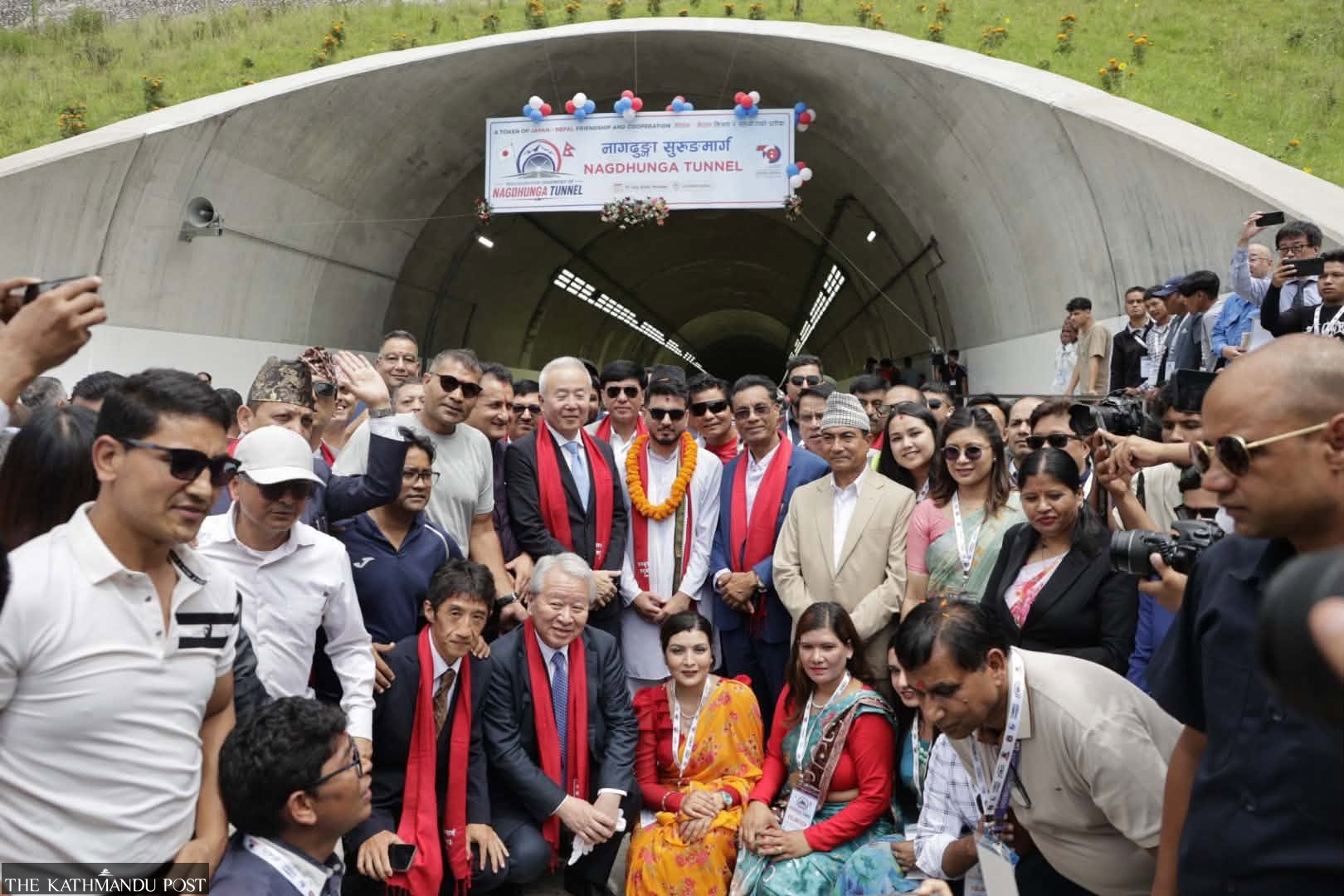
The completion ceremony for the Nagdhunga Tunnel
The project received extensive coverage in local media, with citizens welcoming the development, saying, "Nepal now has world-class infrastructure of a kind previously seen only in developed countries." Saujanya Nepal expressed hope for the project's impact, noting, "The completion of the Nagdhunga Tunnel marks a turning point in the modernization of our country's infrastructure."
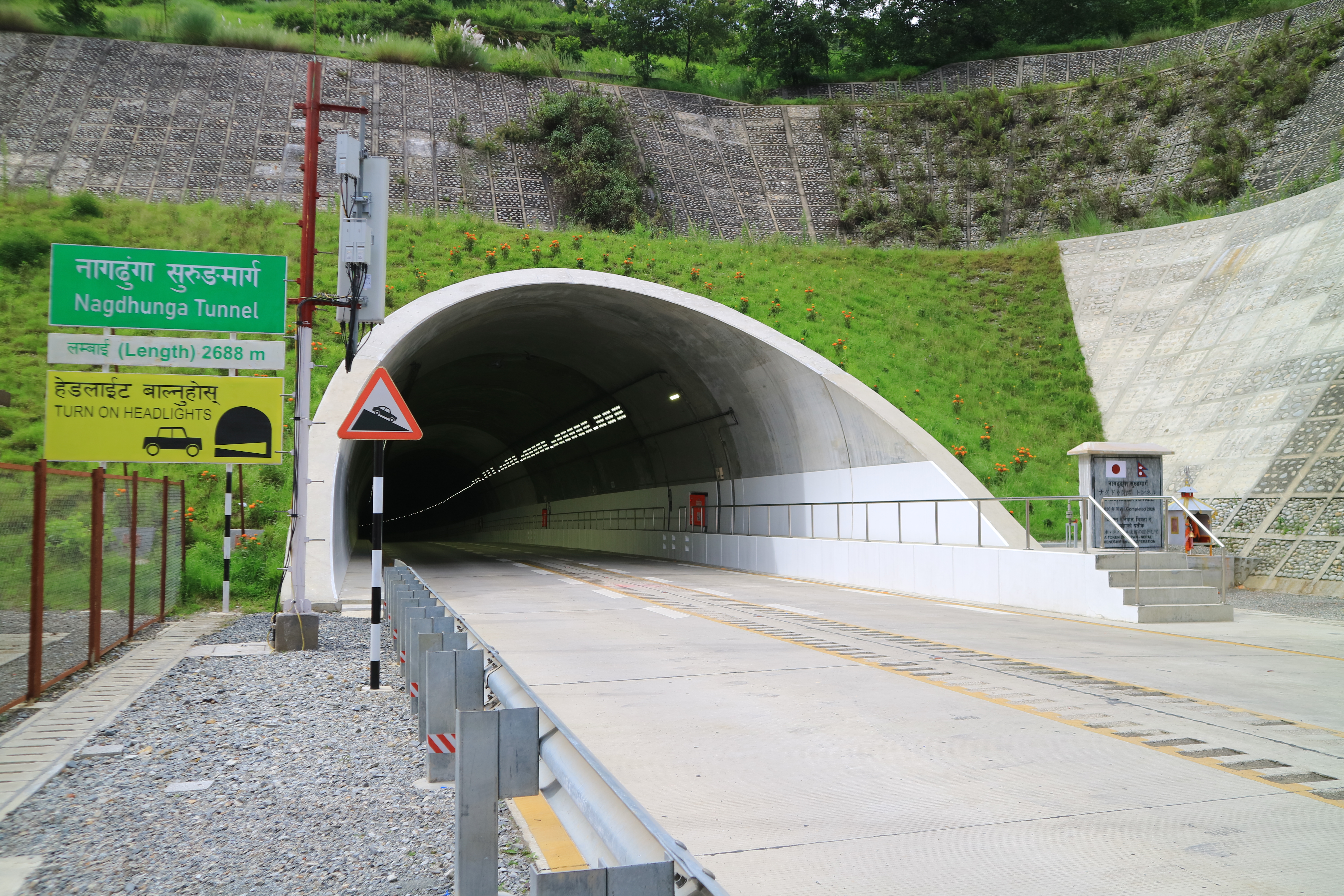
The completed Nagdhunga Tunnel (Photo provided by Hazama Ando Corp.)
The long-awaited tunnel project was prompted by Nepal's transportation challenges. In recent years, economic growth has increased the movement of goods and people, but development of the country's road network has failed to keep pace, resulting in chronic traffic congestion. During the rainy season, landslides have also caused accidents, making road safety another concern.
To find a way to improve the situation, JICA conducted studies on traffic volume, geological conditions and other factors at the planned site of the Nagdhunga Tunnel. The findings indicated that developing a tunnel would be an effective way to reduce traffic congestion and the risk of accidents in the area. After comparing possible routes in terms of geological stability and their potential environmental and social impacts, JICA identified the optimal route through more stable bedrock. Construction of the Nagdhunga Tunnel proceeded through this careful process of preparation and review.
Previously, traveling this section by car took 30 minutes to an hour, but the opening of the tunnel cut the journey to six or seven minutes. In addition to ventilation and lighting systems, the tunnel has a parallel evacuation tunnel that people can use in an emergency. The tunnel is expected to serve as a new model for road infrastructure in Nepal.
In early September, shortly after the tunnel opened, an incident demonstrated its value. A section of the existing road leading to Kathmandu collapsed, severely disrupting traffic. Many vehicles, including ambulances and other emergency vehicles, used the tunnel at the time. The tunnel thus served not only to ease everyday congestion but also as an alternative route when the existing road was disrupted.
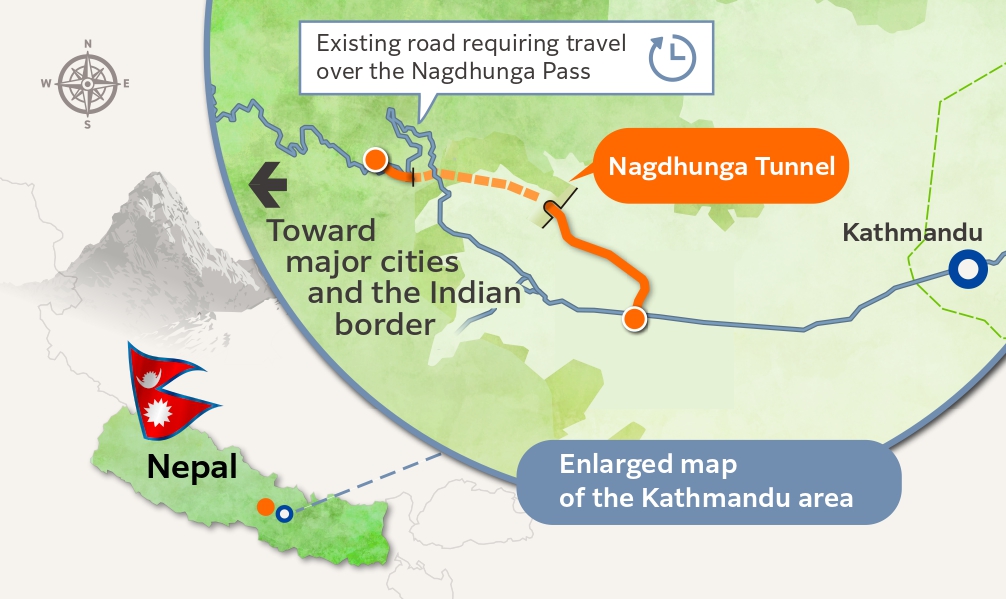
Previously, drivers had to navigate a series of sharp curves over the Nagdhunga Pass. With the opening of the tunnel, they can now take a shortcut that bypasses the mountain road, cutting travel time from 30 minutes to an hour to just six or seven minutes.
Despite thorough surveys and careful preparation, the construction of the tunnel proved more difficult than anticipated.
Inoue Kenichi, who served as site manager for Hazama Ando Corp., a major Japanese construction company that carried out the work, recalls: "As we excavated the tunnel, I came to realize the unique challenges of working in the Himalayas and the immense power of nature."
The Himalayas extend across Nepal and include Mount Everest, the world's highest peak, and other peaks above 8,000 meters. The mountain range was formed by the collision of the Indian and Eurasian tectonic plates, and tectonic activity continues today. As a result, ground pressure in Nepal's mountainous areas is extremely high, and the bedrock is weak and prone to collapse in many places. These harsh geological conditions posed serious difficulties during tunnel construction.
The Nagdhunga Tunnel Construction Project also encountered numerous challenges. Intense ground pressure caused the rock to push into the tunnel in places, while sections of rock collapsed. Nearly 40 rockfalls occurred during construction.
"We continued to see deformation and ground movement on a scale that would be almost unimaginable in ordinary tunnel construction," Inoue says.
In tunnel projects in Japan, deformation caused by ground pressure is typically limited to a few centimeters. At this site, however, deformation reached a maximum of about 1.5 meters. The pressure was so powerful that it twisted apart the steel supports inside the tunnel, forcing engineers to respond to ground pressure far beyond what they had anticipated.
.jpg)
Inside the tunnel after a rockfall (Photo provided by Hazama Ando Corp.)
Measurement work played an important role in dealing with the difficult ground conditions. In tunnel construction, measurements are taken continuously to monitor how the surrounding ground behaves after excavation.
Inoue repeatedly explained the importance of the measurements to the Nepali workers: why they had to be taken from the same measuring points and why a high degree of accuracy was required. The work proceeded as this understanding was shared throughout the construction site.
In ordinary tunnel construction, measurements are typically taken at intervals of 20 to 30 meters. At this site, however, the difficult geological conditions required measurements every 10 meters. Moreover, because the ground continued to move, workers had to take measurements covering an extensive stretch of about 200 meters every day. The Nepali workers continued taking measurements even while excavation was suspended, steadily recording how the ground moved and changed over time.
Inoue recalls: "The Nepali workers never cut corners, even though the work was painstaking, and they kept at it with remarkable patience. Without that data, I think it would have been difficult to understand why the ground was moving in this tunnel."
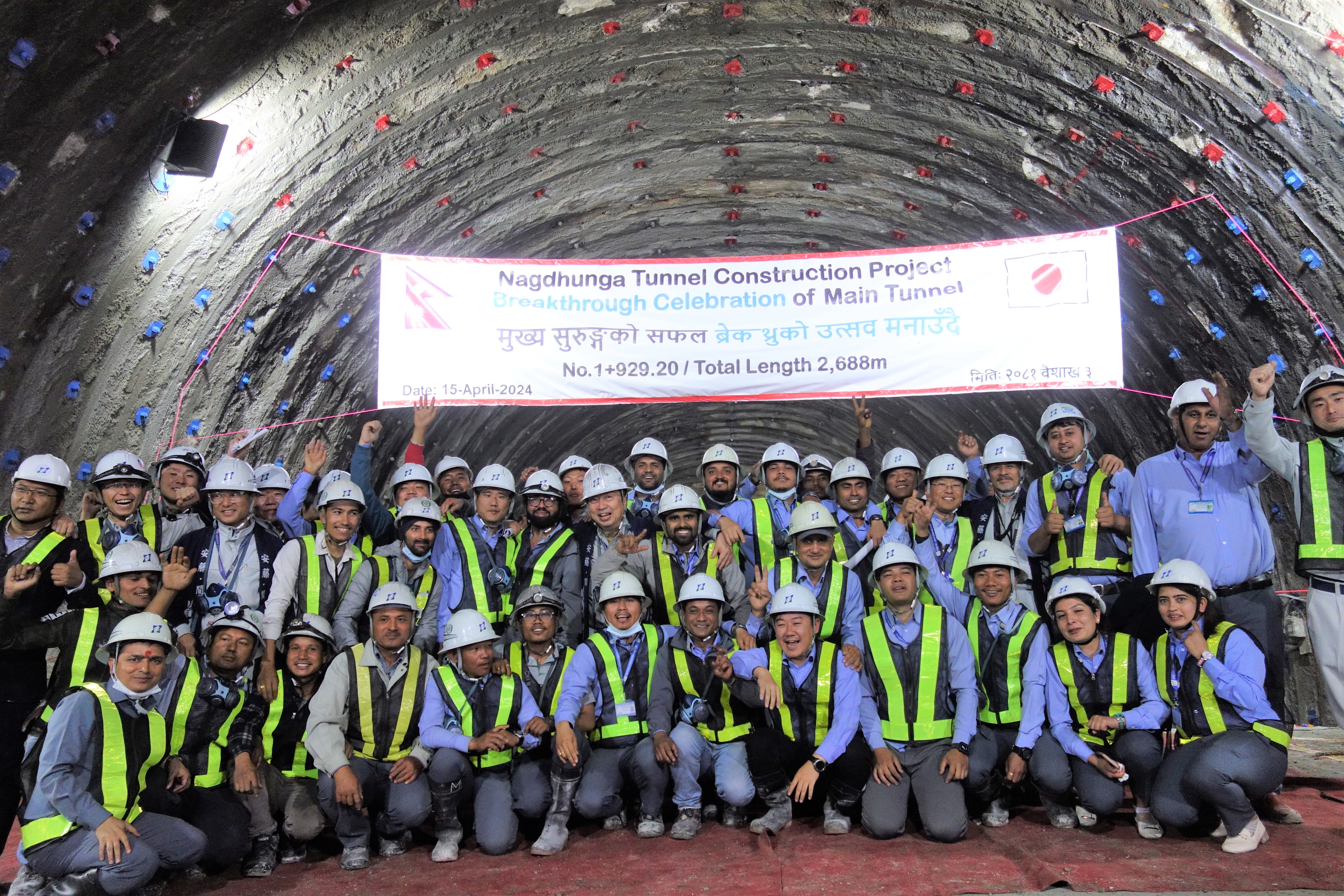
Workers pose for a photo at the breakthrough ceremony for the Nagdhunga Tunnel. (Photo provided by Hazama Ando Corp.)
Inoue believes that the technical expertise and experience gained through the project will be valuable assets for both Nepal and Japan.
While Japan continues to face a shortage of workers in the construction industry, many young people in Nepal are highly motivated to learn Japanese technology. "I would be happy if the connections formed through this project could create a cycle in which Nepali people gain experience and knowledge in Japan, then return home and put that experience and knowledge to use in Nepal," Inoue says.
Saujanya Nepal says, "For Nepali engineers, this was a valuable opportunity to learn about modern road tunnel construction firsthand. I hope it will lead to the construction of many more tunnels (in Nepal) and that cooperation with Japan will continue."
Inoue adds, "Many people have told us that working alongside a Japanese company helped them acquire technical skills and knowledge, as well as learn how to confront difficulties. It made me realize once again that our work has been useful."
Completed over seven years, the tunnel embodies the journey of Japanese and Nepali engineers who joined forces to overcome numerous difficulties.
Sns share!


