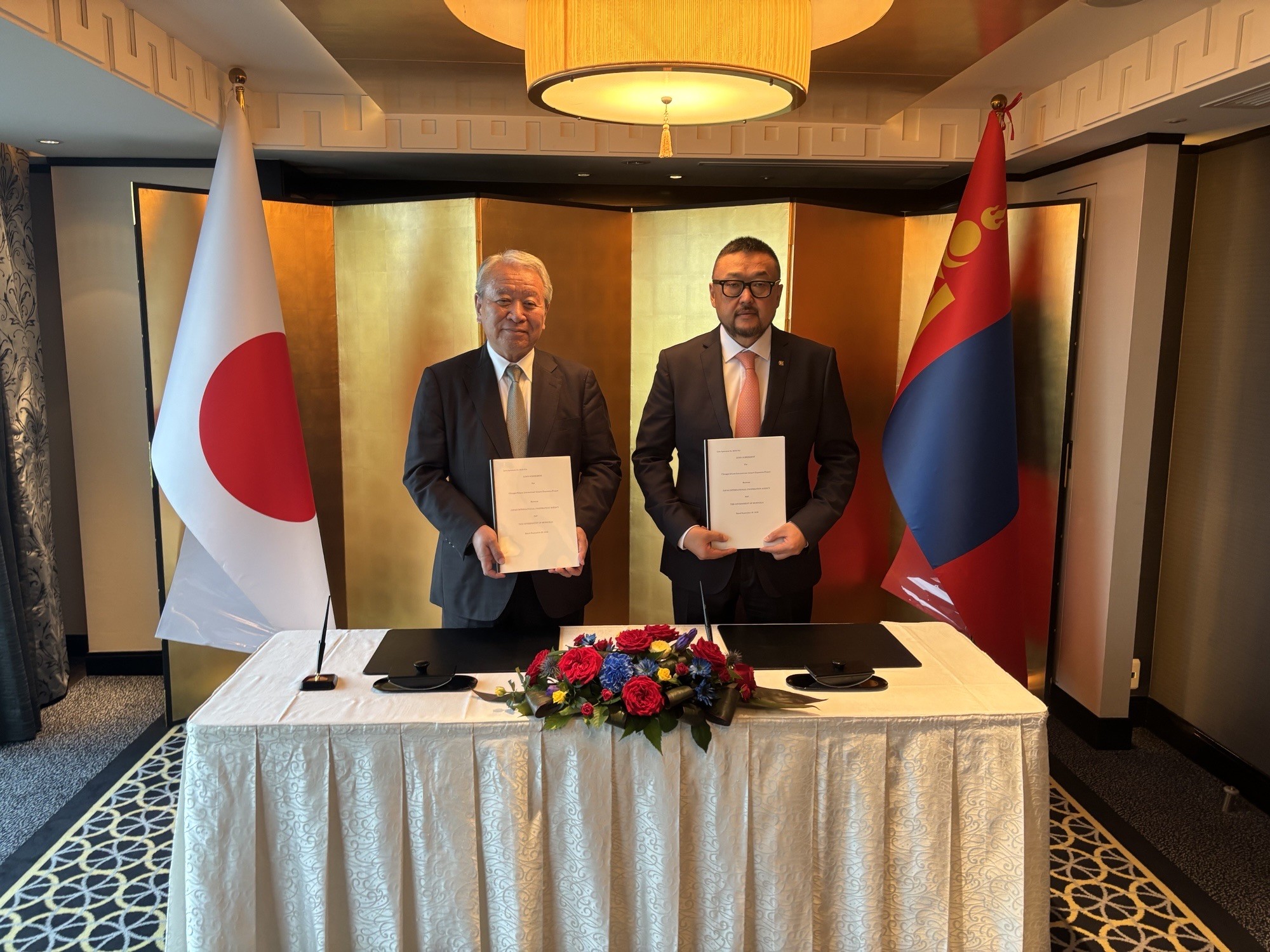
On September 29, the Japan International Cooperation Agency (JICA) signed a loan agreement with the Government of Mongolia in Tokyo, to provide Japanese ODA loan for the Project for Chinggis Khaan International Airport Expansion Project. The signatures were exchanged between Minister Mendsaikhan Zagdjav of Ministry of Finance of Mongolia and JICA President Tanaka Akihiko.
This Project will expand the Chinggis Khaan International Airport, which was constructed with Japanese ODA loan and commenced operations in 2021. As the county’s international gateway airport, the expansion will further enhance Mongolia’s connectivity with other countries through air transportation, which is of particular importance for a landlocked country.
Since its opening, the airport has been operated with the participation of Japanese companies and has served as a symbol of cooperation between Japan and Mongolia. This Project will contribute to the airport’s continued development and strengthen the partnership between the two countries.
The project outline is explained below.
Terms and Amount of Loan
Chinggis Khaan International Airport Expansion Project
- Country
(Target Areas)
Mongolia (Sergelen Soum, Tuv Province)
- Project Objective
The objective of the Project is to ease congestion and enhance further convenience through accommodation of future growth in air passenger and cargo transportation demand, by expanding Chinggis Khaan International Airport, thereby contributing to further economic development of Mongolia.
- Project Component
1. Civil works, building construction, and equipment installation:
Construction of a new passenger terminal building; development of taxiways, aprons, parking facilities, and access roads; enhancement of utility infrastructure, etc.
2. Consulting services:
Detailed design, construction supervision, procurement assistance, etc.
3. Cargo Terminal Building (CTB) development
(financed by the Mongolian side)
Design and construction of a new CTB; demolition of the existing CTB; relocation and associated works
- Maximum Loan Amount
158,284 million Japanese Yen
- Annual
Interest Rate
Project: 1.10%, Consulting Services: 1.10%
- Repayment Period
40 Years
- Procurement
Japan tied
- Executing Agency
Ministry of Road and Transport
“KHUSHIGIIN KHUNDII AIRPORT” State Owned LLC
- Contribution to SDGs
Goal 9(Industry, innovation and infrastructure)
Goal 11(Sustainable cities and communities)
-
Planned Implementation Schedule
1. Completion of the Project: December 2033, upon the commencement of operation of the new facilities
2. Issuing letters of invitation for consulting services (including detailed design work): October 2026
3. Tendering of announcement of initial procurement package for international competitive bidding on project construction:
Package for Airport Expansion Works, Release date: March 2028
Special Terms for Economic Partnership (STEP)*1 will apply to the Japanese ODA loan for this project, and Japanese technology including construction and civil engineering technologies, airport-related equipment, and Eco-Airport*2 technologies are expected to be utilized.
-
※1. STEP refers to special assistance terms for promoting the visibility of Japanese aid through a transfer of outstanding Japanese technology and expertise to developing nations. The main contract is Japan tied and subcontracting is general untied. The main agreement partner must generally be a Japanese company, an overseas subsidiary of a Japanese company, or a joint venture between a Japanese company and the borrowing country where the Japanese company is the lead partner, although under certain conditions, a joint venture between a Japanese company (which is the lead partner of the joint venture) and an affiliated company (as accounted under the equity method) of a Japanese company may be the main agreement partner.
-
※2. Eco-Airport is defined in the “Eco-Airport Guidelines” formulated by Japan’s Ministry of Land, Infrastructure, Transport and Tourism (MLIT) and refers to an airport that implements measures for environmental conservation and the creation of a better environmental setting both within the airport and in its surrounding areas. Technologies and measures generally associated with Eco-Airport include energy conservation, CO₂ emissions reduction, water conservation and waste reduction within airport facilities, as well as the protection of the natural environment and biodiversity in areas surrounding airports.