
【COP30 Side-Event】Promoting Nation/Corporate/Facility Level Transparency for Climate Change Mitigation
Day:2025.12.10
event |





| Full Name | Affiliation | Title |
| Kurisaki Keiko | Urban and Regional Development Group, Infrastructure management Department | Deputy Director |
Date:2025/11/11
Host:MOE, Japan
Location(Pavilion Name):Japan Pavilion
| Full Name | Affiliation | Title |
| Mr. DOI Kentaro | MOE, Japan | Vice-Minister, |
| Mr. Bambang Brodjonegoro | Asian Development Bank Institute (ADBI) | Dean and CEO |
| Mr. Luis Antonio Ibañez Guerrero | Authority of Urban Transportation for Lima and Callao (ATU), Peru | Air Quality Monitoring Coordinator |
| Ms. KURISAKI Keiko | JICA | Deputy Director |
| Ms. Chheng Tharika | Department of Climate Change, Ministry of Environment, Cambodia |
Chief of office |
| Mr. KATO Makoto | Overseas Environmental Cooperation Center, Japan (OECC) | Member, Board of Directors |
| Dr. NOMOTO Takuya | MOE, Japan | Senior Negotiator |
| Dr. Mohd Hafdzuan Bin Adzmi | NRES, Malaysia | Principal Assistant Secretary, |
This event is being held amid growing momentum to ensure transparency in GHG emissions. It aims to share case studies on promoting transparency at various levels (national, sectoral, and project) and discuss strategies to link efforts across these levels. At the project level, JICA and its counterpart (ATU) presented initiatives under the “Public Transport Master Plan for Lima and Callao” in Peru.
A clear and accurate understanding of the current situation is crucial for achieving NDC targets. Under the Paris Agreement’s enhanced transparency framework, Parties are required to submit biennial transparency reports (BTRs) every two years. However, even among countries that have successfully submitted BTRs, tracking progress, especially for economy-wide mitigation efforts, remains as a common challenge, highlighting the needs for continued capacity building.
At the same time, the private sector faces growing pressure to measure and reduce the GHG emissions in response to demands from investors, financial institutions and international frameworks including carbon pricing mechanisms. Some countries have developed systems to calculate and report the GHG emission in order to stimulate companies.
In response to these needs, the Ministry of the Environment, Japan, supports developing countries through initiatives such as Support Initiative for Transparency in Asia (SITA) for BTR preparation and PaSTI for the development of national systems for the calculation and reporting of facility and company-level GHG emissions.
・Mr. Doi referred to “Support Initiative for Transparency in Asia (SITA)”, which includes support packages for inventory and BTR (Biennial Transparency Report) preparation.
・Mr. Bambang emphasized the need for a clear policy framework to promote GHG emissions reduction, as well as the necessity of calculating, reporting, and disclosing data on GHG emissions. He noted that these processes involve various stakeholders, including government and private sectors. He also stressed the importance of collaboration with financial authorities to attract investment for implementing GHG reduction measures.
・JICA and Authority of Urban Transportation for Lima and Callao (ATU) in Peru, introduced Climate Change measures under the “Public Transport Master Plan for Lima and Callao”. One of the outputs Image of the Master Plan is Calculate the contribution of the projects to reducing GHG emissions.
・Prior to the Master Plan, an ongoing “Data Collection Survey on Climate Change Mitigation Effects of Public Transportation Shift in Lima and Callao metropolitan Area” has proposed MRV method (Simplified GHG calculation for NDC tracking). The Master Plan also considers approaches to Climate Funds, for which not only improved transparency but also continuity in calculation is essential.
・ATU has concluded, it was stated that collaboration between the Planning Division (which is responsible for traffic survey, data calculation, and reporting) and the Environment Division (which is responsible for GHG emissions calculation), as well as inter-sectoral coordination, is crucial. In the panel discussion, JICA also highlighted the importance of sectoral collaboration, particularly in the context of accessing Climate Funds.
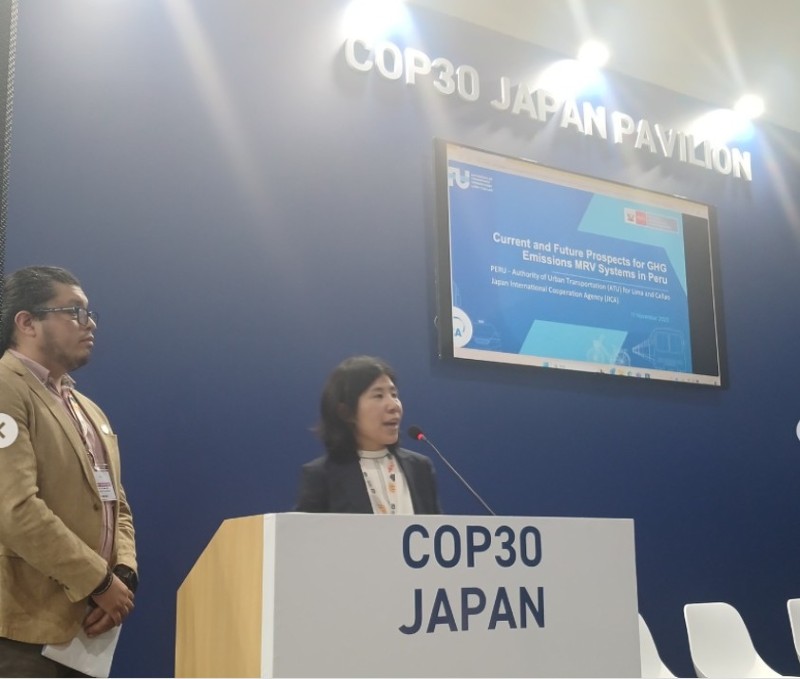
Photo1:Presentation
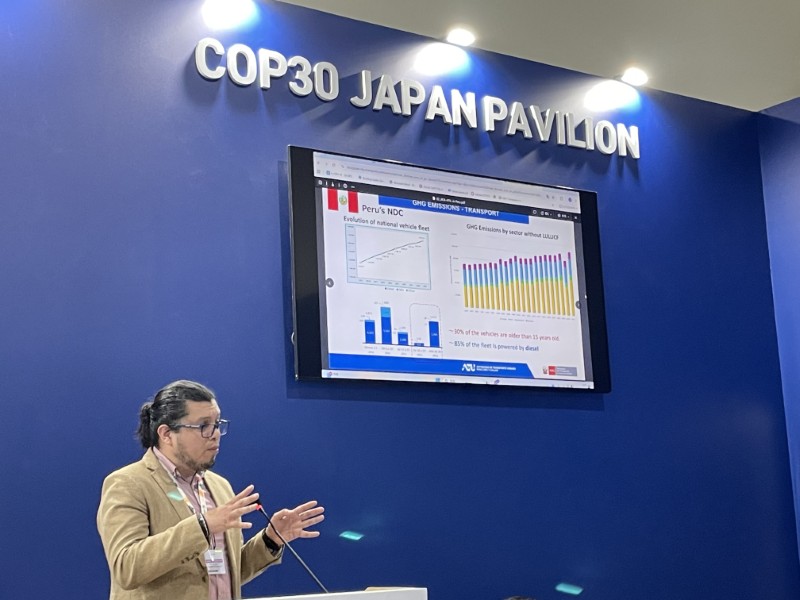
Photo2:Presentation of ATU Counterpart
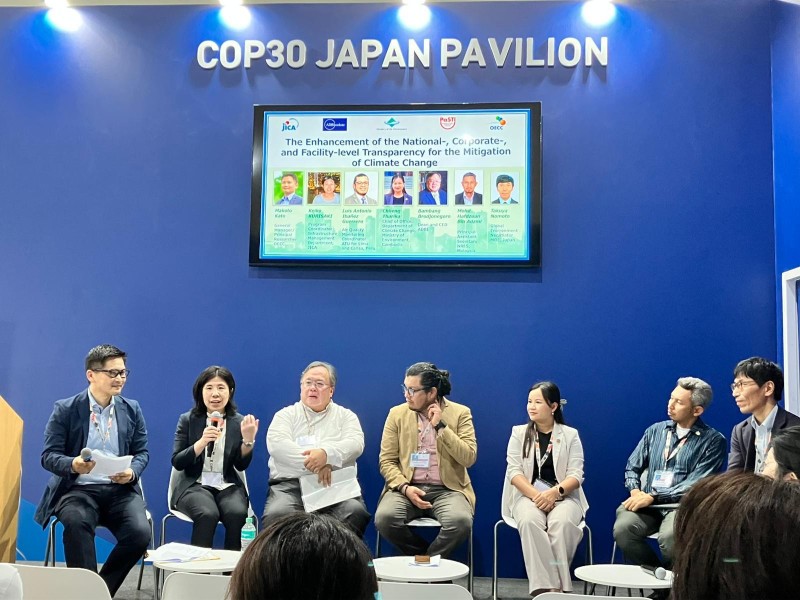
Photo3:Panel Discussion


