
【COP30 Side-Event】Addressing the Gap - Barriers and Enablers for Scaling Adaptation Finance for Nature-based Solutions
Day:2025.12.10
event |





| Name | Organization | Position |
| Toru Yoshida | JICA | Senior Deputy Director |
Date:11/18/2025
Host:WWF, UNEP-WCMC and IDFC
Location (Name of Pavilion):International Development Finance Club Pavilion
| Name | Organization |
| Toru Yoshida | JICA |
| Rodrigo García Ramos Tosta | BNDES |
| Atika Ben Meid | AfD |
| Alexander von Kapffel | KfW |
| Angela Tormin | KfW |
| Manuel Pulgar Vidal | WWF |
Floods, droughts, and sea-level rise caused by climate change are worsening globally, impacting the economies and government budgets of vulnerable regions. Expanding adaptation finance through nature-based solutions (NbS) to build resilience is an urgent priority. NbS, such as mangrove restoration and wetland conservation, provide low-cost and sustainable adaptation measures while delivering co-benefits like biodiversity conservation and livelihood improvement. However, investment remains insufficient. Barriers include unclear policies, a lack of revenue-generating projects, risk perception, and insufficient metrics. To address these challenges, WWF and UNEP-WCMC are developing a global platform called “PLAN.” This session will establish a technical foundation for scaling up NbS investment through barrier analysis, showcasing successful models, and promoting collaboration.
The session discussed challenges and opportunities for scaling up adaptation finance for nature-based solutions (NbS). JICA presented its integrated approach combining technical and financial cooperation, showcasing diverse initiatives across four areas such as forest conservation and water resource management. BNDES emphasized the profitability of adaptation investments, while AFD pointed out concerns over insufficient indicators and an overreliance on “concrete-heavy” solutions. KfW highlighted the Mozambique flood case to advocate for mainstreaming biodiversity, and DBSA shared critiques of current NbS evaluation methods. ADB stressed cost-effectiveness and the importance of developing indicators, sharing the creation of an NbS finance hub and executive training programs. Other examples included challenges of siloed adaptation funds and a women-led marine project in Gambia. To address these issues, WWF and UNEP-WCMC are building a global platform called “PLAN,” aiming to expand NbS investment through public-private partnerships and innovative financing models.
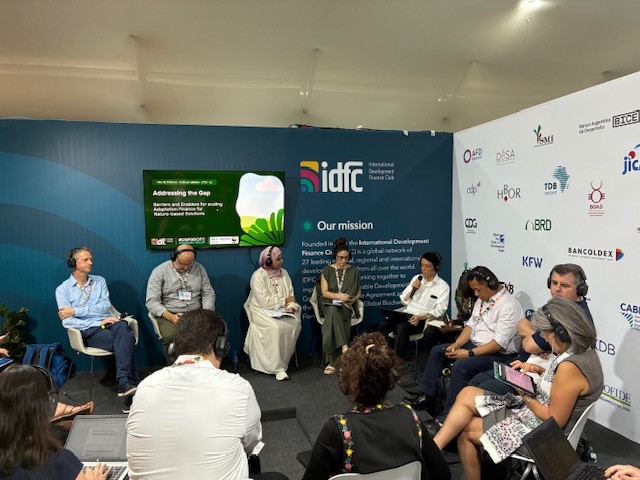
Roundtable Meeting


