
【COP30 Side-Event】Integrating Peatland Restoration and FOLU within the Global Carbon Market Framework
Day:2025.12.10
event |





| Name | Organization | Position |
| Ryunosuke Kataoka | Forest and Nature Conservation Group, Global Environment Department, JICA | Deputy Director |
Date:2025/11/21
Host:Indonesian Tropical Peatland Center (ITPC)
Location(Pavilion Name):Indonesian Delegation Office (Originally scheduled to be held at the Indonesia Pavilion, but the venue was changed following a fire the previous day)
| Name | Organization | Position |
| Martin Krause | UNEP | Director of Climate Change Division |
| Amy Duchelle | FAO | Senior Forestry Officer and Team Leader Forest & Climate |
| Simon Lewis | University of Leeds | Head of Congo Peat Project and Professor of Geography |
| Mitsuru Osaki | JICA and Japan Peatland Society (JPS) | Expert of JICA and President of JPS |
| Franziska Tanneberger | Greifwald Mire Center | Director |
Tropical peatlands serve as essential long-term carbon reservoirs that play a critical role in global climate regulation. However, their contribution to climate mitigation and adaptation is increasingly threatened by degradation, limited financing, and uncertainties surrounding transparency, credibility, and measurement, reporting, and verification (MRV) within emerging carbon market mechanisms. In response, many countries—including Indonesia—have integrated peatland management and carbon reduction efforts into national climate strategies, with Indonesia placing these actions at the core of its Forestry and Other Land Use (FOLU) framework.
Despite this progress, challenges related to methodology, governance, and regulatory clarity persist.
This session aims to address these issues by facilitating an informed exchange on tropical peatland restoration and the role of global carbon markets. By examining the experiences of Indonesia, Peru, the Democratic Republic of the Congo, and the Republic of the Congo, the session seeks to identify pathways to strengthen credibility, enhance permanence, and expand sustainable financing. Ultimately, the objective is to promote cross-country learning and international cooperation that can support peatland protection, FOLU implementation, and global climate goals.
This session addressed the latest developments in tropical peatland restoration, carbon management, and Forest Other Land Use (FOLU) initiatives in Indonesia, Peru, the Democratic Republic of the Congo, and the Republic of the Congo. Discussions focused on comparing the challenges and progress made by each country. Participants also shared good practices for ensuring the reliability of carbon markets and debated approaches to generating credits and mobilizing funds without compromising reliability.
Mr. Krause, in his explanation of the current state of peatlands worldwide, specifically mentioned that tropical peatlands are rapidly increasing in risk as a source of greenhouse gas emissions. He also introduced case studies, including funding mechanisms, on the outcomes of UNEP's South-South cooperation and collaboration with Indonesia through the ITPC, based on this understanding.
Ms. Duchelle explained the "Peatland Breakthrough" initiative, jointly adopted at COP30 by Wetlands International, UNEP, FAO, and others. She emphasized the initiative's significance and importance, while also addressing the funding requirements needed to achieve its goals by 2030. She also touched on past FAO cooperation in peatland restoration in countries like the Democratic Republic of the Congo and Peru, highlighting that peatland restoration is positioned as a key measure for achieving Indonesia's NDC.
Mr. Lewis, using the example of research conducted under his project to calculate carbon maps for peatlands in the Congo Basin, argued that stakeholder consensus is crucial for peatland conservation. He also mentioned the potential for peatland restoration through the TFFF from a financing perspective.
Mr. Osaki introduced the development of the Tier 3 monitoring system for greenhouse gas emissions from peatlands, currently underway as part of JICA's ongoing technical cooperation project "Climate Change Mitigation Project in LULUCF Sector". He stressed the importance of the MRV model that considers not only carbon but also water balances.
Ms. Tanneberger introduced Germany's ongoing peatland mapping initiatives. She also shared research findings on financing challenges for peatland restoration, ecosystem changes resulting from peatland rewetting, and associated ecosystem services.
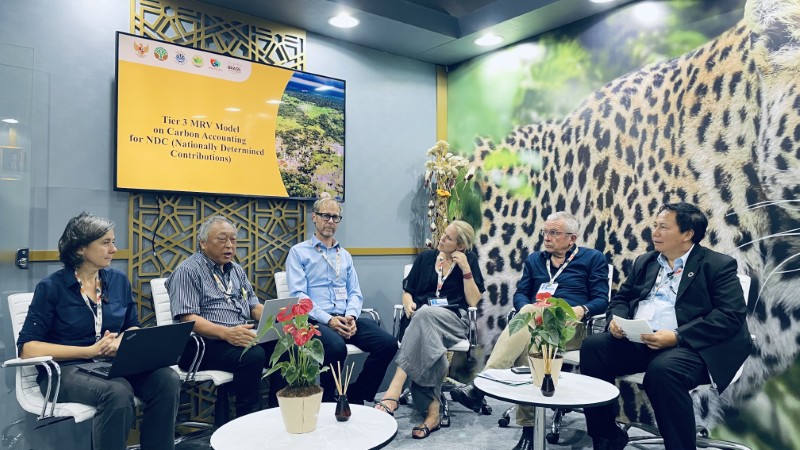
1. Presentation by Mr. Osaki
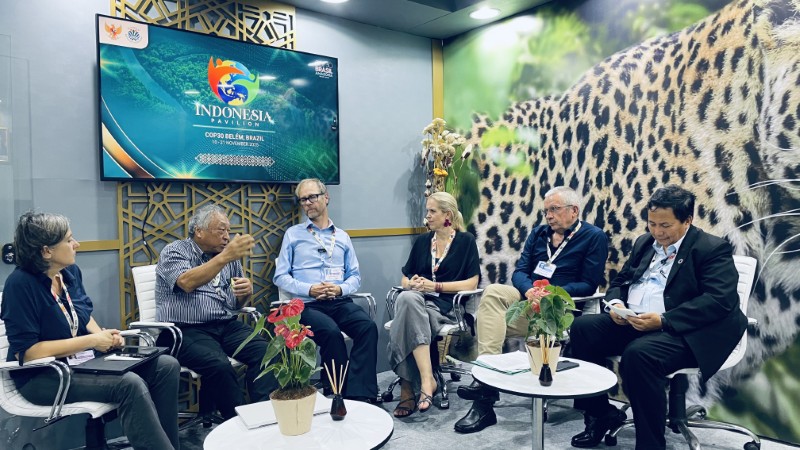
2. Panel Discussion
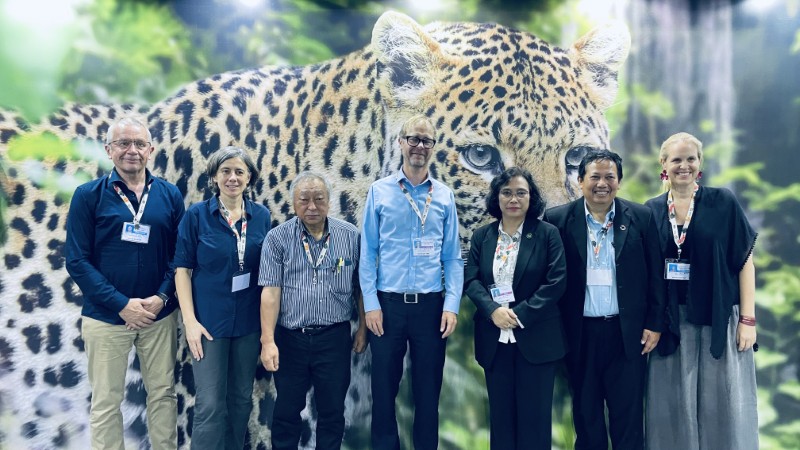
3. Group Photo


