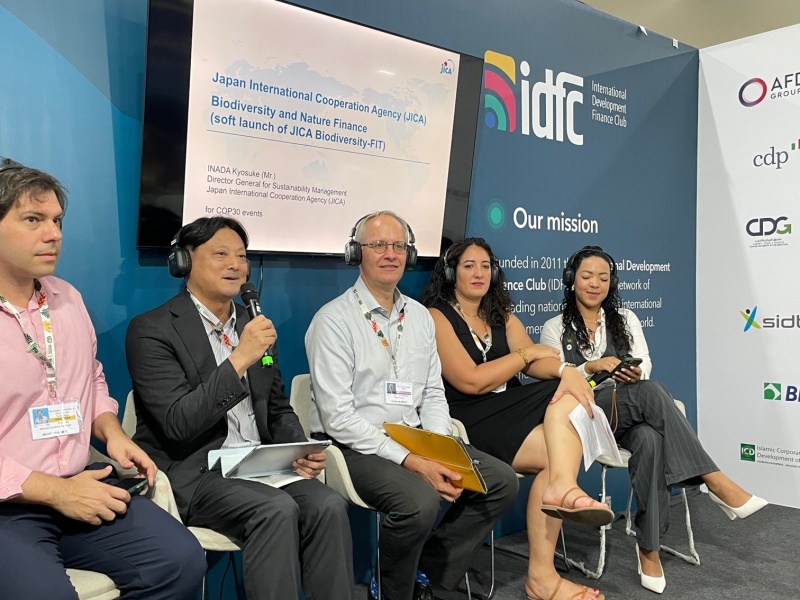
【COP30 Side-Event】 IDFC Scaling Up Nature-based Solutions (NbS): The Role of Public Development Banks in Driving Finance for People and Planet
Day:2025.12.19
event |







| Name | Organization | Position |
| Kotaro TANIGUCHI | Office for Sustainability Management, Operations Strategy Department, JICA | Director |
Date:2025/11/17
Host:International Development Finance Club (IDFC)
Location(Pavilion Name):IDFC Pavilion
| Name | Organization | Position |
| Mustapha Kleiche | IDFC | Facility Director |
| Jean Rodrigues Benevides | ABDE | Director |
| Marie Trémolet | WWF | Programme Officer for Regional Cooperation in the Guiana Shield, WWF-French Guiana |
| Najma Mohamed | UNEP-World Conservation Monitoring Centre (WCMC) | Head of Nature-based Solutions |
| Peter Hilliges | KFW | Chief Climate Officer |
| Kyosuke INADA | JICA | Director General for Sustainability Management |
| Atika Ben Maid | AFD | Deputy Head of Climate and Nature |
| Nabil Moura Kadri | BNDES | Deputy Managing Director for Environment |
・Showcase the strategic role of Public Development Banks in scaling Nature-based Solutions (for adaptation)
・Showcase of how IDFC and ABDE mobilize their networks of development banks to finance NbS-a projects
・Share concrete experiences and lessons learned from different regions, with a focus on Latin America and the Caribbean, but also drawing from Africa, Asia, and Europe.
・Foster dialogue on the main barriers and opportunities for mainstreaming NbS in banking operations
・Explore synergies between NbS, climate adaptation/mitigation, and biodiversity protection, emphasizing their contribution to achieving the GBF and the Paris Agreement.
・Highlight partnerships (including with private sector) and innovative instruments (such as blended finance, green bonds, biodiversity funds) that make NbS projects bankable.
・Position IDFC and ABDE as a driver for nature and climate finance
In the beginning, IDFC highlighted that climate change and biodiversity are closely interconnected, making an integrated approach essential. It also pointed out that financial mobilization for biodiversity is extremely limited compared to climate change, that Public Development Banks (PDBs) can contribute both financially and through capacity building, and that attracting private capital is also expected.
Next, ABDE emphasized that Nature-based Solutions (NbS) should not be implemented in a top-down manner, but rather require the participation of local governments, traditional communities, and civil society. It stressed the importance of linking local challenges to global issues to scale up and amplify local voices internationally, and introduced examples where governments provided policy and technical support, the private sector offered financing, and local communities took initiative to create positive impacts on people’s lives.
In the first half of the panel discussion, WWF presented an NbS case that not only conserved forests but also protected the livelihoods and cultures of indigenous peoples. UNEP-WCMC explained that data-driven NbS initiatives ensure community participation and enable PDBs to make informed financing decisions. ABDE shared examples of engaging academia, communities, public institutions, private actors, and civil society, using seed funding to foster innovation and enhance community engagement.
In the second half of the panel discussion, participants exchanged views on the role of PDBs. KfW stressed that projects led by communities do not succeed with 100% grants alone, and highlighted the importance of securing both public benefits and economic returns for communities and PDBs alike. JICA introduced the amendment of JICA Act on April 2025 that allow expanded financial instruments such as bond acquisition and credit guarantees, and mentioned the ongoing development of the guidance "JICA Biodiversity-FIT" tool to promote biodiversity mainstreaming. AFD shared its efforts to strengthen NbS under its Climate-Nature Roadmap 2026–2030, including examples such as afforestation for landslide prevention in India, joint financing with ADB for NbS in Southeast Asia, and initiatives involving carbon credits, blue carbon, and sustainability-linked loans. BNDES presented projects such as forest conservation co-financed with KfW, coral reef restoration, and activities utilizing concessional climate funds.
Finally, the moderator reaffirmed that NbS has become a central concept in development, finance, and resilience, stressing the importance of science-based data and local community participation, and noted that PDBs are actively working to enhance project effectiveness.