

Research Frontlines Vol. 3 | The First Country to Ban the Import of Gasoline Vehicles: Ethiopia’s Early Insights
2026.09.16







Updates from JICA Ogata Research Institute on the latest events, publications and more.
RegistrationHow to Find Us


JICA Ogata Sadako Research Institute for Peace and Development (JICA Ogata Research Institute) conducts research on a wide range of development challenges, asking critical questions and exploring possible solutions.
This series highlights ongoing research projects, introducing the questions researchers seek to answer and the motivations and issues that inform their analyses. In this third installment, we feature a research project titled “Enhancing Human Security and Promoting Growth and Development through a Just Green Transition (Sixth Joint Research Project with Initiative for Policy Dialogue at Columbia University) .”
Authors: HARADA Tetsuya, Principal Research Fellow, Economic Growth and Poverty Reduction, JICA Ogata Research Institute and Head of JICA France Office, and SOLOMON H. Teklehaymanot, Research Fellow, Economic Growth and Poverty Reduction, JICA Ogata Research Institute
Electric vehicles are rapidly becoming part of the global automotive market. According to the IEA’s Global EV Outlook 2026, more than 20 million EVs were sold worldwide in 2025, accounting for one in every four new cars sold. The transition is about more than climate policy. For many countries, it is increasingly linked to energy security, industrial policy, and dependence on global supply chains.
These issues are particularly important for lower-income countries. For countries that depend heavily on imported petroleum and face foreign-exchange constraints, electric mobility may offer economic as well as environmental benefits. But the transition also raises new questions about affordability, infrastructure, domestic production, and dependence on imported vehicles and technologies.
Ethiopia provides a particularly striking case. In January 2024, it took the unusual step of banning imports of gasoline- and diesel-powered passenger vehicles, even while its EV ecosystem was still developing. What happened next?
Our research examines how Ethiopia’s automobile import market has changed since the January 2024 ban. We ask whether a shift from gasoline vehicles to battery electric vehicles (BEVs) has actually taken place, how large that shift has been, and what is happening within the market as the transition unfolds.
We also consider what these changes may mean more broadly for consumers and for domestic industries in Ethiopia.
Adjustments to the internal market are expected due to the unique nature of the policy ban, requiring immediate action. Importers need to revise their supply channels; Gasoline-based assemblers need to rethink their approach in favor of EVs; Financial institutions need to consider credit-linked access to EVs. Meanwhile, consumers are considering petrol versus electric options during the transition. Thus, early evidence could reveal the immediate adjustments resulting from the policy ban.
To examine these questions, we combine monthly customs data on vehicle imports with international trade statistics and insights from field interviews with government officials, firms, financial institutions, researchers, and other stakeholders in Ethiopia.
Our early analysis points to a substantial shift in Ethiopia’s vehicle import market. Imports of BEVs have risen rapidly, while imports of new gasoline passenger vehicles have declined sharply. Importantly, these changes did not begin only after the January 2024 ban. Gasoline vehicle imports had already been declining, and BEV imports had begun to increase, reflecting broader factors including foreign-exchange constraints and other macroeconomic pressures. The ban appears to have accelerated these existing trends rather than initiating them independently.
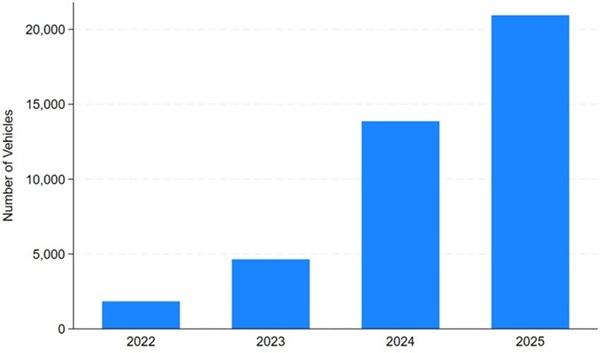
Annual Imports of New Battery Electric Vehicles
We also went to Ethiopia to see how the policy was being implemented and talked to government officials, firms and EV users. This was important for understanding how the transition is unfolding beyond the customs data. Public agencies and private firms are supporting activities related to EV assembly and charging services, although charging infrastructure remains concentrated mainly in Addis Ababa and other major urban areas.
EV owners that we interviewed highlighted challenges including limited access to charging stations, long waiting times, difficulties with long-distance travel, battery replacement costs, limited maintenance skills, insurance issues, and affordability concerns. These factors will be important in determining whether the shift to electric mobility can be sustained.
Empirical research on EVs is available and mostly focuses on high-income countries. In such cases, governments typically stimulate demand through subsidies, tax exemptions, fuel-economy regulations and the development of charging infrastructure before electric vehicles (EVs) become more widespread.
However, Ethiopia’s approach is different. In many African economies, the key challenges extend beyond consumer choices and vehicle technology. These include high initial costs, limited access to consumer financing, an uneven electricity supply, inadequate charging infrastructure, weak maintenance capabilities, concerns about battery replacement, and scarce after-sales services. These factors hinder the direct application of policy models from high-income countries in lower-income contexts.
In Ethiopia, the import ban was introduced while EV support infrastructure was still developing, making it a particularly interesting case. Charging infrastructure and complementary services are still being developed. According to discussions with Ethiopian public agencies, the January 2024 policy was influenced by various factors, including petroleum import costs, foreign exchange shortages, and the intention to promote electric mobility.
This case also contributes to the discussion on strengthening Africa’s climate leadership, given that Ethiopia is preparing to host COP32 in 2027. Many developing nations expect the green transition to foster domestic capabilities in manufacturing, infrastructure and services.
However, early insights into the challenges faced by developing countries is important. Although imports of battery electric vehicles (BEVs) increased rapidly, the initial growth was driven mainly by fully assembled vehicles rather than the components used to manufacture them. This policy altered the composition of imports more quickly than it transformed the domestic production system.
The transition also raises a broader question. While it may reduce Ethiopia’s dependence on imported petroleum, it could create new forms of dependence on imported EVs, batteries, and charging technologies unless domestic capabilities develop alongside the transition.
Ethiopia’s experience suggests that import restrictions can change the composition of the vehicle market relatively quickly. However, restricting gasoline vehicles alone does not necessarily create a sustainable electric mobility system. The longer-term transition will also depend on charging infrastructure, maintenance and after-sales services, access to finance, and the development of domestic capabilities.
The transition also extends beyond passenger cars. Petrol-powered motorcycles still dominate Ethiopia’s two-wheeler market, although electric two-wheeler imports have also begun to rise. Given the importance of two-wheelers for affordable mobility, delivery services, and employment, the development of electric motorcycles, charging or battery-swapping systems, financing, and maintenance services could become another important part of Ethiopia’s transition.
At the same time, the rapid growth in EV imports does not mean that Ethiopia’s vehicle fleet will become electric overnight. Gasoline vehicles still account for the large majority of vehicles currently on the road. Cars have also traditionally been valuable and long-lived assets in Ethiopia, with active trading in the used-car market and relatively limited depreciation even as vehicles age.

A Street Scene in Addis Ababa
This is why, alongside new-vehicle imports, we are also interested in what is happening in the used-car market. EVs remain relatively expensive to purchase, although their running costs can be substantially lower than those of gasoline vehicles. Some consumers may therefore see clear advantages in switching to EVs. For others, however, the upfront cost remains a major barrier. Gasoline vehicles may also retain particular value for people who regularly travel outside major urban areas, where charging infrastructure remains limited.
Meanwhile, the import ban is gradually making existing gasoline vehicles a scarcer asset. These competing forces make used-car prices particularly interesting: they may provide a useful signal of how Ethiopian consumers are assessing the costs, benefits, and uncertainties of the transition to electric mobility. In the next phase of our research, we plan to examine these changes using detailed data on Ethiopia’s used-car market.
Sns share!



事業事前評価表(地球規模課題対応国際科学技術協力(SATREPS)).国際協力機構 地球環境部 . 防災第一チーム. 1.案件名.国 名: フィリピン共和国.
事業事前評価表(地球規模課題対応国際科学技術協力(SATREPS)).国際協力機構 地球環境部 . 防災第一チーム. 1.案件名.国 名: フィリピン共和国.
事業事前評価表(地球規模課題対応国際科学技術協力(SATREPS)).国際協力機構 地球環境部 . 防災第一チーム. 1.案件名.国 名: フィリピン共和国.
事業事前評価表(地球規模課題対応国際科学技術協力(SATREPS)).国際協力機構 地球環境部 . 防災第一チーム. 1.案件名.国 名: フィリピン共和国.
事業事前評価表(地球規模課題対応国際科学技術協力(SATREPS)).国際協力機構 地球環境部 . 防災第一チーム. 1.案件名.国 名: フィリピン共和国.


