

Sustaining Peace in Uncertain Times: Launch of the Adaptive Peacebuilding Guidebook
2026.11.06




Updates from JICA Ogata Research Institute on the latest events, publications and more.
RegistrationHow to Find Us


How can peacebuilding practitioners support sustaining peace in societies affected by conflicts? Researchers and practitioners explored adaptive responses to this challenge on October 2, 2026, at the “Towards Sustaining Peace: Adaptive Peacebuilding Guidebook Launch Seminar.” The hybrid seminar, co-hosted by the JICA Ogata Sadako Research Institute for Peace and Development (JICA Ogata Research Institute) and the Norwegian Institute of International Affairs (NUPI), introduced practical guidance for working with complexity and uncertainty, as well as for supporting locally led peacebuilding efforts.
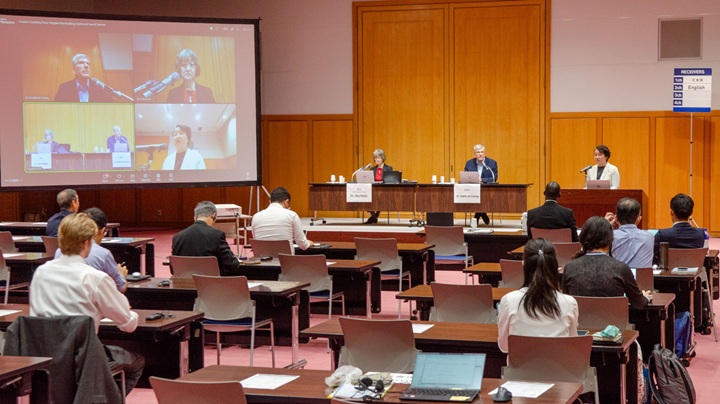
Researchers and practitioners participated in the hybrid seminar in person and online
In her opening remarks, Kamei Haruko , Director General at the JICA Ogata Research Institute, noted that there is no universal blueprint for peacebuilding, emphasizing that practitioners must learn alongside local communities. The newly published “Adaptive Peacebuilding Guidebook ,” she emphasized, provides a way of connecting research and practice, building on the institute’s academic volume “Adaptive Peacebuilding: A New Approach to Sustaining Peace in the 21st Century ” and reflecting JICA’s field-oriented approach and commitment to human security.
In his keynote speech, NUPI Research Professor Cedric de Coning outlined three building blocks of adaptive peacebuilding: recognizing complexity, navigating uncertainty through learning, and placing community participation at the center.
Firstly, he argued that the peacebuilding community had made a fundamental category error by assuming that experts could diagnose conflicts and design solutions through predictable chains of cause and effect. Societies affected by conflict have been treated as if they were machines to be fixed or a patient to be healed. Yet social-ecological systems are dynamic, nonlinear, self-organizing, emergent and adaptive, so their responses cannot be fully predicted. This also creates possibilities for adaptation and creativity that peacebuilding can facilitate.
Secondly, de Coning described adaptive peacebuilding as an inductive approach based on learning and adapting through experience. Through variation, feedback, and selection, practitioners explore options, monitor their effects and adjust their actions accordingly. Harmful actions should be stopped, ineffective actions changed, and effective actions scaled up, all the while remaining subject to adaptation. As de Coning noted, what works today may not work tomorrow.
Thirdly, he emphasized that the responsibility for peacebuilding must shift from experts to societies themselves. Communities should lead conflict analysis, identify their vision for peace and make critical decisions, with the support of external advice, technical expertise and resources. However, excessive external influence can undermine ownership, disrupt self-organization and create dependency. This is why peacebuilding has to be essentially local.
The guidebook translates these principles into practical guidance, drawing on approaches already used by JICA and others. However, de Coning cautioned that “This is not an IKEA manual for assembling a sofa.” Each peace process is unique and requires continuous adaptation.
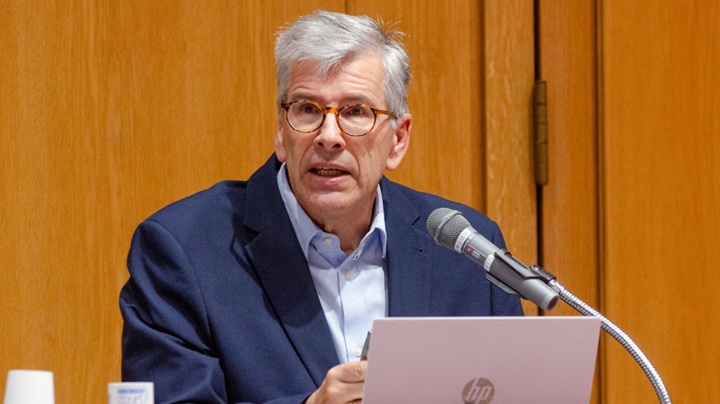
Cedric de Coning, Research Professor at the Norwegian Institute of International Affairs, giving the keynote speech
Tsuchiya Tsunetaka , Associate Professor at Kyoto Tachibana University, explained the guidebook's four-step peacebuilding cycle: 1) assess, 2) plan, 3) implement and monitor, and 4) reflect and adapt. He then outlined five principles—context-specific, participatory, adaptive, iterative and holistic—that guide each stage of the process. Assessment tools should be fit for purpose and context-specific, and indicators should be developed by the people involved. People affected by conflict are crucial knowledge holders whose participation should extend throughout the cycle. Adaptive peacebuilding explores multiple options simultaneously, each supported by a clearly defined theory of change, in order to learn from their effects. Assessment and analysis should remain living documents, while objectives and plans may evolve over time. Actions should be understood in relation to the broader peacebuilding process. He emphasized that adaptation is an ongoing daily practice, not merely a feature of the project cycle. The guidebook, he noted, is intended not to replace existing institutional guidance but rather to complement it with an adaptive perspective.
Muto Ako , Specially Appointed Research Fellow at the JICA Ogata Research Institute, introduced eight case studies from the Guidebook, illustrating an adaptive peacebuilding approach throughout the four-step cycle. Despite differences in geography, implementing organizations, stakeholders and activities, she identified five common perspectives: communities are central actors; trust, dialogue and networks are crucial; decisions should be locally driven; livelihoods and economic opportunities can support peace; and a long-term perspective complements short-term outcomes. Muto emphasized that JICA’s human security approach places people at the center, aligning with adaptive peacebuilding’s emphasis on the agency of the people it works with.

Tsuchiya Tsunetaka, Associate Professor at Kyoto Tachibana University
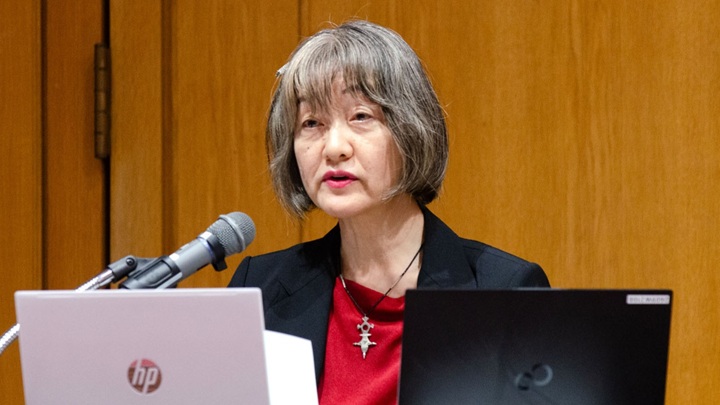
Muto Ako, Specially Appointed Research Fellow at the JICA Ogata Research Institute
Frida Swidan of the Folke Bernadotte Academy (FBA) described a project that supports inclusive and transparent local governance through community participation in southern Iraq. Building relationships between partner organizations and between local government and civil society representatives enabled participatory analysis. Through a dialogical approach, participants built trust, formed a Community Participation Team connected to the local government, and tested responses to local challenges. Analysis remained a continuous process, and as learning accumulated, the theory of change (the assumptions linking activities to desired outcomes) and even the target group evolved over time.
Nayef al-Fahad of the Iraqi Research Foundation for Analysis and Development (IRFAD) explained that the project was able to adapt to changing circumstances thanks to local knowledge, trust and long-standing relationships. Rather than predetermined activities, the project responded to emerging needs with tailored support by working through existing structures. Participation was understood as an interaction between individual capacities, relationships and institutions. While strengthening local participation in decision-making provided a starting point, the understanding of the problem and theory of change evolved over time. Participants tested their own initiatives under their own leadership and structures, with adaptation driven by continuous learning.

Frida Swidan of the Folke Bernadotte Academy

Nayef al-Fahad of the Iraqi Research Foundation for Analysis and Development
In a pre-recorded video, Elizabeth Lucy Turner of the United Nations Secretary-General’s Peacebuilding Fund highlighted how community-based monitoring allowed young people in Guatemala to influence project design through locally generated evidence. The findings led to adaptations that addressed barriers to young women’s participation and strengthened youth engagement in local governance. The initiative contributed to a 77% improvement in perceptions of youth participation and supported the adoption of youth and gender policies in four municipalities.
In her comment, Dohi Yuko, Senior Advisor in JICA’s Governance and Peacebuilding Department, described the guidebook as a timely contribution at a time of increasingly complex and protracted conflicts. She stressed that sustaining peace must be generated by the society concerned through continuous learning and participation. She offered three priorities: maintaining a long-term vision while adapting to change, supporting local agency, and investing in relationships of trust. Effective peacebuilding, she noted, requires careful consideration not only of what to support, but also when, how, and with whom to engage. She emphasized that trust is an important source of resilience in peacebuilding.
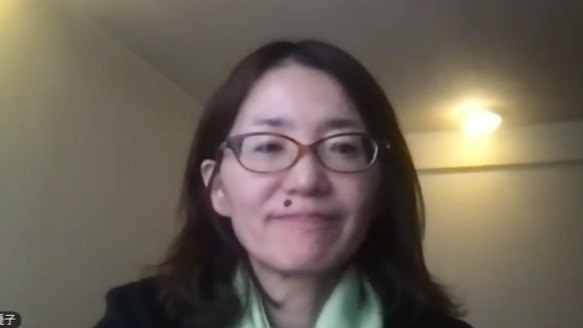
Dohi Yuko, Senior Advisor in JICA’s Governance and Peacebuilding Department
The video recording of the seminar will be available on this page soon.
Sns share!



事業事前評価表(地球規模課題対応国際科学技術協力(SATREPS)).国際協力機構 地球環境部 . 防災第一チーム. 1.案件名.国 名: フィリピン共和国.
事業事前評価表(地球規模課題対応国際科学技術協力(SATREPS)).国際協力機構 地球環境部 . 防災第一チーム. 1.案件名.国 名: フィリピン共和国.
事業事前評価表(地球規模課題対応国際科学技術協力(SATREPS)).国際協力機構 地球環境部 . 防災第一チーム. 1.案件名.国 名: フィリピン共和国.
事業事前評価表(地球規模課題対応国際科学技術協力(SATREPS)).国際協力機構 地球環境部 . 防災第一チーム. 1.案件名.国 名: フィリピン共和国.
事業事前評価表(地球規模課題対応国際科学技術協力(SATREPS)).国際協力機構 地球環境部 . 防災第一チーム. 1.案件名.国 名: フィリピン共和国.


