

Exploring the Afterlives of Peacebuilding: JICA Ogata Research Institute Researchers Present New Research at ACUNS 2026
2026.11.16



Updates from JICA Ogata Research Institute on the latest events, publications and more.
RegistrationHow to Find Us


Research Fellow Maryam AlKubati and Specially Appointed Research Fellow Muto Ako from the JICA Ogata Sadako Research Institute for Peace and Development (JICA Ogata Research Institute) participated in the 39th Academic Council on the United Nations System (ACUNS) Annual Meeting held at the Universidade NOVA de Lisboa in Lisbon, Portugal on July 1–3, 2026. Under the theme “Multilateralism under Challenge and the Future of the Pact,” the event brought together scholars, diplomats, and policy experts from around the world.
The roundtable session “What Shapes and Sustains Peace When Peacebuilding as We Have Known It, No Longer Does?” discussed the future of peacebuilding, as international peacebuilding actors no longer occupy the same central role in shaping peace processes. This is an increasingly pressing question given that the international peacebuilding landscape is changing amid rising levels of conflict, the changing role of the United Nations, and waning political commitments among international actors to support peacebuilding initiatives.
AlKubati served as chair and introduced the research project “The Afterlives of Peacebuilding: Local Continuities, Reorganization and Fragmentation,” currently under development at the Institute. The project explores how societies continue to shape and sustain peace as international peacebuilding support loses centrality. In this context, “loss of centrality” refers to a situation in which traditional actors no longer occupy the same central role in shaping peace processes. The project examines how societies continue to shape peace in these contexts, focusing on local practices, institutions and relationships. The research will examine case studies from Afghanistan, Colombia, the Sahel, Lebanon/Palestine, the Philippines, Ukraine and Yemen. The selected cases will cover a wide range of contexts, including countries emerging from decades of international intervention, settings where international missions have withdrawn, and places where conflict continues despite extensive external engagement.
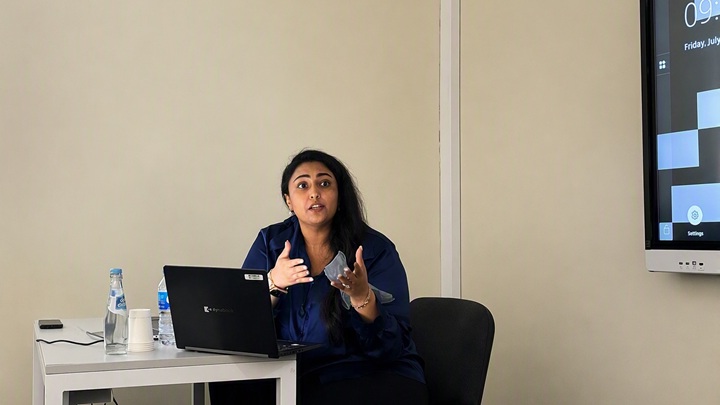
Maryam AlKubati, Research Fellow at the JICA Ogata Research Institute, outlines the research project “The Afterlives of Peacebuilding: Local Continuities, Reorganization and Fragmentation.”
Following the introductory presentation, Cedric de Coning, Research Professor at the Norwegian Institute of International Affairs (NUPI), situated the project within broader debates in peacebuilding research, explaining how it builds upon previous work on adaptive peacebuilding and complexity systems perspectives. He emphasized that the project is not concerned with whether international peacebuilding survives after external interventions change, but with how societies continue to sustain peace as the influence of international actors evolves over time. By shifting attention from international interventions to local institutions, practices, and relationships, he argued that the framework complements rather than replaces existing peacebuilding scholarship, offering a broader perspective on how peace evolves across different contexts.
Drawing on both research and practical experience, Muto, who participated virtually, stressed that sustainable peace must be driven by the commitment and initiatives of local actors, with international cooperation playing a supportive role. She added that the project aims to help bridge research and practice, generating insights that inform future international peacebuilding policies and programs.
Commenting on the presentations, Fujishige Hiromi, Professor at Aoyama Gakuin University, welcomed the project’s overall conceptual direction and its focus on broader societal processes beyond international interventions. While expressing strong support for the approach, she raised several questions regarding the project’s research design, including case selection, the measurement of “loss of centrality,” and the application of the analytical framework. She also encouraged further reflection on how the project’s findings might contribute to broader debates on peacebuilding.
The roundtable prompted lively discussion among attendees. In response to questions about the meaning of “loss of centrality,” the speakers emphasized that it should be understood as a shift in the relative influence of international peacebuilding actors, rather than simply the withdrawal of international actors or a reduction in funding. Participants from international organizations and development agencies pointed out the importance of demonstrating the project’s practical relevance, particularly how its findings could inform peacebuilding practice, donor programming and the long-term sustainability of peacebuilding efforts.
The findings can help international actors better understand existing local peace ecosystems, design more locally grounded and adaptive programming, and contribute to the long-term sustainability in a changing international peacebuilding landscape. The research findings from the cases will be brought together in an edited volume currently under development by the research team.
Sns share!



事業事前評価表(地球規模課題対応国際科学技術協力(SATREPS)).国際協力機構 地球環境部 . 防災第一チーム. 1.案件名.国 名: フィリピン共和国.
事業事前評価表(地球規模課題対応国際科学技術協力(SATREPS)).国際協力機構 地球環境部 . 防災第一チーム. 1.案件名.国 名: フィリピン共和国.
事業事前評価表(地球規模課題対応国際科学技術協力(SATREPS)).国際協力機構 地球環境部 . 防災第一チーム. 1.案件名.国 名: フィリピン共和国.
事業事前評価表(地球規模課題対応国際科学技術協力(SATREPS)).国際協力機構 地球環境部 . 防災第一チーム. 1.案件名.国 名: フィリピン共和国.
事業事前評価表(地球規模課題対応国際科学技術協力(SATREPS)).国際協力機構 地球環境部 . 防災第一チーム. 1.案件名.国 名: フィリピン共和国.


