
【COP30 Side-Event】Japan's Blended Finance Journey towards Climate Transition
Day:2025.12.10
event |







| Name | Organization | Position |
| Ryosuke Takahashi | Operations Strategy Department | Deputy Director |
Date:2025/11/14
Host:JICA
Location(Pavilion Name):International Development Finance Club Pavilion
| Name | Organization | Position |
| Kyosuke Inada | JICA | Director Genaral for Sustainability Management |
| Ryosuke Takahashi | JICA | Deputy Director, Operations Strategy Department |
| Sean Kidney | Climate Bonds Initiative | Chief Executive Officer (CEO) |
| Kirsty McNichol | Department of Foreign Affairs and Trade of Australia | Director of Climate Finance Section, Climate Resilience and Finance Branch |
| Matt Eldridge | Gates Foundation | Climate Finance Advisor |
| Clarisa De Franco | Allied Climate Partners | Senior Advisor |
| Muhammed Sayed | Development Bank of Southern Africa (DBSA) | Specialist, Climate & Environment Finance Unit |
・At COP29, the target of at least $300 billion in climate finance for developing countries was agreed, and all actors were called for actions to reach $1.3 trillion. In this context, mobilizing private capital and collaboration between private sector and public sector are essential to achieving goals.
・This event aims to share what JICA is working on in terms of blended finance and promote discussions between participants such as ministry/department, development finance institutions and philanthropic institutions which are likewise working on blended finance.
・At the beginning of the event, JICA's Deputy Director Takahashi provided an overview of JICA's Private Capital Mobilization Financing, an operation that makes catalytic investment in funds to attract private capital.
・Ms. McNichol cited the Australian government's blended finance initiatives, including fund investments through Australian Development Investments (ADI), the Private Infrastructure Development Group (PIDG), and investments through the Australian Climate Finance Partnership (ACFP) established at the Asian Development Bank. She also mentioned that the Export Finance Australia (EFA) is also working on blended finance. She further noted that in addition to climate change, gender is also an important sector, and noted the potential for synergistic effects between the two.
・Mr. Eldridge noted that the Gates Foundation's efforts include support at an upstream stage rather than fund investment. Specifically, he explained that Gates Foundation utilizes tools such as R&D, TA grants, direct investment, and guarantees to build complementary relationships with other organizations. He also mentioned that in the agricultural sector, in which he is involved, opportunities exist for adaptation and mitigation, such as strengthening the productivity and resilience of small farmers and wholesalers, and biofertilizers.
・Ms. Franco explained that Allied Climate Partners is a philanthropic organization that invests in for-profit funds. She also noted that because the organization is not necessarily large, fund investment is an efficient approach. She noted the importance of addressing the risks, given the lack of data to determine investments in developing regions and the importance of building a track record of investments. She also mentioned the importance of investing in local funds and prioritizing development bottlenecks.
・Mr. Sayed explained that, as a Green Climate Fund (GCF) accredited organization, DBSA provides subordinated loans using GCF funds, and emphasized the importance of supporting project preparation. He also mentioned the desire to replicate this in other regions. He mentioned opportunities in areas such as just transition, nature, and green hydrogen.
・The side event confirmed that it is important for institutions engaged in catalytic investments to collaborate with each other, including by sharing such knowledge.
・In his commentary on the side event, Mr. Kidney stated that capital exists in the market, and that it is important to mobilize this capital where it is needed, such as climate change. Regarding resilience, which is attracting much attention at COP30, he explained that it is a concept that does not only refer to physical resilience but also includes social resilience, and also pointed out its relevance to gender. He concluded by stressing the importance of financial engineering to mobilize capital, and of deepening collaboration among stakeholders.
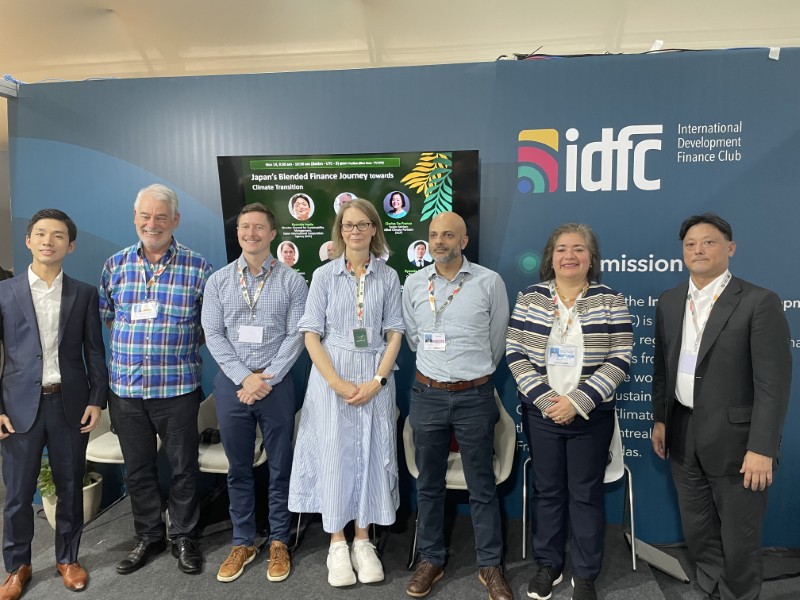
1. Group Photo
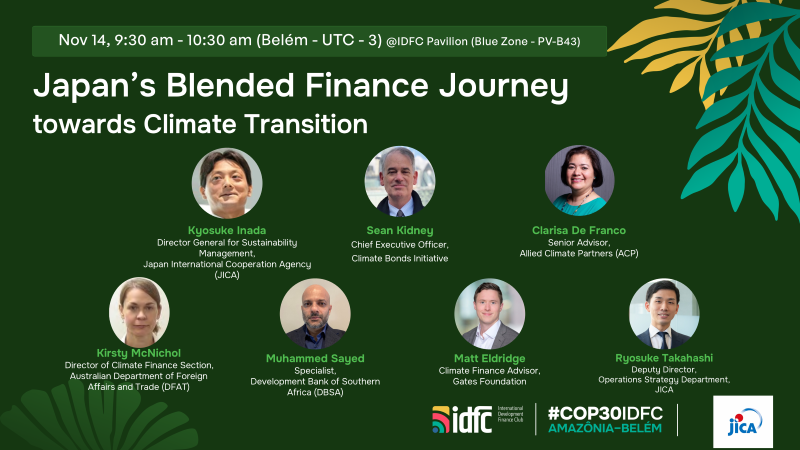
2. Presenters


