

Interview With Visiting Fellow Aiba Daiju: Development of the Cambodian Financial Sector Through the Promotion of Home-Currency Use and Financial Inclusion
2026.01.08





Updates from JICA Ogata Research Institute on the latest events, publications and more.
RegistrationHow to Find Us


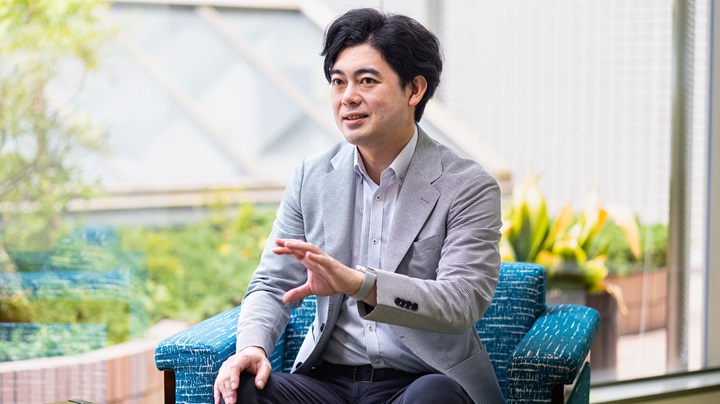
Aiba Daiju , Visiting Fellow, has continuously been part of research projects on the Cambodian financial sector at the JICA Ogata Sadako Research Institute for Peace and Development (JICA Ogata Research Institute). He is currently a JICA Expert as well. We asked Aiba to share the challenges facing the Cambodian financial sector and the so-far research findings from the vantage point of someone who has continued to see both research and policy making.
―You have been studying the Cambodian financial sector for more than a decade. What challenges does the sector face?
In Cambodia, both the local currency “riel,” and the United States dollar (USD) are widely used. This situation has historical roots: the home currency and banks were abolished under the Pol Pot regime (1975–1979); after the regime collapsed, a trustable financial system was not built during the course of nation rebuilding; and large inflows of international aid in USD led to a dollarized economy.
However, once a USD-based financial system has been developed, money supply will become uncontrollable, making it difficult to stabilize the domestic currency value or implement an effective interest-rate policy. This is because the National Bank of Cambodia (NBC), cannot issue USD banknotes. The NBC has been therefore making a variety of efforts to promote the use of the riel. For example, in 2020, the NBC was one of the first central banks in the world to introduce a blockchain-based digital payment infrastructure, known as Bakong. In addition, it is working to promote financial inclusion so that more people can access financial services. Yet still, one would have to say that many challenges remain.
―Can you tell us about the outcomes of “Empirical Study on the Promotion of Home Currency in Cambodia ,” a research project by the JICA Ogata Research Institute?
I have been involved in this research project since 2014. In 2014, it was said that 99% of the Cambodian economy was USD-based: more than 90% of bank deposits in Cambodia were in USD and loans were taken out in USD. Therefore, in this research project, we investigated the actual usage of the riel and USD in households, corporates and banks across the nation. Surprisingly, our results revealed that dollarization was limited to areas around Phnom Penh, the capital city, and the riel was frequently used in rural areas. This was a huge surprise to the Cambodian financial sector. By conducting surveys and providing objective data to verify assumptions, policymakers can design next-step policies that reflect actual conditions. After seeing the results, the NBC fully implemented a riel-usage promotion policy and a regulation that mandates 10% of the total amount of loans held by a bank to be in riels. There was opposition in the beginning, arguing that the regulation is unrealistic, but by 2019, the 10% goal was achieved by many banks.
In addition, in 2017, the Cambodian government introduced an interest rate cap regulation so that lending rates can be set by policy. As a result, the annual interest rate by microfinance institutions, which mainly provide loans to those in poverty, was lowered to 18%. Awareness of the problems caused by excessive debt and high interests was behind the establishment of the interest rate cap regulation. In this research project, to understand what actual impacts were brought about by the regulation, the economy of around 1,000 households was studied and with the help of NBC, credit information databases owned by local credit information agencies were accessed to analyze information of around 10 million individual loans held by financial institutions across Cambodia. As a result, we found out that the number of loans provided by microfinance institutions had decreased, especially in rural areas, because the interest rate cap was set.
Consumers often assume that lower interest rates make borrowing easier, but for financial institutions, the reality is more complex. This is because if more consumers, attracted by low interest rates, come to take out loans, there would be a greater risk of ending up with more consumers who cannot repay. In rural areas where more people tend to be in poverty, microfinance institutions were particularly concerned about the risk of losing money, leading to their reluctance to give out loans. This means that regulations on interest rates resulted in those in rural areas or in poverty having less access to loans. As the 18% interest rate is too low from the perspective of business sustainability of the lenders, the research project recommended the Cambodian government to set the cap at an appropriate level.
―Can you tell us about the outcomes of the research project “Study on the Promotion of Financial Inclusion: The Case of Cambodia ,” another research project by the JICA Ogata Research Institute?
This project started in 2019 to explore how to advance financial inclusion in Cambodia—ensuring everyone can access and use essential financial services—with a focus on sustaining microfinance institutions. To lead to the development of a policy that promotes comprehensive financial inclusion, regulations and the lending behavior of financial institutions were analyzed, the promotion of financial inclusion with fintech (information technology applied to financial services) was verified, and the impact of better financial inclusion of women to poverty reduction was analyzed from three perspectives: financial institutions, household economies including the economic activities of farmers and women, and corporates.
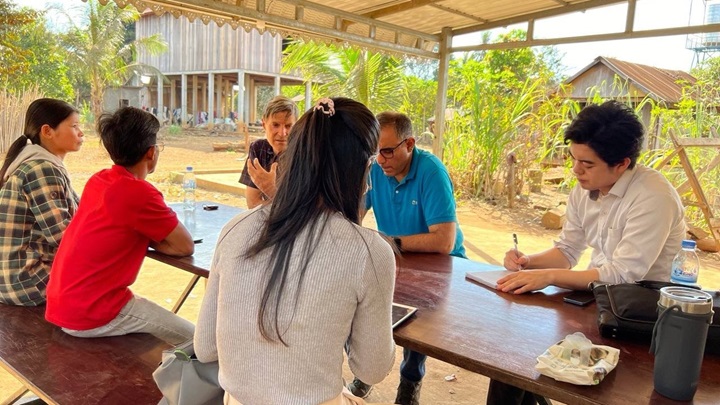
Aiba (far right) interviews locals about household excessive debt.
For example, we investigated how and from where about 80 microfinance institutions are raising capital and whether these have changed from the past. We found out that while Cambodian microfinance institutions used to often receive loans from impact investors, in recent years, they are funded more by profit-oriented general investors. Furthermore, when we investigated how loan recipients change their lifestyles and behavior at the household level, we found a sharp increase in the amount of excessive debt. We therefore studied how a financial literacy program that uses kakeibo (household accounting books) would influence this situation and saw improvement in the financial literacy of the people. “Microfinance in Cambodia: Development, Role, and Prospects,” a book that summarizes these findings, will be published soon.
―What activities are you currently working on in Cambodia?
From 2023, I have been assigned to NBC as a JICA Expert for “Capacity Development for Economic Analysis, Research, and Operations in Support of Cambodia’s Monetary Policy,” a JICA technical cooperation project that aims to strengthen NBC’s capacity to make decisions on and implement monetary policies and promote the local currency in the market. As Cambodia has in fact gone through economic development along with dollarization over the years, it is important to develop financial infrastructure so that the home currency can be gradually used more in the market without issues, rather than implementing a radical de-dollarization policy. To do so, the capacity of NBC staff to formulate monetary policies and manage the liquidity of the riel needs to be strengthened. As the first step for monetary policy formulation, studies to understand the reality are essential, and we are therefore building capacity among NBC staff to conduct such studies.
―Based on your position both as a researcher and a JICA Expert, what do you think are important in order to link research and policy?
In March 2025, a symposium to facilitate evidence-based policy making (EBPM) was held in Cambodia. Many Cambodian stakeholders understand the importance of evidence-based policy because they have a strong passion for local currency promotion and improving financial inclusion. The process of conducting studies to understand actual situations accurately, presenting evidence, building consensus and then implementing policies is extremely important, especially in countries like Cambodia where statistical data are insufficient, because people tend to make different assumptions and interpret things in different ways. To ensure the use of research outcomes in this process, it is essential for us to communicate our findings, not only through academic papers, but also through various channels such as by publishing policy notes that are more likely read by policymakers and holding seminars .
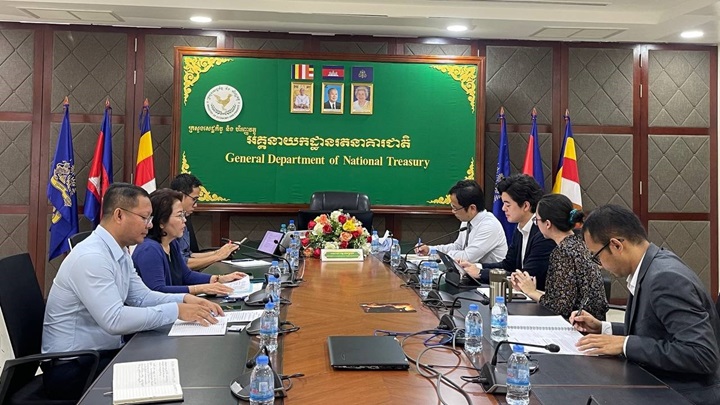
Together with NBC staff, Aiba (right row, second from the back wall) conducts an interview with the General Department of National Treasury, Ministry of Economy and Finance, as part of the research project to promote the use of the riel.
―Could you share with us your future aspirations?
Looking back, my involvement with Cambodia started by coincidence. It all started when I chose the Cambodian financial sector as the topic of my master’s thesis. Until then, I had never even visited the country but with more involvement with the JICA Ogata Research Institute’s research projects, I started to spend nearly half the year in Cambodia annually. Now I am based in Cambodia, conducting research while working as a JICA Expert. The challenges that the Cambodian financial sector faces cannot be solved straight away. In the past, as a researcher, I focused more on producing academically interesting output but now my focus has shifted more to how I could conduct research work that could feed more into policy. I would like to continue to cherish the networks that I have built with Cambodian locals and further contribute to the development of the Cambodian financial sector.
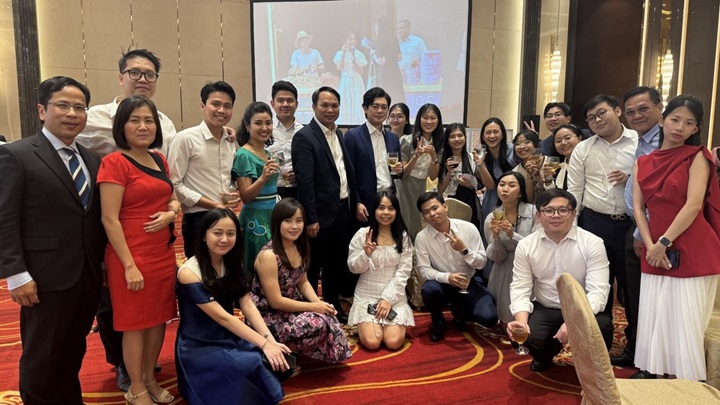
Colleagues at NBC where Aiba is assigned as a JICA Expert
Sns share!



事業事前評価表(地球規模課題対応国際科学技術協力(SATREPS)).国際協力機構 地球環境部 . 防災第一チーム. 1.案件名.国 名: フィリピン共和国.
事業事前評価表(地球規模課題対応国際科学技術協力(SATREPS)).国際協力機構 地球環境部 . 防災第一チーム. 1.案件名.国 名: フィリピン共和国.
事業事前評価表(地球規模課題対応国際科学技術協力(SATREPS)).国際協力機構 地球環境部 . 防災第一チーム. 1.案件名.国 名: フィリピン共和国.
事業事前評価表(地球規模課題対応国際科学技術協力(SATREPS)).国際協力機構 地球環境部 . 防災第一チーム. 1.案件名.国 名: フィリピン共和国.
事業事前評価表(地球規模課題対応国際科学技術協力(SATREPS)).国際協力機構 地球環境部 . 防災第一チーム. 1.案件名.国 名: フィリピン共和国.


