

Blog Post | Rethinking Developing-Country Debt — Key Takeaways from an Interview with Professor Joseph Stiglitz
2026.09.09







Updates from JICA Ogata Research Institute on the latest events, publications and more.
RegistrationHow to Find Us


In recent years, many low- and middle-income countries have faced mounting debt challenges. In addition to the economic shock caused by the COVID-19 pandemic, rising global interest rates and surging food and energy prices have significantly increased debt-servicing burdens across the developing world.
Against this backdrop, Harada Tetsuya , Chief Representative of the JICA France Office and Principal Research Fellow at the JICA Ogata Sadako Research Institute for Peace and Development (JICA Ogata Research Institute), spoke with Joseph Stiglitz , Nobel Laureate in Economics and Professor at Columbia University, about the growing debt challenges facing developing countries. Stiglitz is one of the co-authors of the Jubilee Report , a landmark report on sovereign debt released in 2025 by the Jubilee Commission, which was established at the request of the late Pope Francis. In this post, Harada reflects on some of the key insights from their discussion.
Author: Harada Tetsuya , Chief Representative of the JICA France Office and Principal Research Fellow at the JICA Ogata Research Institute

Joseph Stiglitz (right), Professor at Columbia University and Research Partner at the JICA Ogata Research Institute, and Harada Tetsuya, Chief Representative of the JICA France Office and Principal Research Fellow at the JICA Ogata Research Institute, during their discussion.
One of Professor Stiglitz’s central messages was that the current situation should not be viewed simply as a debt crisis. To avoid default, many developing countries are allocating scarce fiscal resources to debt repayment. As a result, investments in education, healthcare, infrastructure, and other areas critical for long-term growth are being reduced. For this reason, Professor Stiglitz described the situation as a “debt and development crisis.” The problem, he argued, is not debt repayment itself, but the fact that prioritizing repayment is depriving countries of opportunities to invest in their future development.
Professor Stiglitz traced the roots of the current crisis to the prolonged period of exceptionally low interest rates that followed the 2008 global financial crisis. As interest rates in developed countries fell to historic lows, investors searched for higher returns and increasingly channeled capital into developing countries. Many developing economies, in turn, gained access to financing on more favorable terms than before. However, the situation changed dramatically with the COVID-19 pandemic, Russia’s invasion of Ukraine, and a wave of interest rate hikes around the world. As interest rates rose while debt stocks remained high, debt-servicing costs increased sharply. Professor Stiglitz also reflected on the Heavily Indebted Poor Countries (HIPC) Initiative, launched roughly 25 years ago. While the initiative delivered significant debt relief and helped many countries regain fiscal space, the re-emergence of debt distress today suggests that structural problems in global financial markets remain unresolved. In particular, he highlighted the procyclical nature of private capital flows through international capital markets: capital tends to flow into developing countries when their economies are strong and flow out when conditions deteriorate, thereby amplifying economic instability. He also noted that developing countries often face borrowing costs that cannot be fully explained by risk alone. Rather than describing these costs simply as a “risk premium,” Professor Stiglitz characterized them as a kind of “penalty” imposed on developing countries, arguing that high borrowing costs can themselves increase the likelihood of default.
Discussions of debt crises often focus on the responsibility of borrowing countries. Professor Stiglitz challenged this view, arguing that “every bad loan is a result of bad borrowing and bad lending.” According to Professor Stiglitz, international financial institutions and private lenders possess the expertise and resources to assess financial risks and debt sustainability. In many cases, however, lending decisions were made without sufficiently rigorous assessments of borrowers’ long-term repayment capacity. This, he argued, has been an important contributor to today's debt challenges.
The interview also explored an important question from JICA’s perspective. Japan’s Official Development Assistance (ODA) has long relied on concessional loans, particularly yen loans for infrastructure development, as a key instrument for supporting long-term economic growth. As a result, balancing responses to debt distress with the need to preserve future development financing remains a critical challenge. When asked whether debt relief alone risks creating incentives for countries to repeat the same borrowing patterns in the near future, Professor Stiglitz expressed skepticism toward the conventional “moral hazard” argument. He argued that developing countries are generally not borrowing today in anticipation of future debt forgiveness. Rather, he pointed to what he described as a form of “hidden bailout,” whereby emergency financing from international institutions during crises can end up being used to repay private creditors, effectively shielding them from losses. He argued that such bailouts can weaken incentives for some private creditors to conduct adequate risk assessments, thereby contributing to irresponsible lending.
At the same time, the interview also examined the responsibilities of borrowing countries. Professor Stiglitz emphasized the importance of strengthening domestic resource mobilization. Drawing on the development experiences of Japan and East Asian economies, he noted that sustainable development requires countries to make effective use of domestic savings and tax revenues. He also acknowledged that political leaders may face incentives to prioritize short-term gains while shifting repayment burdens onto future generations. Understanding these political incentives and incorporating them into lending decisions, he argued, is an important responsibility for lenders. Furthermore, Professor Stiglitz highlighted broader structural challenges in the international economy, including tax avoidance by multinational corporations and the difficulties many resource-rich countries face in capturing a fair share of revenues from their natural resources. These factors, he noted, often constrain the ability of developing countries to mobilize domestic resources effectively.
One of the key messages emerging from the interview is the need to look beyond debt as a narrow question of repayment capacity and instead consider its implications for long-term development. Professor Stiglitz emphasized both the shortcomings of the international financial system and the responsibilities of lenders in contributing to debt vulnerabilities. At the same time, he underscored the importance of sound economic management and stronger domestic resource mobilization on the part of borrowing countries. As the international community seeks to balance sustainable development with responsible development finance, further dialogue and analysis will be essential. Reflecting on this discussion, I believe we need to deepen our understanding of these challenges and continue exploring practical pathways forward through dialogue with a wide range of experts.
The full interview that inspired this blog post is available to watch below.
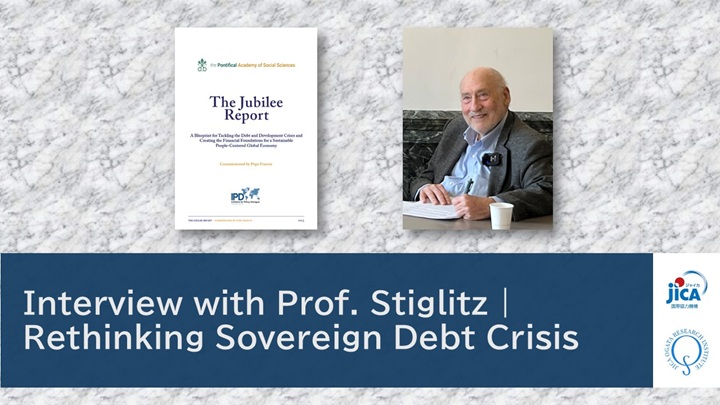
Interview with Prof. Stiglitz| Rethinking Sovereign Debt Crisis
Harada Tetsuya
Harada is a Principal Research Fellow at the JICA Ogata Research Institute. His previous roles include economist at the World Bank as well as positions at the JICA Indonesia Office and the Credit Risk Analysis and Environmental Review Department, JICA. Harada started his career at the Overseas Economic Cooperation Fund (OECF), followed by positions at the Japan Bank for International Cooperation (JBIC) and the Japan International Cooperation Agency (JICA), where he was in charge of infrastructure development projects, development policy loans, and private sector finance screening in Southeast Asia and Sub-Saharan Africa. His research interests include development economics, applied econometrics, impact evaluation, industrial structure transformation in developing countries, and infrastructure development.

Sns share!



事業事前評価表(地球規模課題対応国際科学技術協力(SATREPS)).国際協力機構 地球環境部 . 防災第一チーム. 1.案件名.国 名: フィリピン共和国.
事業事前評価表(地球規模課題対応国際科学技術協力(SATREPS)).国際協力機構 地球環境部 . 防災第一チーム. 1.案件名.国 名: フィリピン共和国.
事業事前評価表(地球規模課題対応国際科学技術協力(SATREPS)).国際協力機構 地球環境部 . 防災第一チーム. 1.案件名.国 名: フィリピン共和国.
事業事前評価表(地球規模課題対応国際科学技術協力(SATREPS)).国際協力機構 地球環境部 . 防災第一チーム. 1.案件名.国 名: フィリピン共和国.
事業事前評価表(地球規模課題対応国際科学技術協力(SATREPS)).国際協力機構 地球環境部 . 防災第一チーム. 1.案件名.国 名: フィリピン共和国.


