

Blog Post | Co-Creation between Practice and Research: Reflections on the KCCP Course “Electoral Management in Democratic Countries”
2026.11.19


Updates from JICA Ogata Research Institute on the latest events, publications and more.
RegistrationHow to Find Us


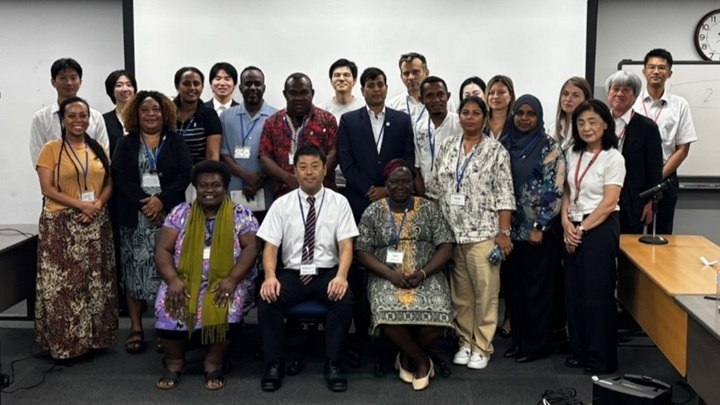
Participants in the lecture and discussion held as part of the KCCP course Electoral Management in Democratic Countries
On Sept. 17, 2026, Nagatsuji Takashi , a Research Fellow in the Politics and Governance Cluster at the JICA Ogata Sadako Research Institute for Peace and Development (JICA Ogata Research Institute), led a lecture and discussion at JICA Tokyo Center as part of the Knowledge Co-Creation Program (KCCP) course on Electoral Management in Democratic Countries.
In this column, an intern at the JICA Ogata Research Institute who observed the sessions describes how participants learned from one another about the different systems and challenges of electoral management in their countries. The column also reflects on the co-creation that emerged from these exchanges, and on the roles expected of JICA and researchers in connecting experiences from different countries to future practice and research.
By Yamasaki Yutaro
Intern, Research Program Division
JICA Ogata Sadako Research Institute for Peace and Development
The Knowledge Co-Creation Program (KCCP) is one of JICA’s human resource development programs through which government officials, technical specialists and others from developing countries come to Japan to learn about shared challenges. As the term “co-creation” suggests, the emphasis goes beyond passing on knowledge from Japan. Participants and those involved from the Japanese side learn from one another’s experiences and create new knowledge together.
This course brought together electoral management practitioners from Cambodia, Ethiopia, the Maldives, Nepal, Papua New Guinea, South Sudan, Timor-Leste and Ukraine. Participants learned about Japan’s systems through lectures and visited polling stations, schools and other sites to see how those systems work in practice. They then discussed what they had learned in relation to the circumstances in their own countries. Finally, they developed action plans1 to guide their work after returning home.
Shimizu Daisuke, a board member of the Institute of Japanese Election System and Administration who oversees the course as a whole, explained that he aims to design a program in which participants deepen their mutual understanding through discussion and gain knowledge they can use in their own work, rather than simply take Japan’s systems home with them.
Nagatsuji’s lecture took place on day 15, the day before the course ended. With participants presenting their action plans the following day, the program was entering its final stage.
The lecture was titled “Electoral Management in the World.”
It drew on political science theory to explain differences in the institutional position of electoral management bodies and in voter registration systems across countries. The session was not structured as a one-way transfer of knowledge from the lecturer to participants.
Nagatsuji posed a series of questions to participants: “Which framework applies to your country?” “Why was that system adopted?” “What challenges arise when putting it into practice?” As participants shared their countries’ circumstances and their own views with the group, the lecture moved between these experiences and the theoretical frameworks.
In Japan, for example, people are entered on the electoral roll once they meet the eligibility requirements, and polling station admission cards are sent to them. Such arrangements are generally known as passive voter registration systems.
Other countries use active voter registration systems, in which voters must register themselves before an election. Those who fail to register may be unable to vote even if they have the right to do so.
Adding registration to the steps needed to cast a ballot increases the time and opportunity costs of voting. Political science theories of voting behavior would suggest that this could reduce voter turnout.
Participants, however, offered another perspective. Might registering oneself help develop a sense of being a voter and provide motivation to go to the polls? Might automatic registration, in turn, leave voters more passive?
Comparing systems is not a simple matter of judging one superior to another. The same system can have different meanings and effects depending on the social context, trust in public administration, and access to registration procedures.
Bringing practitioners’ experiences from different countries into conversation with theory revealed these multiple dimensions.
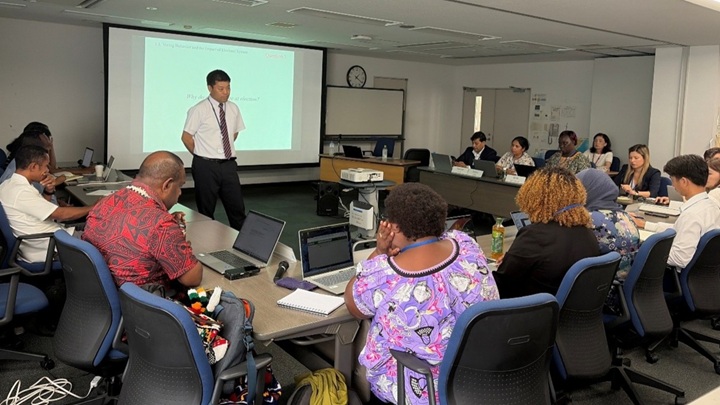
JICA Ogata Research Institute Research Fellow Nagatsuji Takashi leads the lecture by posing questions to participants
The lecture was followed by a discussion on “Voter Education,” which included a “Knowledge Co-Creation Exercise.”
Participants first wrote down the problems facing voter education in their own countries and analyzed their causes. They then considered solutions that addressed those causes and made presentations on behalf of another country, speaking from that country’s perspective. These activities formed an integrated active learning exercise based on project-based learning (PBL).
According to Nagatsuji, the aim of the discussion was to inform the action plans that participants would develop and implement. Identifying the causes of problems and considering improvements to existing efforts are steps that electoral management practitioners may be able to begin taking relatively soon.
Voter education is already provided in all the participating countries. The emphasis was therefore on helping participants take stock of their own national circumstances and consider better ways to address the difficulties encountered in practice, drawing on knowledge and experience from other countries. Shimizu also stressed that voter education is an important task for all countries, even when their political systems and other circumstances differ.
A distinctive feature of the discussion was the way participants from two countries were paired to consider each other’s challenges.
They reviewed the problems, causes and possible solutions identified by their partner country, and added comments and new suggestions to its proposed solutions. Finally, they organized the points discussed and presented them on that country’s behalf.
As Nagatsuji explained, all the participants were electoral management specialists, but their systems and experiences differed from country to country. Peer review of each other’s proposals could reveal causes and solutions that might be difficult to identify through discussion within one country alone.
Presenting on behalf of another country also had a further purpose: to help participants understand problems from their partners’ perspective while reconsidering their own situation from an outside perspective. Hearing how participants from another country understood and described their challenges could offer material for developing better solutions.
One participant put it this way:
“What you know is maybe something I do not know. Having the opportunity to learn what you know and how you do things is a privilege, because those things are not always available to us.” 2
The discussion also highlighted the importance of understanding the context behind another country’s institutions and initiatives, rather than simply copying them, and then considering how to improve one’s own systems.
A faculty member at a Japanese university who observed the discussion noted how intellectually demanding it was to pair up on the spot and present another country’s situation: participants had to listen and organize information in a short time. Being able to develop ideas through dialogue in the moment, rather than deliver a prepared presentation, was a strength of meeting face to face. The faculty member said that he hoped to use the approach in his own teaching.
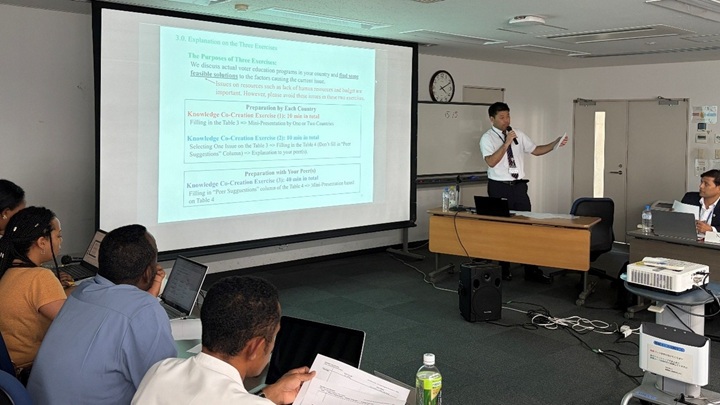
Nagatsuji explains the discussion method
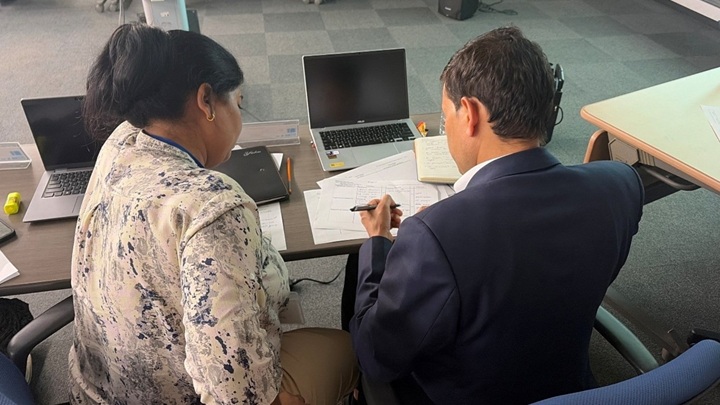
Participants exchange views in pairs
The discussion raised a wide range of issues: the quality of voter education; political participation among women, persons with disabilities and socially isolated people; and declining voter turnout and interest in elections.
Many of the proposed solutions involved developing high-quality educational materials, videos, games and other content. Yet the same content cannot necessarily be used unchanged in countries and communities with different circumstances.
Ouchi Tomomi , a JICA expert dispatched to the Papua New Guinea Electoral Commission, works to improve voter education.
Ouchi joined the course to consider what insights participants from Papua New Guinea would gain in Japan and how these could be applied back home.
Ouchi explained that even when educational materials have been developed, reaching everyone is far from easy.
Papua New Guinea has many languages and islands, and geographical conditions vary across the country. An approach that works in the capital or other urban areas may not work equally well in rural areas. Translating materials is only part of the task; methods also need to reflect local languages, living conditions and access to information.
There is value, too, in gaining a perspective from which to consider which ideas could work at home, what would need to change and whose cooperation would be needed.
The issues and ideas raised here also informed the action plans that participants presented the following day.
The outcomes of KCCP extend beyond the knowledge gained through lectures and site visits, and the action plans participants develop.
Ogino Mei , who coordinates this course at JICA Tokyo Center, explained that advising one another on their countries’ challenges could encourage participants to continue exchanging information through groups and other channels after the program ends.
Ogino cited examples from past programs in which participants stayed in touch through social media and shared updates on their action plans even around two years after completing the course.
Having someone to turn to after returning home can help participants put their action plans into practice. When a new challenge arises in one country, a practitioner from another country whom they met during the course may have had a similar experience or hold a clue to a solution.
Co-creation does not end when the course does. The relationships formed during the program may allow participants to keep learning from one another long afterward.
Knowledge does not flow only from Japan to other countries through the program. While knowledge gained in Japan is put into practice elsewhere, the experiences and perspectives participants bring also offer new insights to those on the Japanese side.
Knowledge from Japan travels abroad, is reconsidered through other countries’ experiences and returns to Japan. This circulation of knowledge and experience is another important source of KCCP’s value.
The Japanese university faculty member’s wish to use the discussion method in their own teaching may be one example.
Comparing different systems can also provide a fresh perspective on arrangements that are taken for granted in Japan.
What, then, does a researcher’s participation bring to a course that gathers practitioners from such varied national backgrounds?
Nagatsuji specializes in comparative politics and development assistance. His research examines issues such as the quality of democracy in developing countries and public perceptions of official development assistance (ODA). During this course, he drew on these research insights to offer theoretical frameworks.
Through their daily work, practitioners gain firsthand experience of why institutions may not function as intended and how citizens perceive elections.
Researchers, meanwhile, can connect these individual experiences to theory and previous research, comparing countries to identify similarities and differences. They can pursue questions such as: “Why is this problem occurring?” “Are there other possible explanations?” “What insights could be applied in other countries?”
They can also draw on previous research to identify which approaches have been shown to work, and under what conditions, and use that evidence to inform program design.
Researchers, however, do not have a complete grasp of every factor at work in the real world.
Practitioners’ experiences can alert them to factors that existing theories do not fully capture. These insights can lead to new research questions and hypotheses.
Reflecting on the value of researchers taking part in KCCP, Nagatsuji explained that they can offer theory and evidence from a broad perspective while learning from practitioners about how institutions operate in practice in ways that research alone may not reveal, as well as phenomena that theory cannot fully explain.
One reason the JICA Ogata Research Institute’s involvement in such courses matters is that it enables an ongoing exchange between field experience and research insights.
Practitioners’ experiences enrich research, and the resulting findings feed back into KCCP and work on the ground. This cycle may be one way to understand co-creation between practice and research.
What becomes visible when we present another country’s challenges rather than our own?
We come to see more than that country’s problems.
Listening to others and retelling their experiences in our own words brings differences in institutions and social contexts into view. At the same time, hearing our own country’s challenges described in someone else’s words can reveal assumptions we have taken for granted and aspects of problems we had not noticed.
Observing this course, I felt that the value of holding KCCP in Japan lies not only in sharing Japanese knowledge abroad, but also in creating a place where experiences from different societies meet and people can question one another’s assumptions.
Participants take the knowledge and ideas gained there back to their own work. The results and new challenges that emerge in practice can then be shared through continued exchanges and future courses and may also give researchers new questions to explore.
From KCCP to practice, from practice to research, and from research to the next round of KCCP and practice.
I felt that one of the roles expected of the JICA Ogata Research Institute is to sustain this circulation of knowledge between practice and research, helping learning from a single course lead to further change.
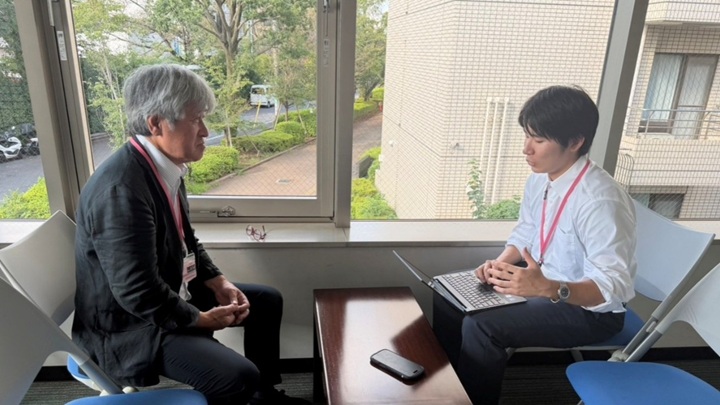
The author interviews Shimizu Daisuke (left), a board member of the Institute of Japanese Election System and Administration
*1 An action plan sets out specific steps for applying what participants have learned during the course to their work and for addressing the challenges they face.
*2 The participant’s remarks have been lightly edited for clarity without changing their meaning.
Sns share!



事業事前評価表(地球規模課題対応国際科学技術協力(SATREPS)).国際協力機構 地球環境部 . 防災第一チーム. 1.案件名.国 名: フィリピン共和国.
事業事前評価表(地球規模課題対応国際科学技術協力(SATREPS)).国際協力機構 地球環境部 . 防災第一チーム. 1.案件名.国 名: フィリピン共和国.
事業事前評価表(地球規模課題対応国際科学技術協力(SATREPS)).国際協力機構 地球環境部 . 防災第一チーム. 1.案件名.国 名: フィリピン共和国.
事業事前評価表(地球規模課題対応国際科学技術協力(SATREPS)).国際協力機構 地球環境部 . 防災第一チーム. 1.案件名.国 名: フィリピン共和国.
事業事前評価表(地球規模課題対応国際科学技術協力(SATREPS)).国際協力機構 地球環境部 . 防災第一チーム. 1.案件名.国 名: フィリピン共和国.


