

Noguchi’s Field Survey Looks at Tuvaluan Migrants and Climate Change Policies in Australia
2026.01.05







Updates from JICA Ogata Research Institute on the latest events, publications and more.
RegistrationHow to Find Us


Between September and October 2025, Noguchi Fumiko , Research Fellow, JICA Ogata Sadako Research Institute for Peace and Development (JICA Ogata Research Institute), conducted a field survey in Australia as part of the research project “Situational Analysis of the Most Vulnerable Climate Change Displaced People and Their Participation and Empowerment for Sustainable Community Development .” This survey was conducted with support from the Institute for Global Environmental Strategies (IGES) as part of its project on climate security in which Noguchi participates as a co-researcher.
In response to international cooperation policies for climate change adaptation by countries like Australia, some people from Oceanian developing countries such as Tuvalu have chosen to migrate to developed countries. From the perspective of empowerment, this research project analyzes the current state and challenges of local communities of those who have migrated to developed countries as well as local communities of those who are left or have chosen to remain in their home countries. The basis of the cultural identity of the Tuvaluans particularly lies in Tuvaluan life, which is based on traditional knowledge and is inseparable from the ocean and land. Focusing on the economic, social and psychological impacts of migration to developed countries on Tuvaluans, field surveys are conducted both in developed countries, i.e., the migration destination, and developing countries that send them out.
The field data collection in Tuvalu and Fiji that took place between April and May 2025 revealed that intricately intertwined natural environment and local communities shape the identity of Tuvaluans, and that various concerns are making Tuvaluans consider migration.
The recent field work took place in three Australian cities where many Tuvaluans have migrated. Noguchi met with researchers at key universities and government thinktanks to discuss climate security and climate change adaptation, as well as migration and development in the Pacific region. She also visited the Department of Foreign Affairs and Trade in Canberra, Australia’s capital, to interview the team responsible forin charge of implementing the Australia-Tuvalu Falepili Union Treaty. As part of climate change adaptation, this treaty grants Tuvaluans Australian permanent residency. Noguchi found out the following: in 2025, the visa quota was 280 but 8,450 Tuvaluans, i.e., about 90% of the population, applied; the first migrants who were granted visas under this scheme are scheduled to arrive in November; and these Tuvaluans are allowed to choose when and where to migrate to in Australia and will receive the same education and welfare support as Australian citizens.

Central Melbourne, in southeast Australia
Large Tuvaluan communities already exist in Australia. Migration from Tuvalu to Brisbane has a long history and many migrants who directly came from Tuvalu live there. Meanwhile, Melbourne tends to be the destination for Tuvaluans who have already migrated to New Zealand. To conduct participant observation, Noguchi attended Tuvalu Independence Day celebrations and church services in Tuvaluan communities in both cities. She also conducted interviews with pastors, church members, community leaders and general Tuvaluan migrants about the following: background of their migration, the condition of their lives after migration, the challenges that they face in Australian society, their cultural identity, and their views on the Australia-Tuvalu Falepili Union Treaty.
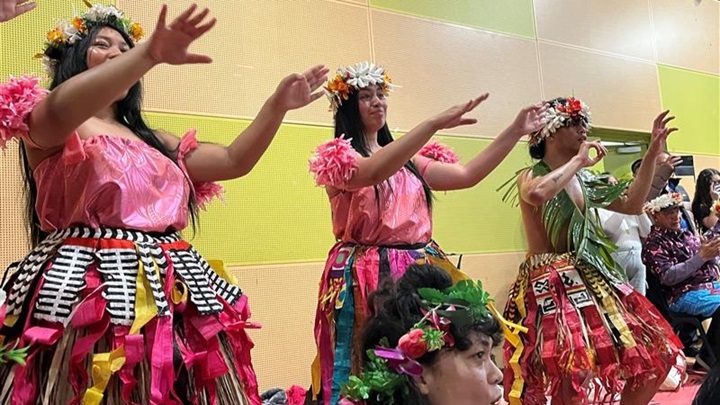
Traditional Tuvaluan dance performance during an event to celebrate the Tuvalu Independence Day in Melbourne.
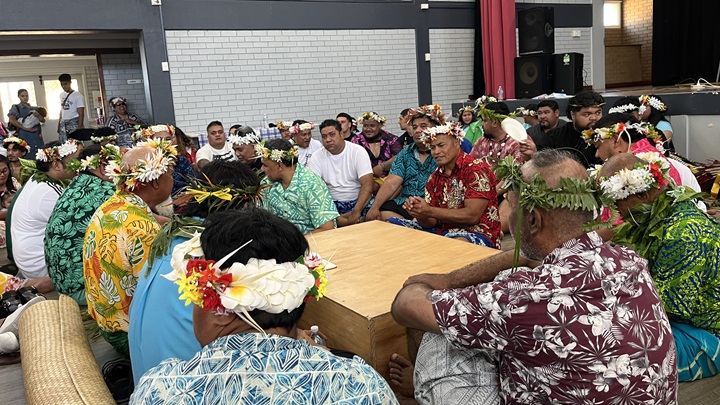
Traditional musical performance during an event to celebrate the Tuvalu Independence Day in Brisbane. The men in the center hit the large wooden table together to tap out a rhythm.

A lot of time is allocated for participants to sing Tuvaluan songs together during a service at a Tuvaluan church in Brisbane.

Participants of a sports day in Melbourne enjoy “te ano,” a Tuvaluan traditional game.
Results showed that many Tuvaluans migrated in search of better education for their children, employment opportunities and better healthcare and welfare systems. This finding was largely consistent with the results of field surveys conducted in Tuvalu and Fiji. In addition, many interviewees said that they struggle to adapt to life in Australia. Noguchi observed their sorrow, stemming from having to work in unfamiliar environments or being separated from family members. In some cases, social and economic restrictions and denial of their culture have led to drinking problems or domestic violence. Some teenage migrants said that although they do not like living in Australia, they feel powerless and have no plans to return to Tuvalu because they are aware that the islands may eventually sink underwater. Their anxiety about the future—driven by climate change and the discomfort of living in Western societies—was evident. Meanwhile, existing Tuvaluan communities and churches are playing a key role in welcoming new migrants. They are preserving Tuvaluan culture and nurturing a sense of belonging through the church and cultural activities.
Looking back on the survey, Noguchi feels that if migrant-receiving countries learn from each other about the values and traditional knowledge of Oceanian countries like Tuvalu, they can create opportunities to overcome existing challenges and build sustainable, resilient communities. She added that Japan’s experience in rural revitalization could be useful for such efforts. Noguchi hopes to conduct further studies on topics such as how new Tuvaluan migrants are permanently settling in Australia, changes in the relationship between newcomers and existing Tuvaluan migrants, how Australians view migrants, and the possibility of intervention in community education.

Noguchi (far right) with Tuvaluan migrants who shared during an event in Brisbane how they feel about their homeland and about their daily life after migration
Sns share!



事業事前評価表(地球規模課題対応国際科学技術協力(SATREPS)).国際協力機構 地球環境部 . 防災第一チーム. 1.案件名.国 名: フィリピン共和国.
事業事前評価表(地球規模課題対応国際科学技術協力(SATREPS)).国際協力機構 地球環境部 . 防災第一チーム. 1.案件名.国 名: フィリピン共和国.
事業事前評価表(地球規模課題対応国際科学技術協力(SATREPS)).国際協力機構 地球環境部 . 防災第一チーム. 1.案件名.国 名: フィリピン共和国.
事業事前評価表(地球規模課題対応国際科学技術協力(SATREPS)).国際協力機構 地球環境部 . 防災第一チーム. 1.案件名.国 名: フィリピン共和国.
事業事前評価表(地球規模課題対応国際科学技術協力(SATREPS)).国際協力機構 地球環境部 . 防災第一チーム. 1.案件名.国 名: フィリピン共和国.


