

Book Launch Explores the Future of Work in Developing Economies
2026.05.22







Updates from JICA Ogata Research Institute on the latest events, publications and more.
RegistrationHow to Find Us


The Initiative for Policy Dialogue (IPD) at Columbia University, in cooperation with the JICA Ogata Sadako Research Institute for Peace and Development (JICA Ogata Research Institute), held a public panel in Paris, France, on March 19, 2026, to mark the launch of “The Future of Work in Developing Countries ,” the outcome of their fifth joint research project, “Employment: The Impact of Global Industrial Structure and Demographic Changes on Employment .”
Kamei Haruko , Director General, JICA Ogata Research Institute, delivered the opening remarks, setting the stage by emphasizing that employment in low- and middle-income countries remains one of the most pressing development challenges. She noted that these challenges have been further complicated by automation, AI, and changing global supply chains. The subsequent panel session, moderated by Professor Arjun Jayadev of Azim Premji University, examined how developing countries can shape the future of work and livelihoods in the face of rapid global change.
Nobel Laureate Joseph Stiglitz , Co-President of the IPD and Professor at Columbia University, opened the discussion by reflecting on long-standing collaborative research on the application of the “East Asia Miracle.” Countries such as Japan, South Korea, and later China achieved extraordinary economic growth, raising a central question that has guided this body of research over the past 18 years: how lessons from one region’s success can be translated to very different contexts marked by distinct institutions, levels of human capital, and state capacity—particularly in Africa. He emphasized that economists have focused too heavily on GDP, despite its failure to capture key dimensions of development. He argued that employment is central—not only because jobs serve as the primary safety net in developing countries, but also because they provide meaning to life and contribute to social cohesion and political stability.
Stiglitz went on to identify several “mega trends” that are making employment creation more difficult: rapid population growth in Africa, the declining role of manufacturing as a source of jobs, the weakening of globalization, and the growing impact of AI and automation on labor demand. He noted that neoliberalism is “basically dead,” with industrial policy now returning worldwide. While the book highlights portfolio-based strategies and opportunities linked to the green transition, Stiglitz concluded on a sober note, warning that current economic and structural conditions have intensified the challenge of job creation and underscoring the urgency of rethinking development policy.
Harada Tetsuya , Chief Representative for Europe (Head of the JICA France Office) and Principal Research Fellow at the JICA Ogata Research Institute, focused on the nature of employment in Africa. While economic growth was relatively strong in the 2000s and 2010s, he argued that it was often not accompanied by strong improvements in labor productivity. He emphasized that focusing on employment growth alone is insufficient, as GDP per capita, a proxy for living standards, depends closely on value added per worker. Drawing on sectoral analysis, Harada showed that agriculture remains central due to its large share of employment, and that productivity gains are often driven by the reallocation of labor out of agriculture. However, employment gains in both manufacturing and services have not been matched by strong productivity growth. The core challenge, therefore, is not only creating jobs, but creating productive jobs. In response, JICA supports productivity improvement through the Kaizen approach of continuous improvement and promotes startup-led job creation through initiatives such as Project NINJA (Next Innovation with Japan), which supports African entrepreneurs through business competitions, mentorship, and financial assistance.
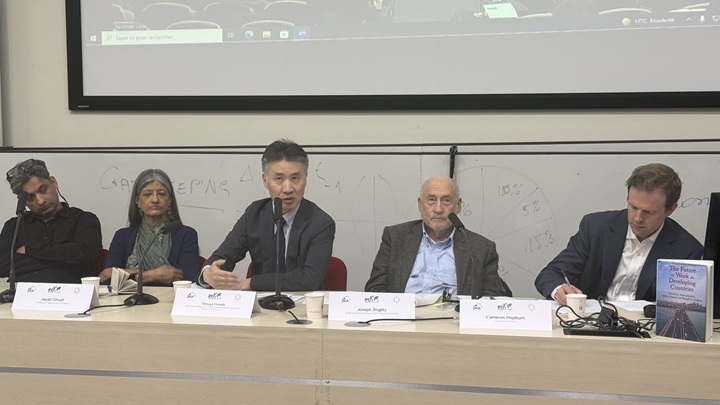
Harada Tetsuya (center), Principal Research Fellow at the JICA Ogata Research Institute, presents on the nature of employment in Africa.
Jayati Ghosh, Professor of Economics, University of Massachusetts Amherst, highlighted the continued relevance of the book’s arguments despite rapid global changes. She emphasized that today’s conditions require more complex development strategies and identified inequality as a central issue, arguing that technological change has intensified the concentration of wealth and power. Without active policy intervention, she argued, the benefits will not be widely shared. She stressed that markets alone will not generate the types of jobs required, particularly in socially important sectors such as care, where public provision remains essential. At the same time, she noted that periods of instability can create opportunities for structural transformation, provided that governments adopt more active and creative policy approaches.
Cameron Hepburn, Professor at the Oxford Martin School, University of Oxford, offered an optimistic perspective by highlighting Africa’s youthful demographic profile, noting that a median age of around 19 represents energy, mobility, and capacity to learn. While acknowledging challenges such as automation, capital-intensive manufacturing, and the impact of AI, he argued that this does not mean there is nothing to do. He pointed to large-scale infrastructure needs and opportunities in services, tourism, care, startups, and innovation. Central to his argument was the massive structural transformation required in the global economy, encompassing climate change, biodiversity loss, and pollution. He emphasized that the green transition is inherently labor-intensive and highlighted Africa’s advantages in renewable energy and critical minerals. With effective coordination across skills, occupations, and job demand, he concluded that there is strong reason for optimism.
Ahead of the book launch, the IPD and the JICA Ogata Research Institute held a task force meeting in Paris on March 18, 2026, to launch a new joint research project titled “Industrial Policy and Green Structural Transformation.” This sixth collaborative research initiative aims to identify policies that can accelerate the green transition in Africa and other developing countries, advancing environmental sustainability while raising living standards. The meeting brought together leading thinkers across disciplines to address these challenges.

Visiting Fellow Kobayakawa Toru (far left) presents his findings during the session, with Research Fellow Solomon Haddis Teklehaymanot seated next to him (right).
In a session titled “Case Studies of African Green Transition,” researchers from the JICA Ogata Research Institute—Principal Research Fellow Harada Tetsuya, Research Fellow Solomon Haddis Teklehaymanot , and Visiting Fellow Kobayakawa Toru (Professor at Nihon University)—presented their findings. Harada and Solomon discussed Ethiopia’s move to become the first country to ban gasoline vehicle imports in 2024 and its rapid promotion of electric vehicle adoption, while cautioning that long-term success will depend on broader policy coherence and institutional capacity under fiscal constraints. Kobayakawa argued that population aging and decarbonization are not conflicting objectives. By integrating age‑ready city approaches with climate policy through urban planning and industrial policy, cities can pursue sustainable and inclusive urban development while addressing both challenges simultaneously.
In closing, Stiglitz emphasized that structural transformation must be reframed around the green transition, requiring coordinated political economy frameworks that extend beyond market mechanisms. For Africa, he noted, green technologies offer leapfrogging opportunities but depend on substantial global financial support.
A video recording of the book launch webinar can be viewed at the link below.
Sns share!



事業事前評価表(地球規模課題対応国際科学技術協力(SATREPS)).国際協力機構 地球環境部 . 防災第一チーム. 1.案件名.国 名: フィリピン共和国.
事業事前評価表(地球規模課題対応国際科学技術協力(SATREPS)).国際協力機構 地球環境部 . 防災第一チーム. 1.案件名.国 名: フィリピン共和国.
事業事前評価表(地球規模課題対応国際科学技術協力(SATREPS)).国際協力機構 地球環境部 . 防災第一チーム. 1.案件名.国 名: フィリピン共和国.
事業事前評価表(地球規模課題対応国際科学技術協力(SATREPS)).国際協力機構 地球環境部 . 防災第一チーム. 1.案件名.国 名: フィリピン共和国.
事業事前評価表(地球規模課題対応国際科学技術協力(SATREPS)).国際協力機構 地球環境部 . 防災第一チーム. 1.案件名.国 名: フィリピン共和国.


