

JICA’s Assistance for Trade Facilitation in East Africa Presented at the 8th JSCE Conference for Professional Practices in Civil Engineering
2026.07.15





Updates from JICA Ogata Research Institute on the latest events, publications and more.
RegistrationHow to Find Us


On June 9, 2026, Negishi Seiichi , Executive Senior Research Fellow at the JICA Ogata Sadako Research Institute for Peace and Development (JICA Ogata Research Institute), delivered a presentation titled “JICA’s Practical Assistance for Trade Facilitation in East Africa” at the 8th Japan Society of Civil Engineers (JSCE) Conference for Professional Practices in Civil Engineering. This conference aims to enhance the technical capacity of civil engineers by sharing their research findings and practical approaches to global challenges.
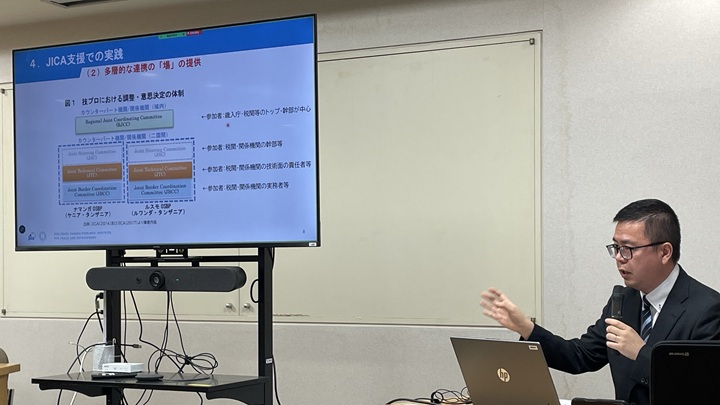
Negishi Seiichi, Executive Senior Research Fellow at the JICA Ogata Research Institute, delivering his presentation
The study was conducted jointly with Tokuori Tomomi, JICA Senior Advisor, and Koizumi Yukihiro, JICA Long-term Expert (Chief Advisor of the Project for Strengthening Facilitation Capacity for Logistics Improvement in Cambodia ). In his presentation, Negishi introduced JICA’s initiatives to improve cross-border logistics in East Africa. He explained how JICA has promoted regional integration and trade facilitation through a comprehensive approach that combines “hard” assistance (such as the development of transport infrastructure and border facilities) with “soft” assistance (such as customs modernization and improvement of institutional measures for trade facilitation).
Specifically, he highlighted JICA’s assistance for member states of the East African Community (EAC), a regional organization comprising eight countries in East Africa. In addition to providing financial assistance for transport infrastructure and border facilities, JICA has also implemented technical cooperation to support the establishment of institutional frameworks and human resource development necessary for efficient cross-border procedures. Through the development and operational support of One Stop Border Posts (OSBPs) , which integrate border clearance procedures between neighboring countries, significant improvements have been achieved. For example, cargo dwell time at the Namanga OSBP on the Kenya—Tanzania border was reduced from 22 hours and 47 minutes in 2014 to 10 hours and 14 minutes in 2021—an approximately 55% reduction.
Negishi identified several key factors behind these achievements: (1) the involvement of a wide range of government stakeholders; (2) the establishment of multi-layered decision-making and coordination mechanisms at the border, bilateral, and regional levels; (3) collaboration with the EAC Secretariat to support the development of legal frameworks and operational manuals for OSBPs, thereby promoting multilateral cooperation; and (4) the effective use of multiple JICA cooperation schemes—including financial assistance, technical cooperation, and dispatch of JICA experts—to generate complementary and synergistic effects. Negishi highlighted these factors as key lessons for future initiatives.
Further information on JICA’s efforts to strengthen connectivity and promote trade facilitation can be found below.
Sns share!



事業事前評価表(地球規模課題対応国際科学技術協力(SATREPS)).国際協力機構 地球環境部 . 防災第一チーム. 1.案件名.国 名: フィリピン共和国.
事業事前評価表(地球規模課題対応国際科学技術協力(SATREPS)).国際協力機構 地球環境部 . 防災第一チーム. 1.案件名.国 名: フィリピン共和国.
事業事前評価表(地球規模課題対応国際科学技術協力(SATREPS)).国際協力機構 地球環境部 . 防災第一チーム. 1.案件名.国 名: フィリピン共和国.
事業事前評価表(地球規模課題対応国際科学技術協力(SATREPS)).国際協力機構 地球環境部 . 防災第一チーム. 1.案件名.国 名: フィリピン共和国.
事業事前評価表(地球規模課題対応国際科学技術協力(SATREPS)).国際協力機構 地球環境部 . 防災第一チーム. 1.案件名.国 名: フィリピン共和国.


