

Rethinking Inter-Regional Business Networking: Lessons From Japan’s ABE Initiative Presented at the Regional Studies Association Annual Conference
2026.07.02







Updates from JICA Ogata Research Institute on the latest events, publications and more.
RegistrationHow to Find Us


At the Regional Studies Association Annual Conference held in Gothenburg, Sweden, from June 15 to 18, 2026, Kaizuka James , Research Fellow at the JICA Ogata Sadako Research Institute for Peace and Development (JICA Ogata Research Institute), presented his research at a panel titled “Skills and Education for a Regional Workforce .” His presentation examined how Japan’s African Business Education Initiative for Youth (ABE Initiative) has contributed to inter-regional business networking between Japan and African countries. Drawing on approximately 30 interviews with former participants, JICA staff, and Japanese companies conducted in Kenya and Rwanda, he offered a nuanced assessment of both the program’s achievements and its limitations.
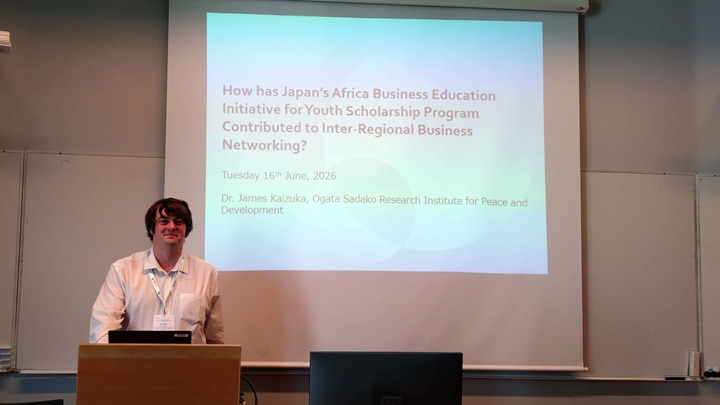
James Kaizuka, Research Fellow at the JICA Ogata Research Institute, speaks at the panel “Skills and Education for a Regional Workforce.”
Launched to promote human resource development and strengthen Japan–Africa ties, the ABE Initiative has supported over 2,000 participants from 54 African countries, providing graduate education in Japan alongside corporate internship opportunities. While the program has laid a valuable foundation for long-term engagement, Kaizuka noted that its direct impact on business network formation remains relatively limited.
A key finding of the study is that outcomes are shaped less by local context than by organizational factors—particularly firm type, hierarchical positioning, and the alignment of stakeholder expectations. Firm type plays a decisive role: small and medium-sized enterprises offer the greatest potential for inter-regional networking but often face constraints in capital and institutional capacity, while participants in large firms tend to have limited autonomy. Hierarchical status is also critical, as individuals in more senior positions are better able to initiate projects and leverage social capital to attract Japanese business interest.
Timing, however, presents a structural challenge. Shortly after returning to their home countries, ABE graduates typically maintain strong links to Japan but lack the decision-making authority needed to leverage them effectively. Over time, as their professional status improves, these ties tend to weaken, creating a mismatch between their growing decision-making capacity and their diminishing connections to Japan. As a result, the optimal window for fostering business networks is often missed.
Despite these constraints, the case studies presented demonstrate the program’s potential. In Rwanda, where lightning strikes are frequent, collaboration between an ABE alumnus and a Japanese firm led to the successful introduction of surge protection technology, with support from JICA . Kaizuka described this as a strong example of institutionally mediated bridging. A second case in Kenya similarly illustrates how alignment among expertise, institutional support, and social capital can help overcome structural barriers.
Kaizuka concluded that although challenges such as limited visibility, capital constraints, and institutional distance persist, successful cases show that effective inter-regional business networking is achievable when key conditions align. More broadly, he suggested that training and scholarship programs like the ABE Initiative should be viewed not only as tools for human resource development but also as organizational and positional interventions that shape transnational economic relationships.
Following the presentation, Kaizuka responded to questions from the audience on topics such as how Japan can learn from ABE participants, the role of the so-called “advantage of backwardness” in development—particularly in relation to Rwanda’s digital platforms—and the impact of people-to-people exchanges.
Sns share!



事業事前評価表(地球規模課題対応国際科学技術協力(SATREPS)).国際協力機構 地球環境部 . 防災第一チーム. 1.案件名.国 名: フィリピン共和国.
事業事前評価表(地球規模課題対応国際科学技術協力(SATREPS)).国際協力機構 地球環境部 . 防災第一チーム. 1.案件名.国 名: フィリピン共和国.
事業事前評価表(地球規模課題対応国際科学技術協力(SATREPS)).国際協力機構 地球環境部 . 防災第一チーム. 1.案件名.国 名: フィリピン共和国.
事業事前評価表(地球規模課題対応国際科学技術協力(SATREPS)).国際協力機構 地球環境部 . 防災第一チーム. 1.案件名.国 名: フィリピン共和国.
事業事前評価表(地球規模課題対応国際科学技術協力(SATREPS)).国際協力機構 地球環境部 . 防災第一チーム. 1.案件名.国 名: フィリピン共和国.


