

JICA Development Studies Program Workshop Highlights How Research Can Drive Change at Home
2026.08.06





Updates from JICA Ogata Research Institute on the latest events, publications and more.
RegistrationHow to Find Us


The JICA Development Studies Program invites future leaders from developing countries to Japan to learn about Japan's unique modernization and development experience, as well as its role as a post-war donor. For this program, the JICA Ogata Sadako Research Institute for Peace and Development (JICA Ogata Research Institute), in collaboration with the International University of Japan (IUJ), develops teaching and learning materials to support both instructors and students.
As part of this initiative, Kaizuka James , Research Fellow at the JICA Ogata Research Institute, authored a case material titled, “How can your knowledge and research from Japan create wider impacts at home? A case study of educational robotics in the Rwandan national curriculum ” in 2025. On June 24, 2026, Kaizuka facilitated a workshop based on the case study at IUJ, encouraging international students to reflect on how what they learn in Japan can contribute to development in their home countries.
The case material examines how Gabriel Baziramwabo, a Rwandan recipient of the African Business Education Initiative for Youth (ABE Initiative) scholarship, transformed his master’s research in Japan into a national educational reform in Rwanda. While studying educational robotics at the Kobe Institute of Computing, Baziramwabo focused on making programming education accessible beyond elite institutions. The case highlights how knowledge acquired abroad can be adapted to local contexts and scaled to create broader societal impact.
During the workshop, Baziramwabo joined online to share his firsthand experience. Reflecting on challenges he encountered, he described several barriers to adopting educational robotics in Rwanda, including the use of English-based programming languages, the high cost of existing technologies, limited accessibility due to infrastructure and training requirements, and teaching approaches that failed to engage students at an early stage.
To address these challenges, Baziramwabo developed “Benax,” a low-cost educational robot, along with “BenaXcript,” a programming language based on Kinyarwanda, the local language, while studying in Japan. This system has opened new opportunities for students by lowering linguistic and financial barriers and making programming education more engaging and accessible.
After returning to Rwanda in 2018, Baziramwabo further refined his work through teaching and curriculum development. A pilot program at New Generation Academy, a nursery, primary and secondary school in Rwanda, demonstrated promising results, paving the way for the development of a nine-year curriculum and, eventually, a national pilot program across 26 schools. The case underscores how locally grounded innovation can generate scalable educational impact. He emphasized that success was driven not by technology alone, but also by the creation of an enabling ecosystem that included curriculum design, teacher training, local production capacity, and institutional alignment.
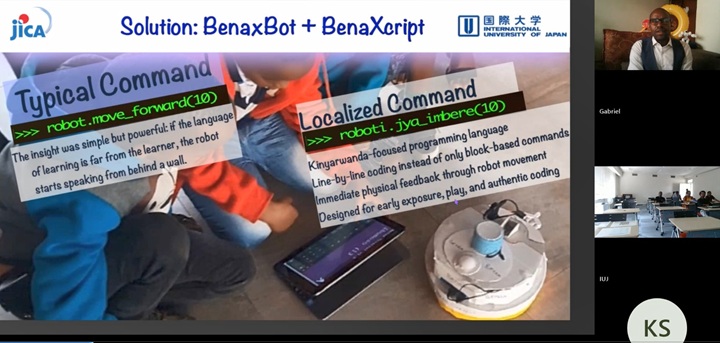
Gabriel Baziramwabo (upper right) joins the workshop online to share how he transformed his master’s research in Japan into an educational reform initiative in Rwanda.
Following the presentation, Kaizuka moderated a discussion among IUJ’s international students, primarily from Africa and Asia. Participants reflected on key issues arising from Baziramwabo’s experience, including the role of academic support, the challenges of introducing educational robotics in Rwanda, and the broader relevance of research to national development. The discussion was guided by the six questions shown below.
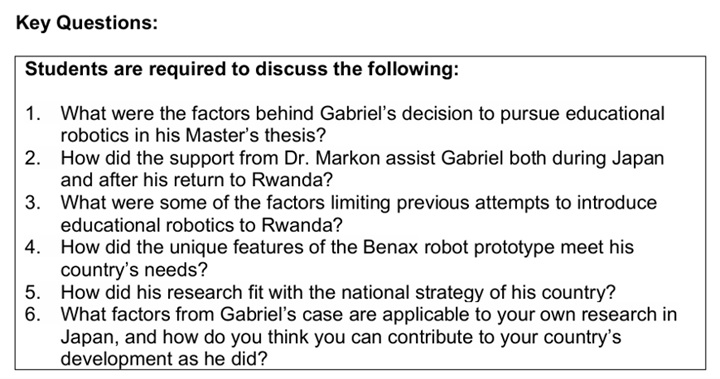
Key questions from the case material
Many participants commented on the importance of localizing academic research to address the specific needs of their respective countries, considering their positions in fields such as project management and governance as well as IT. Students were first asked to consider the points from Baziramwabo’s case (questions 1-5 in the case study) before considering question 6 , asking them directly how they could apply some of the lessons from the workshop at home. Participants commented on numerous points of Baziramwabo’s case which had inspired them, with some noting that they now wished to publish research from their degree theses in academic journals and refine it further upon return so that it would attract policymaker attention, or seek to present directly to policy audiences. The key lesson was keep the research alive - participants came to realize that their research held value beyond only their degree programs, and that it could achieve real impact if handled well.
JICA works with universities across Japan to welcome international students from around 100 countries. Through teaching and learning materials and workshops, the JICA Ogata Research Institute remains committed to nurturing future leaders who will drive development in their home countries.
Sns share!



事業事前評価表(地球規模課題対応国際科学技術協力(SATREPS)).国際協力機構 地球環境部 . 防災第一チーム. 1.案件名.国 名: フィリピン共和国.
事業事前評価表(地球規模課題対応国際科学技術協力(SATREPS)).国際協力機構 地球環境部 . 防災第一チーム. 1.案件名.国 名: フィリピン共和国.
事業事前評価表(地球規模課題対応国際科学技術協力(SATREPS)).国際協力機構 地球環境部 . 防災第一チーム. 1.案件名.国 名: フィリピン共和国.
事業事前評価表(地球規模課題対応国際科学技術協力(SATREPS)).国際協力機構 地球環境部 . 防災第一チーム. 1.案件名.国 名: フィリピン共和国.
事業事前評価表(地球規模課題対応国際科学技術協力(SATREPS)).国際協力機構 地球環境部 . 防災第一チーム. 1.案件名.国 名: フィリピン共和国.


