

Research Frontlines Vol. 1 | Understanding the Most Vulnerable Climate-Displaced People and Their Participation in and Empowerment for Sustainable Community Development
2026.08.03







Updates from JICA Ogata Research Institute on the latest events, publications and more.
RegistrationHow to Find Us


JICA Ogata Sadako Research Institute for Peace and Development (JICA Ogata Research Institute) conducts research on a wide range of development challenges, asking critical questions and exploring possible solutions.
This series highlights ongoing research projects, introducing the questions researchers seek to answer and the motivations and issues that inform their analyses. In this first installment, we feature a research project by Research Fellow Noguchi Fumiko titled “Situational Analysis of the Most Vulnerable Climate Change Displaced People and Their Participation and Empowerment for Sustainable Community Development .”
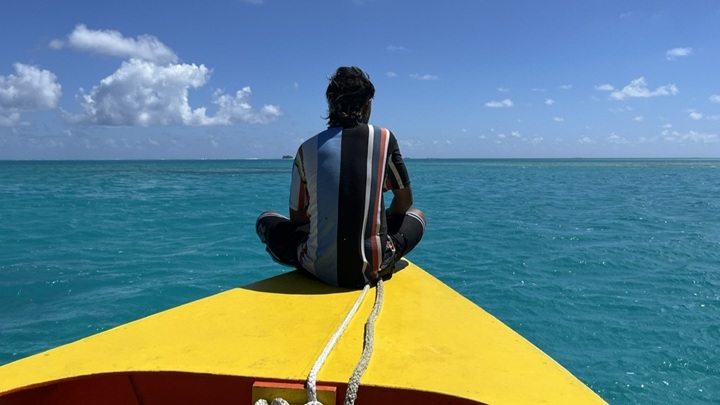
The ocean is an essential part of life for the people of Tuvalu. Their knowledge encompasses seasonal fish species, ocean currents, underwater geography, and traditional navigation techniques.
This research focuses on people who relocate across national borders due to climate-related natural disasters—commonly referred to as climate migrants. It examines what kind of support Japan can provide to ensure that both those who migrate and those who remain in their home countries can live with dignity and agency and become empowered within their respective communities—core aspirations of the human security approach.
As of 2024, approximately 45.8 million people were displaced by climate-related natural disasters. By 2050, the number of people displaced by climate-related factors is projected to reach around 200 million. These figures, however, primarily reflect internally displaced persons who flee sudden-onset disasters and seek shelter in designated evacuation facilities. They do not include seasonal workers who move to urban areas due to slow-onset impacts such as sea-level rise, rising temperatures, and saltwater intrusion, nor do they include cross-border migrants or people who are unable to move despite facing environmental threats.
Given the uncertainties inherent in climate change projections, many existing policy frameworks fail to account for the complex and diverse decision-making processes surrounding migration, including whether to move, when to move, how to move, and which family members should migrate. At the same time, many climate migrants remain in legally precarious situations.
Against this backdrop, Pacific Island countries have been advancing policy initiatives such as the Pacific Regional Framework on Climate Mobility. The Falepili Union Treaty between Australia and Tuvalu is particularly noteworthy. The treaty aims to strengthen community resilience to climate change while providing an institutional framework for managing human mobility.
This research examines how migration under the Falepili Union Treaty affects community resilience and how these effects relate to the empowerment of both Tuvaluans who relocate and those who remain in Tuvalu. A key premise of the study is that the indigenous knowledge developed by Tuvaluans through their interactions with the natural environment and local communities serves as an important source of identity and empowerment. From this perspective, the research analyzes both the experiences of migrants living in modern Australian society and the circumstances of those who remain in Tuvalu, where depopulation and outmigration are steadily progressing.
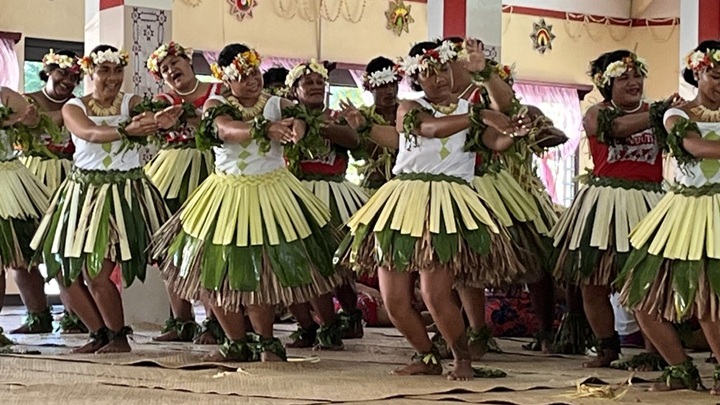
Fatele, a traditional Tuvaluan dance, performed at a community gathering. Many songs celebrate the relationship between people, the ocean, and marine life.
The research also explores the potential of environmental education and Education for Sustainable Development (ESD) in Japan’s international cooperation efforts, drawing on Japan’s experiences in rural revitalization and post-disaster recovery. Many rural areas in Japan, where cultural traditions and indigenous knowledge have been cultivated through generations of people managing and living in close interaction with satoyama and satoumi landscapes—ecosystems and landscapes shaped by the long-term interaction between people and nature—are experiencing depopulation. Population decline, urban migration, and low birthrates have reduced the number of people who sustain lifestyles in harmony with nature. At the same time, these communities are often highly vulnerable to natural disasters, making recovery increasingly difficult. There are many parallels between the challenges facing rural communities in Japan and those confronting communities in Tuvalu. In both contexts, indigenous knowledge serves as a foundation of cultural identity. However, as communities struggle to remain sustainable amid depopulation and outmigration, the erosion of that cultural identity can have negative implications for individual empowerment.
Moving beyond the traditional distinction between developed and developing countries, this research suggests that communities facing similar challenges brought about by modernization and urbanization can learn from one another. Such mutual learning may open new pathways toward sustainable development. In particular, environmental education and ESD have important roles to play in promoting learning and empowerment, and there is considerable potential for developing educational materials and training programs that strengthen the capacities of both practitioners and affected communities.
Related reading on initiatives in Japan’s rural regions:
Discussion Paper No. 37 Human Security and Disaster in Rural Japan: Reflections from the 2020 Kyushu Floods
(JICA Ogata Research Institute)
Throughout fiscal year 2025, I conducted field research in Tuvalu and among Tuvaluan communities in Fiji and Australia. The findings reinforced my understanding that cultural identity, the ocean-centered natural environment, and local communities are deeply interconnected for the people of Tuvalu. Going forward, I will focus on two key themes: social inclusion and climate security. With regard to social inclusion, I will examine what forms of empowerment and capacity development are needed in both host and origin countries to better integrate indigenous knowledge into sustainable community development, particularly from the perspectives of environmental education and ESD. Regarding climate security, I will investigate how the preservation of cultural identity among climate migrants relates to security challenges and how these issues intersect with existing international and regional policy frameworks.
Sns share!



事業事前評価表(地球規模課題対応国際科学技術協力(SATREPS)).国際協力機構 地球環境部 . 防災第一チーム. 1.案件名.国 名: フィリピン共和国.
事業事前評価表(地球規模課題対応国際科学技術協力(SATREPS)).国際協力機構 地球環境部 . 防災第一チーム. 1.案件名.国 名: フィリピン共和国.
事業事前評価表(地球規模課題対応国際科学技術協力(SATREPS)).国際協力機構 地球環境部 . 防災第一チーム. 1.案件名.国 名: フィリピン共和国.
事業事前評価表(地球規模課題対応国際科学技術協力(SATREPS)).国際協力機構 地球環境部 . 防災第一チーム. 1.案件名.国 名: フィリピン共和国.
事業事前評価表(地球規模課題対応国際科学技術協力(SATREPS)).国際協力機構 地球環境部 . 防災第一チーム. 1.案件名.国 名: フィリピン共和国.


